Unit 4-Encoder Motor Driver (DRV8837DSGR)
⚡ The essentials in 60 seconds
- soc — STM32F030C8T6
- motor_driver — 4x DRV8837DSGR H-bridge
- communication — I2C (Default address 0x24, configurable 0x08-0x77)
- encoder_support — 4-channel AB encoder, 3-15 PPR
- power_input — DC 6-12V (2x PH2.0-2P) or DC 5V (Grove)
- power_output — DC 5V @ 8A max (via DC-DC buck converter)
- On this board : 9 tutorials · 10 code
Imagine a small, unassuming circuit board no larger than a matchbox, weighing barely ten grams, yet possessing the intelligence and muscle to orchestrate the precise movements of a multi-jointed robot arm or a complex four-wheeled chassis. This is the 4-Encoder Motor Driver Unit from M5Stack, a module that serves as the critical bridge between high-level programming logic and the physical world of mechanical motion. At its heart lies a microcontroller, the STM32F030C8T6, which acts as the brain of the operation. Unlike simpler driver boards that merely pass commands from a main computer to motors, this unit possesses its own processing power. This means it can handle the heavy lifting of real-time motor control tasks, such as reading encoder data and adjusting motor speed, without constantly burdening the main controller of your robot. This separation of duties allows for smoother, more responsive motion, as the timing-sensitive tasks are managed locally by the driver’s own processor, ensuring that movements are consistent and reliable even if the main controller is busy with other tasks like sensor processing or communication.
The core of this module’s capability lies in its four DRV8837DSGR H-bridge drivers. To understand what this means, think of an H-bridge as an electronic switchboard that controls the direction and speed of a motor. By toggling different switches within this bridge, the module can make a motor spin forward, reverse, or stop. The DRV8837 is a specific type of driver known for its efficiency and compact size, allowing four of them to fit onto this tiny 56.5 by 24.0 millimeter board. Each channel can handle a current of up to 1.2 amperes at 5 volts, which is sufficient for many small to medium-sized DC motors commonly used in hobbyist robotics. However, the true sophistication of this unit goes beyond simple on/off switching. It supports advanced control modes, including closed-loop speed and position regulation. In a closed-loop system, the module doesn’t just tell the motor to spin at a certain speed; it actively monitors the motor’s actual performance and adjusts the power in real-time to correct any deviations. This is crucial for tasks that require precision, such as holding a robotic arm at a specific angle or ensuring that two wheels on a robot move at exactly the same speed to travel in a straight line.
This precision is made possible by the module’s support for encoders. Encoders are sensors attached to the motor shaft that count how many times the shaft has turned. The unit supports four channels of AB encoders, which provide feedback on both speed and direction. The term "PPR" refers to Pulses Per Revolution, and this module supports encoders ranging from 3 to 15 PPR. While this might seem like a low number compared to industrial encoders, it is well-suited for the small gear motors often used in educational and hobbyist robotics. The module’s internal processor uses this feedback to implement features like soft start and soft stop. Instead of jerking a motor to life or stopping it abruptly, which can cause mechanical stress or make a robot tip over, the unit gradually ramps up or down the power. This results in smoother, more graceful movements that are easier on both the mechanical components and the overall stability of the robot.
Communication with this intelligent driver is handled via the I2C protocol, a standard two-wire interface widely used in electronics. The module has a default address of 0x24, but this can be configured anywhere between 0x08 and 0x77, allowing you to stack multiple units or avoid conflicts with other devices on the same bus. This digital communication method is far more robust than analog signals, as it is less susceptible to electrical noise and allows for the transmission of complex commands, such as setting specific target positions or reading back current motor status. The module features two Grove HY2.0-4P ports, which are standard connectors that allow you to easily daisy-chain multiple I2C devices together, making it simple to expand your robot’s capabilities without soldering.
Power management is another area where this unit demonstrates thoughtful engineering. It can be powered in two ways: via a DC input ranging from 6 to 12 volts, or through the 5-volt line of the Grove port. However, the most impressive feature is its integrated DC-DC buck converter. This component takes the higher voltage input and steps it down to a stable 5 volts, capable of delivering up to 8 amperes. This is significant because it means the module can not only power its own motors but also supply a substantial amount of current to the main controller or other peripherals connected to it. This reduces the number of separate power supplies needed in a robot, simplifying the wiring and making the overall system more compact and easier to manage. For safety and monitoring, the module includes an INA199A current sensing circuit. This allows the system to monitor how much current the motors are drawing, which can be used to detect stalls or overload conditions, providing an extra layer of protection for your robot’s mechanics.
Physically, the module is designed for ease of use. It features four PH2.0-6P connectors specifically designed for six-wire gear motors or TT motors, which include the power wires and the encoder signal wires. This standardized connector system means you can plug in compatible motors without any soldering, making it ideal for rapid prototyping and educational environments. A single WS2812C RGB LED is also included, which can be used for status indication, such as showing the current mode or signaling errors. The entire unit is housed in a compact form factor, measuring just 12.8 millimeters in height, allowing it to fit into tight spaces within a robot’s chassis. Weighing only 10 grams, it adds negligible mass to the overall system, which is critical for maintaining the agility and efficiency of small robots.
In summary, the 4-Encoder Motor Driver Unit is more than just a motor controller; it is a self-contained motion control system. By integrating processing power, precise H-bridge drivers, encoder feedback, and robust power management into a single, small package, it simplifies the complex task of making robots move with accuracy and grace. Whether you are building a line-following robot, a multi-axis robotic arm, or a complex autonomous vehicle, this module provides the foundational control needed to translate digital commands into reliable physical action, all while keeping the wiring simple and the system efficient.
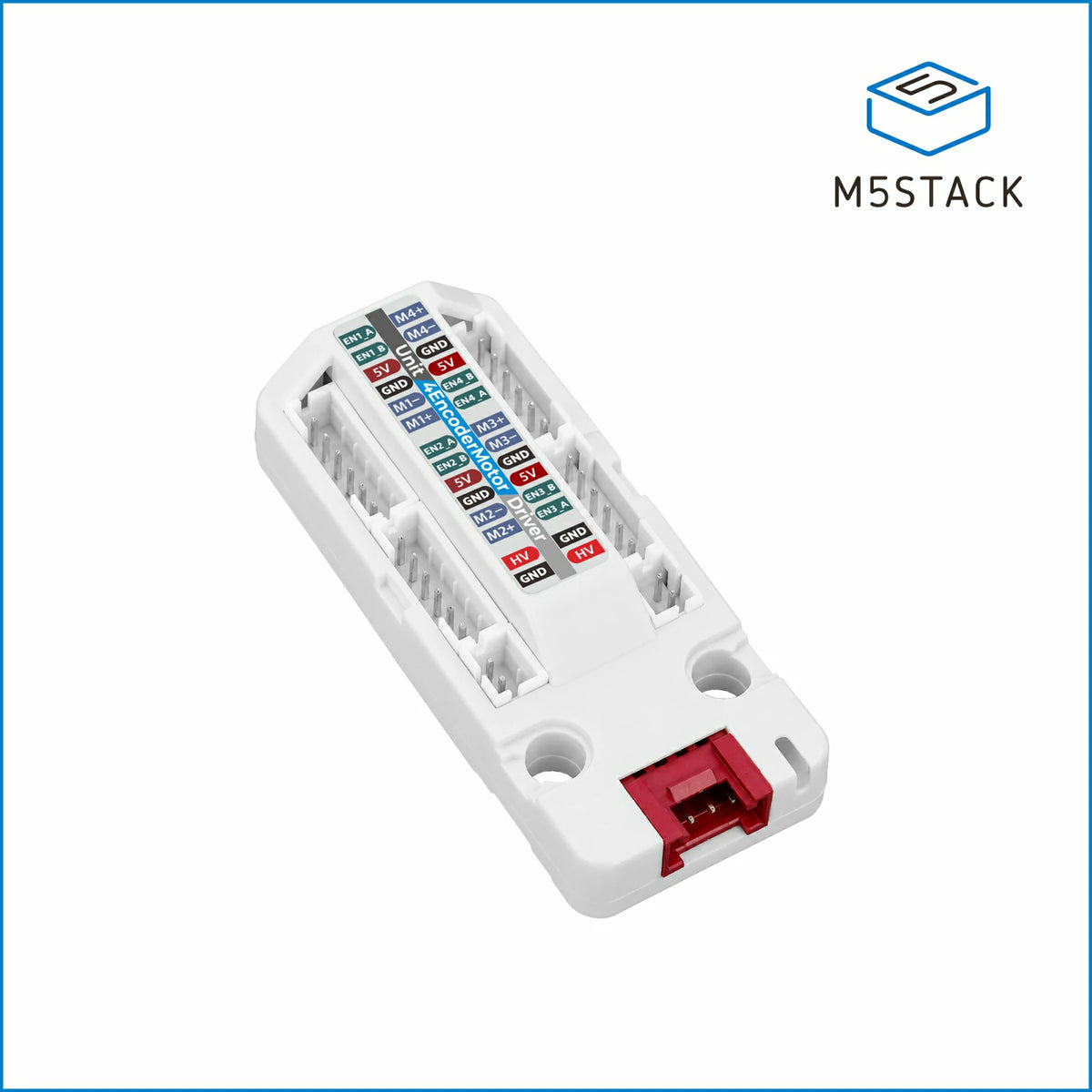
| Attr | Specs | verified |
|---|---|---|
soc | STM32F030C8T6 | ? unverified |
motor_driver | 4x DRV8837DSGR H-bridge | ? unverified |
communication | I2C (Default address 0x24, configurable 0x08-0x77) | ? unverified |
encoder_support | 4-channel AB encoder, 3-15 PPR | ? unverified |
power_input | DC 6-12V (2x PH2.0-2P) or DC 5V (Grove) | ? unverified |
power_output | DC 5V @ 8A max (via DC-DC buck converter) | ? unverified |
motor_load | Max single-channel DC 5V @ 1.2A | ? unverified |
current_sensing | INA199A circuit | ? unverified |
interfaces | 2x HY2.0-4P Grove, 4x PH2.0-6P motor ports | ? unverified |
dimensions | 56.5 x 24.0 x 12.8 mm | ? unverified |
weight | 10.0 g | ? unverified |
led | 1x WS2812C-2020 RGB | ? unverified |
control_modes | PWM, Forward/Reverse, Speed/Position Loop, Soft Start/Stop | ? unverified |
This M5Stack module is designed for precise control of four DC motors with encoders. It relies on an STM32F030C8T6 microcontroller and four DRV8837DSGR H-bridges to provide closed-loop regulation functions via the I2C bus.
+ Strengths
["- Closed-loop speed and position control with soft start/stop capabilities","- Integrated DC-DC converter providing up to 5V @ 8A to power motors and the host","- Native support for AB encoders (3-15 PPR) and compatibility with 6-wire gear motors or TT motors"]
− Weaknesses
["- Maximum load limited to 1.2A per motor channel at 5V","- Requires external DC 6-12V power for motor power (Grove 5V port is insufficient for high loads)","- Compact dimensions (56.5 x 24.0 mm) may limit physical access to connectors in dense stacking"]
- Retour d'expérience expert expert — expert-microdb
- J'ai intégré la carte 4-Encoder Motor Driver (DRV8837DSGR) sur un châssis 4 roues. Le point fort est la boucle fermée PID gérée par le STM32F030, ce qui libère totalement l'hôte. La régulation de vitesse est précise avec des moteurs TT standards. Attention toutefois à la gestion thermique : bien qu… — expert-microdb
- Bon retour. Je confirme que la communication I2C (0x24) est très stable, mais la documentation sur les registres de position est parfois floue. Pour les bras robotiques, le mode veille est crucial pour économiser l'énergie. J'ai noté que les encodeurs 3-15 PPR fonctionnent bien, mais si tu utilises… — membre-forum
Community feedback and projects
Content not available yet.
Content not available yet.
Content not available yet.
["- not reported"]
- First Connection and Startup of the 4-Encoder Motor Driver debutant Apprenez à alimenter, connecter et vérifier la communication I2C de votre module DRV8837 pour la première fois.
- Discovering I/O: RGB LED and Encoder Reading debutant Apprenez à interagir avec les périphériques intégrés du module en contrôlant la LED RGB et en lisant les données des encodeurs via I2C.
- Automate a Robot Chassis with the 4-Encoder Driver debutant Apprenez à contrôler quatre moteurs avec retour d'encodeur pour une automatisation précise via I2C.
- First connection and startup of the 4-Encoder Motor Driver intermediaire Guide étape par étape pour alimenter, connecter les moteurs et initialiser le module DRV8837DSGR via I2C.
- GPIO and RGB LED Control on the 4-Encoder Motor Driver intermediaire Apprenez à utiliser les entrées-sorties et la LED RGB WS2812C intégrée au module DRV8837DSGR via I2C.
- Closed-Loop Automation with the 4-Encoder Driver intermediaire Configurez une automatisation précise en utilisant la régulation de position en boucle fermée et le stockage d'état via I2C.
- First wiring and initialization of the 4-Encoder Motor Driver avance Guide avancé pour le câblage physique, la gestion de l'alimentation et la vérification de la communication I2C du module DRV8837DSGR.
- Advanced I/O Control and Diagnostics on DRV8837 Module avance Apprenez à exploiter les entrées-sorties étendues, le capteur de courant INA199A et la LED RGB pour le diagnostic temps réel.
- Multi-Axis Automation with M5Stack 4-Encoder Motor Driver avance Mettez en œuvre un système de contrôle de position en boucle fermée pour un robot à quatre roues ou un bras articulé en utilisant la régulation PID intégrée.
Code library — examples written for this board
i2c-motor-spin.inoarduinoclosed-loop-speed-control.inoarduinorelative-position-move.inoarduinorgb-led-status-indicator.inoarduinodifferential-drive-robot.inoarduinoi2c_basic_motor_control.pyPythonclosed_loop_speed_pid.inoC++rgb_status_led_ws2812.pyPythoncurrent_sensing_ina199.inoC++multi_motor_sequencer.pyPython