Banana Pi BPI-CM5: Amlogic A311D2 Compute Module with Raspberry Pi CM4 Compatibility
⚡ The essentials in 60 seconds
- soc — Amlogic A311D2 quad-core Cortex-A73 + quad-core Cortex-A53
- gpu — Mali-G52 MP8
- ram — 4GB LPDDR4/LPDDR4x (Max 8GB)
- storage — 16GB eMMC (Max 128GB)
- ethernet — 1x Gigabit Ethernet
- usb — 1x USB 3.0 (5Gbps), 1x USB 2.0 (OTG)
- On this board : 8 tutorials · 10 code
Imagine a computer small enough to fit in the palm of your hand, yet powerful enough to handle complex multimedia tasks, artificial intelligence calculations, and high-speed data processing. This is the essence of the Banana Pi BPI-CM5, a compact System on Module that measures just 55 by 40 millimeters. To understand the significance of this size, consider that it is roughly the area of a standard credit card, yet it contains all the essential components of a full desktop computer. This miniaturization is achieved through advanced semiconductor manufacturing, allowing engineers to pack billions of transistors into a space smaller than a matchbox. The module is designed with Board-to-Board connectors that are physically and electrically compatible with the Raspberry Pi Compute Module 4. This compatibility is a crucial design choice, as it allows developers and hobbyists to reuse existing carrier boards designed for the Raspberry Pi ecosystem. By simply swapping the module, users can upgrade their hardware capabilities without redesigning their entire circuit board, saving time and resources while maintaining a familiar physical interface.
At the heart of this tiny powerhouse lies the Amlogic A311D2 System on Chip. To understand what this means, one must look at the concept of a SoC, which integrates the processor, graphics, memory controller, and input/output interfaces into a single silicon package. The A311D2 employs a big.LITTLE architecture, a strategy that balances performance and power efficiency. It features four Cortex-A73 cores, which are high-performance processors designed for demanding tasks like gaming or video editing, and four Cortex-A53 cores, which are energy-efficient processors ideal for background tasks and light computing. This combination allows the system to dynamically shift workloads between the powerful and efficient cores, optimizing battery life in portable devices and reducing heat generation in enclosed spaces. Supporting these processors is the Mali-G52 MP8 Graphics Processing Unit. Unlike the central processing unit, which handles general logic, the GPU is specialized for rendering images, videos, and animations. The MP8 designation indicates that it has eight processing cores, providing substantial graphical throughput suitable for high-resolution displays and complex user interfaces.
Memory and storage are the short-term and long-term memories of the computer, respectively. The BPI-CM5 comes equipped with 4 Gigabytes of LPDDR4 or LPDDR4x RAM. LPDDR stands for Low Power Double Data Rate, a type of memory designed to consume less energy than standard desktop RAM, which is critical for embedded systems that may run continuously. This 4 GB capacity is sufficient for most Linux distributions and Android applications, but the module is scalable, with configurations available up to 8 GB for more memory-intensive applications. For permanent storage, the module includes 16 Gigabytes of eMMC. eMMC is a type of flash storage that integrates the memory chips and the controller into a single package, offering a balance between speed, cost, and reliability. Like the RAM, the storage is expandable, with options reaching up to 128 Gigabytes, allowing users to store large media libraries or extensive datasets directly on the module.
Connectivity is where the BPI-CM5 truly distinguishes itself, particularly in its video and camera capabilities. The module features a robust video management system centered around HDMI 2.1 technology. It includes one HDMI 2.1 transmitter port, which sends video signals to a display, and notably, three HDMI 2.1 receiver ports. This is an unusual and powerful feature for a module of this size. While most computers only output video, the ability to receive video signals allows the BPI-CM5 to act as a video switcher, recorder, or streamer. It can capture high-definition video from multiple sources simultaneously, making it ideal for digital signage, video conferencing systems, or security monitoring. Additionally, it supports Consumer Electronics Control, allowing users to control connected devices with a single remote. Beyond HDMI, the module offers two V-by-One 8-lane outputs, which are high-speed serial interfaces used in industrial displays to transmit uncompressed 4K by 2K video with minimal latency and cable bulk.
For visual input, the BPI-CM5 is equipped with two 4-lane MIPI-CSI camera interfaces. MIPI-CSI is a standard interface used to connect camera sensors to processors, offering high bandwidth for high-resolution images. These interfaces are paired with a 16-megapixel Image Signal Processor. The ISP is a dedicated hardware component that processes raw data from the camera sensor, handling tasks like noise reduction, color correction, and image stabilization. By offloading these tasks from the main CPU, the ISP ensures that the system can process high-quality images in real-time without slowing down other operations. This makes the module well-suited for computer vision applications, such as object detection, facial recognition, or autonomous navigation.
Data transfer and expansion are handled through a variety of high-speed interfaces. The module includes a Gigabit Ethernet port, providing a stable and fast wired network connection, which is often more reliable than Wi-Fi for industrial or server applications. For peripheral connections, it offers one USB 3.0 port, capable of transferring data at 5 gigabits per second, and one USB 2.0 port with On-The-Go support, allowing the module to act as either a host or a device. Perhaps most importantly for future-proofing, the BPI-CM5 includes a PCIe 2.0 interface. Peripheral Component Interconnect Express is a high-speed bus standard used to connect high-performance components like solid-state drives, network cards, or AI accelerators. By exposing a PCIe interface, the module allows developers to add specialized hardware that is not built into the SoC, significantly extending the range of possible applications.
Software support is a critical aspect of any development board, and the BPI-CM5 is versatile in this regard. It supports Android, a popular operating system for mobile and media devices, as well as several Linux distributions, including Ubuntu, Debian, and Armbian. Linux is a powerful, open-source operating system widely used in servers, embedded systems, and development environments. The availability of multiple distributions gives developers the flexibility to choose the software environment that best fits their project’s needs, whether they require the user-friendly interface of Android or the command-line power and customization options of Linux. This software flexibility, combined with the hardware’s robust connectivity and processing power, makes the Banana Pi BPI-CM5 a compelling choice for a wide range of projects, from smart home hubs and media centers to industrial control systems and edge computing nodes. Its compact form factor, combined with the ability to leverage existing Raspberry Pi CM4 infrastructure, lowers the barrier to entry for creating sophisticated, high-performance embedded devices.
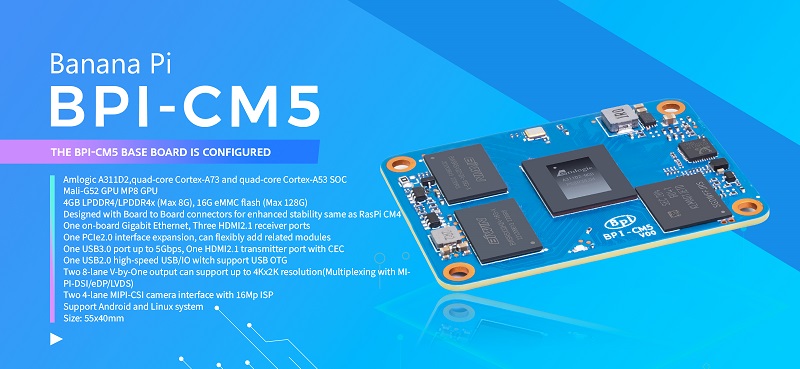
| Attr | Specs | verified |
|---|---|---|
soc | Amlogic A311D2 quad-core Cortex-A73 + quad-core Cortex-A53 | ? unverified |
gpu | Mali-G52 MP8 | ? unverified |
ram | 4GB LPDDR4/LPDDR4x (Max 8GB) | ? unverified |
storage | 16GB eMMC (Max 128GB) | ? unverified |
ethernet | 1x Gigabit Ethernet | ? unverified |
usb | 1x USB 3.0 (5Gbps), 1x USB 2.0 (OTG) | ? unverified |
video | 1x HDMI 2.1 TX (CEC), 3x HDMI 2.1 RX, 2x V-by-One (4Kx2K) | ? unverified |
camera | 2x 4-lane MIPI-CSI (16MP ISP) | ? unverified |
expansion | 1x PCIe 2.0 interface | ? unverified |
dimensions | 55x40mm | ? unverified |
os | Android, Linux (Ubuntu, Debian, Armbian) | ? unverified |
connectors | Board-to-Board connectors compatible with Raspberry Pi CM4 | ? unverified |
The Banana Pi BPI-CM5 is a compact compute module designed as a high-performance alternative to the Raspberry Pi CM4. It leverages the Amlogic A311D2 SoC to deliver advanced processing and video management capabilities in a standardized form factor.
+ Strengths
["- Physical compatibility with Raspberry Pi CM4 Board-to-Board connectors","- Robust video management with 1 HDMI 2.1 output and 3 HDMI 2.1 inputs","- Octa-core CPU performance (4x Cortex-A73 + 4x Cortex-A53) and Mali-G52 MP8 GPU"]
− Weaknesses
["- PCIe interface limited to version 2.0","- Base eMMC storage limited to 16 GB","- Compact 55x40 mm dimensions requiring rigorous thermal management"]
Community feedback and projects
- Discussions Reddit — Banana Pi BPI-CM5 reddit.com
- Articles CNX Software — Banana Pi BPI-CM5 cnx-software.com
Content not available yet.
Content not available yet.
Content not available yet.
["- not specified"]
- First boot of the Banana Pi BPI-CM5 debutant Guide pas à pas pour assembler, alimenter et démarrer votre module Banana Pi BPI-CM5 pour la première fois.
- Mastering GPIO on Banana Pi BPI-CM5 debutant Apprenez à contrôler les broches GPIO de votre BPI-CM5 pour allumer une LED et lire un bouton, une première étape essentielle pour l'interaction physique.
- Configure Network and Storage on Banana Pi BPI-CM5 debutant Apprenez à connecter votre Banana Pi BPI-CM5 à Internet et à gérer son stockage eMMC pour un usage quotidien.
- Getting Started with Banana Pi BPI-CM5 intermediaire Guide pas à pas pour assembler, alimenter et démarrer votre module BPI-CM5 pour la première fois.
- Mastering I/O on Banana Pi BPI-CM5 intermediaire Apprenez à configurer et utiliser les broches GPIO pour interagir avec des capteurs et actionneurs sur le module BPI-CM5.
- Building a NAS and Home Automation Hub with BPI-CM5 intermediaire Transformez votre Banana Pi BPI-CM5 en serveur de fichiers et centre de contrôle domotique grâce à ses interfaces réseau et USB.
- Advanced First Boot of Banana Pi BPI-CM5 avance Guide technique détaillé pour la mise sous tension et le démarrage initial du module BPI-CM5 sur une carte de base compatible CM4.
- Build an Automated NAS with BPI-CM5 avance Transformez votre BPI-CM5 en serveur de stockage réseau performant et automatisé grâce à son interface USB 3.0 et son Gigabit Ethernet.
Code library — examples written for this board
bpi-cm5-gpio-led-blink-python.pyPythonbpi-cm5-network-iperf3-server.shBashbpi-cm5-emmc-storage-check.shBashbpi-cm5-usb-camera-capture.pyPythonbpi-cm5-pcie-nvme-mount.shBashbpi-cm5-netcat-iperf3-bandwidth-test-6.inobashbpi-cm5-cpu-thermal-throttling-monitor-7.inopythonbpi-cm5-hdmi-output-control-8.inobashbpi-cm5-mipi-camera-capture-ffmpeg-9.inobashbpi-cm5-spi-thermal-sensor-read-10.inopython