Banana Pi BPI-RT2: AX3000 WiFi 6 Router Board
⚡ The essentials in 60 seconds
- soc — Realtek RTL8198D dual-core MIPS interAptiv
- ram — 256MB DDR3
- storage — 128MB SPI-NAND flash
- wifi_bluetooth — Dual-band WiFi 6 (802.11ax) AX3000, 2.4GHz (RTL8892XBR) & 5GHz (RTL8832D), 2x2 MIMO, MU-MIMO
- ethernet — 1x Gigabit Ethernet WAN, 3x Gigabit Ethernet LAN
- usb — 1x USB 3.0 Type-A
- On this board : 7 tutorials · 10 code
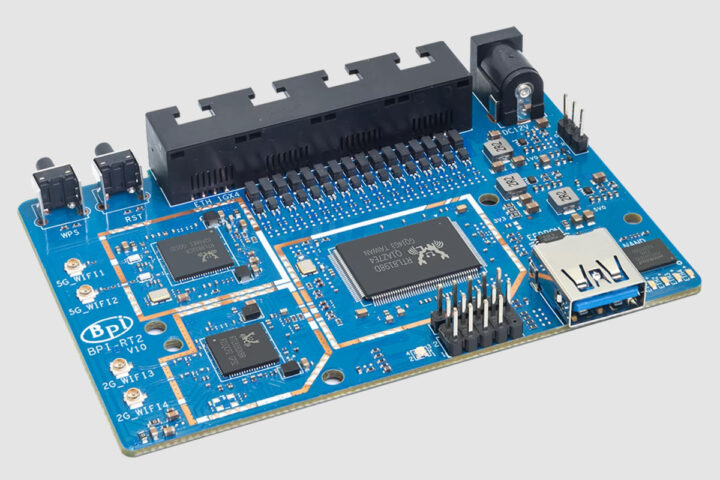
At its core, the Banana Pi BPI-RT2 represents a fascinating intersection of embedded networking hardware and open-source software flexibility, designed specifically for enthusiasts and professionals who require a compact, powerful, and highly customizable WiFi 6 router. Launched on October 30, 2026, this development board distinguishes itself not merely as a consumer appliance but as a platform for experimentation and deployment in home or small office environments. To understand its capabilities, one must first look at the brain of the operation: the Realtek RTL8198D System-on-Chip. This component features a dual-core MIPS interAptiv architecture. For those less familiar with processor architectures, MIPS is a Reduced Instruction Set Computing (RISC) instruction set architecture that has long been a staple in networking equipment due to its efficiency and low power consumption. The "interAptiv" designation refers to a specific generation of MIPS cores designed for high-performance networking applications, allowing the board to handle multiple data streams simultaneously without bottlenecking. This processing power is supported by 256 MB of DDR3 RAM, which provides the volatile memory needed to manage active network connections and routing tables, while 128 MB of SPI-NAND flash storage holds the operating system and configuration files. While these memory figures might seem modest compared to modern smartphones, they are perfectly adequate for the dedicated task of routing network traffic, where efficiency is prioritized over raw computational brute force.
The primary function of the BPI-RT2 is, of course, wireless connectivity, and it excels in this area by implementing the WiFi 6 standard, technically known as 802.11ax. This generation of WiFi technology is designed to improve performance in high-density environments, making it ideal for homes filled with smart devices, laptops, and smartphones. The board achieves an AX3000 rating, a classification that indicates the combined theoretical maximum throughput across its two frequency bands. It operates on both the 2.4 GHz and 5 GHz bands, utilizing specific Realtek chips for each: the RTL8892XBR for the 2.4 GHz band and the RTL8832D for the 5 GHz band. The 2.4 GHz band offers better range and penetration through walls, while the 5 GHz band provides higher speeds and less interference, though with a shorter range. A key feature of this setup is its support for 2x2 MIMO (Multiple Input, Multiple Output) and MU-MIMO (Multi-User MIMO). MIMO technology allows the router to transmit and receive multiple data streams simultaneously using multiple antennas, significantly increasing data throughput and reliability. MU-MIMO takes this a step further by allowing the router to communicate with multiple devices at the same time, rather than switching between them sequentially, which reduces latency and improves overall network efficiency. To maximize this wireless potential, the board includes four external antenna connectors, allowing users to attach high-gain antennas for extended coverage or directional signals.
Beyond wireless capabilities, the BPI-RT2 is equipped with robust wired networking options, recognizing that Ethernet remains the gold standard for stability and speed in critical connections. The board features one Gigabit Ethernet port designated for WAN (Wide Area Network) use, which connects to your modem or upstream internet source, and three additional Gigabit Ethernet ports for LAN (Local Area Network) devices. This configuration allows for a traditional router setup where wired devices like desktop computers, NAS drives, or game consoles can connect directly to the router for maximum performance. Additionally, a USB 3.0 Type-A port is included, which can be used for various purposes such as attaching external storage for file sharing (Samba/NFS), connecting a 4G/5G USB modem for failover connectivity, or even powering small peripherals. The physical design is compact, measuring 97 x 65 mm and weighing 250 grams, making it easy to mount or place in tight spaces. Power is supplied via a standard 12V DC barrel jack, a common and reliable power interface that ensures stable operation under load.
What truly sets the BPI-RT2 apart from many commercial routers is its openness and hackability, facilitated by its software and hardware interfaces. The board ships with firmware based on OpenWrt 22.03, a highly regarded open-source Linux distribution for embedded devices. It is important to note, however, that OpenWrt 22.03 reached its end-of-life status in July 2024. This means that while the base system is stable and feature-rich, users should be aware that official security updates for this specific version have ceased, and they may need to rely on community support or compile custom builds for the latest security patches. The firmware utilizes the Realtek BSP (Board Support Package) provided by Banana Pi, and the source code is available on GitHub, encouraging transparency and community-driven development. For developers and hardware enthusiasts, the board exposes several interfaces for expansion and debugging. There are 5-pin and 9-pin headers that provide access to GPIO (General Purpose Input/Output) and I2C signals. GPIO allows for digital control of external components like LEDs, relays, or sensors, while I2C is a communication protocol used to connect low-speed peripherals such as temperature sensors or displays. Furthermore, a UART interface is available for debugging, allowing developers to connect via a serial console to view system logs and troubleshoot issues at a low level.
The user experience is further enhanced by physical controls and indicators. The board includes reset and boot buttons, which are essential for recovering the system or entering recovery modes if the software becomes unresponsive. A WPS (WiFi Protected Setup) button allows for quick and secure pairing of compatible devices without manually entering passwords. Status LEDs for Power, WAN, and LAN connections provide immediate visual feedback on the network status, helping users diagnose connectivity issues at a glance. Priced at $26 on the official Banana Pi store and $25.20 on AliExpress, the BPI-RT2 offers a compelling value proposition. It bridges the gap between consumer-grade simplicity and developer-grade flexibility. It is not just a device that connects your home to the internet; it is a canvas for learning about networking protocols, embedded Linux systems, and hardware integration. Whether you are looking to create a custom mesh network, experiment with new WiFi features, or simply want a transparent and updatable router, the Banana Pi BPI-RT2 provides the necessary tools and specifications to explore these possibilities within a compact and affordable form factor.
| Attr | Specs | verified |
|---|---|---|
soc | Realtek RTL8198D dual-core MIPS interAptiv | ? unverified |
ram | 256MB DDR3 | ? unverified |
storage | 128MB SPI-NAND flash | ? unverified |
wifi_bluetooth | Dual-band WiFi 6 (802.11ax) AX3000, 2.4GHz (RTL8892XBR) & 5GHz (RTL8832D), 2x2 MIMO, MU-MIMO | ? unverified |
ethernet | 1x Gigabit Ethernet WAN, 3x Gigabit Ethernet LAN | ? unverified |
usb | 1x USB 3.0 Type-A | ? unverified |
gpio | 5-pin and 9-pin headers with GPIO and I2C signals | ? unverified |
power | 12V DC via barrel jack | ? unverified |
os | OpenWrt 22.03-based firmware (Realtek BSP) | ? unverified |
dimensions | 97 x 65 mm | ? unverified |
weight | 250 grams | ? unverified |
debugging | UART debug interface | ? unverified |
misc | Reset/Boot buttons, WPS key, Power/WAN/LAN LEDs, 4x antenna connectors | ? unverified |
Released on October 30, 2026, the BPI-RT2 is a compact router board designed to provide affordable WiFi 6 connectivity. It leverages the Realtek RTL8198D SoC and OpenWrt firmware to deliver an accessible home networking solution.
+ Strengths
["- Dual-band WiFi 6 AX3000 connectivity (2.4/5 GHz) with MU-MIMO and 2x2 MIMO support.","- Highly competitive price of $26 for a complete router board with 4 Gigabit Ethernet ports.","- OpenWrt 22.03-based firmware with source code available on GitHub for customization."]
− Weaknesses
["- Limited memory resources with only 256 MB DDR3 RAM and 128 MB flash storage.","- Dual-core MIPS interAptiv processor architecture, less common than ARM solutions for software ecosystems.","- Specific 12V DC power supply via barrel jack, less universal than USB-C."]
- Retour d'expérience expert expert — expert-microdb
- J'ai testé la BPI-RT2. Pour 26$, c'est imbattable en WiFi 6 AX3000. Les 4 ports Gigabit et l'USB3 sont parfaits. Attention au firmware OpenWrt 22.03, déjà EOL en 2024, donc prévoyez de compiler le BSP Realtek vous-mêmes via GitHub pour sécuriser le routeur. La RAM de 256Mo est suffisante pour le ro… — expert-microdb
- Je confirme le point sur le firmware. C'est frustrant de livrer une carte WiFi 6 avec une base obsolète. Le SoC MIPS est correct, mais la limitation à 128Mo de flash SPI-NAND peut poser problème si vous voulez installer des paquets supplémentaires. Heureusement, les connecteurs GPIO/I2C sont là pou… — membre-forum
Community feedback and projects
- Discussions Reddit — Banana Pi BPI-RT2 reddit.com
- Articles CNX Software — Banana Pi BPI-RT2 cnx-software.com
Content not available yet.
Content not available yet.
Content not available yet.
["- Firmware is based on OpenWrt 22.03, a version that reached end-of-life in July 2024.","- Not specified","- Not specified"]
- Controlling GPIOs on Banana Pi BPI-RT2 debutant Apprenez à activer et utiliser les broches GPIO et I2C pour connecter des capteurs ou des afficheurs.
- Configure a reliable WiFi 6 network with BPI-RT2 debutant Apprenez à transformer le BPI-RT2 en routeur WiFi 6 performant pour votre domicile.
- First Boot and Initial Setup of Banana Pi BPI-RT2 intermediaire Guide étape par étape pour alimenter, connecter et accéder à l'interface OpenWrt du routeur WiFi 6 BPI-RT2.
- Interfacing a DHT11 Sensor with BPI-RT2 GPIO intermediaire Apprenez à lire les données de température et d'humidité via l'en-tête GPIO de la BPI-RT2 sous OpenWrt.
- Configure BPI-RT2 as network gateway and light storage intermediaire Transformez votre routeur WiFi 6 en serveur de fichiers et passerelle sécurisée grâce à ses ports USB et à OpenWrt.
- Advanced setup: First console access and firmware flashing for BPI-RT2 avance Guide avancé pour accéder à la console série et installer le firmware OpenWrt sur la Banana Pi BPI-RT2.
- Mastering GPIO on Banana Pi BPI-RT2 avance Un guide avancé pour configurer, lire et écrire sur les broches GPIO de la BPI-RT2 via sysfs et libgpiod.
Code library — examples written for this board
gpio-led-blink-openwrt.shBashi2c-temp-sensor-python.pyPythonwifi6-status-check-uci.shBashlog-rotation-usb-storage.shBashwan-lan-firewall-rules.shBashgpio-led-blink-openwrt.shbashi2c-sensor-dht11-python.pypythonwifi6-stress-test-iperf3.shbashusb-storage-mount-automount.shbashnetwork-monitoring-netdata.shbash