BeagleConnect QuadESC: 4-Channel BLDC Controller
⚡ The essentials in 60 seconds
- soc — Texas Instruments AM13E23019 (Arm Cortex-M33 @ 200 MHz)
- ram — 128KB SRAM
- storage — 512KB flash
- ai_accelerator — TinyEngine neural-network accelerator
- motor_control — 4x TI DRV8323SRTAR gate drivers, 12x TI CSD88599Q5DC half-bridges
- current_rating — 40A continuous / 70A burst per motor (target)
- On this board : 4 tutorials · 10 code
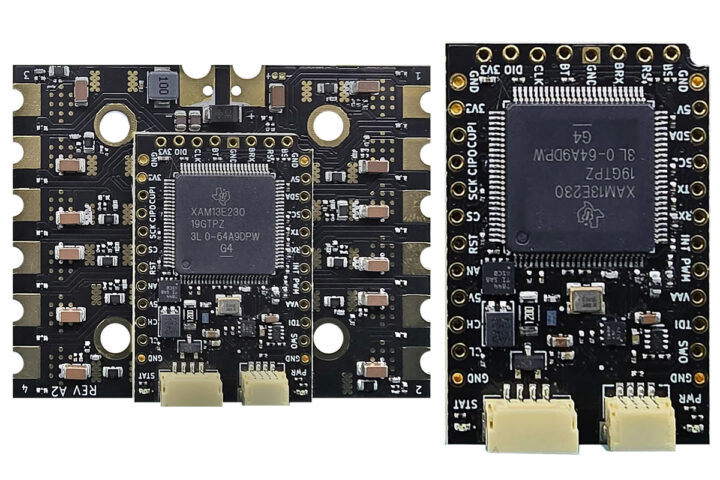
Imagine a compact electronic board, no larger than a standard credit card, capable of orchestrating the precise movements of four independent electric motors simultaneously. This is the BeagleConnect QuadESC, an open-source carrier board designed specifically for Brushless DC (BLDC) motor control. At its heart lies a sophisticated System-on-Module known as the BeagleConnect Torque, which serves as the brain of the operation. This modular approach allows developers to focus on application logic rather than the intricate details of high-power electronics, providing a robust foundation for robotics, drones, and automated machinery. The core processing unit is the Texas Instruments AM13E23019 microcontroller, a powerful Arm Cortex-M33 processor running at 200 MHz. While this clock speed might seem modest compared to high-end application processors, it is perfectly tuned for real-time control tasks where deterministic timing is crucial. The microcontroller is equipped with 128KB of SRAM and 512KB of Flash memory, providing sufficient space for complex control algorithms and firmware storage. What sets this chip apart is its specialized hardware acceleration. It includes a dedicated trigonometric math unit, which significantly speeds up the sine and cosine calculations required for Field-Oriented Control (FOC), a technique used to make motors run smoothly and efficiently. Additionally, the presence of the TinyEngine neural-network accelerator hints at future capabilities, allowing for on-device artificial intelligence tasks such as predictive maintenance or adaptive control strategies without relying on external cloud processing.
The physical power delivery of the BeagleConnect QuadESC is managed by a sophisticated array of drivers and switches. The board features four independent motor channels, each driven by a TI DRV8323SRTAR gate driver. These drivers act as the interface between the low-voltage logic of the microcontroller and the high-current power stage. To handle the actual power switching, the board utilizes twelve TI CSD88599Q5DC half-bridges. Since each three-phase motor requires six switching elements (two for each phase), the twelve half-bridges are distributed evenly across the four motors. This configuration allows the board to deliver substantial power, with target current ratings of 40 Amperes continuous and up to 70 Amperes in burst mode per motor. These figures indicate that the board is designed for high-performance applications where motors may need to accelerate rapidly or handle sudden loads, such as in racing drones or robotic arms. The power input flexibility is another key feature, supporting battery packs ranging from 3S to 6S configurations, which translates to a voltage range of 9 to 25.2 Volts. The design also accounts for transient spikes, with a maximum design voltage of 32 Volts, providing a safety margin against voltage surges that can occur during regenerative braking or inductive load switching.
Precision control is meaningless without accurate feedback, and the BeagleConnect QuadESC is equipped with extensive sensing capabilities to close the control loop. The board integrates twelve channels for current measurement, allowing it to monitor the current flowing through each phase of every motor in real-time. This data is critical for implementing advanced control algorithms that prevent overheating and optimize torque output. Similarly, twelve voltage sensing channels provide visibility into the system’s electrical health, ensuring that the motors are receiving the correct voltage levels. Temperature monitoring is handled by four NTC thermistors, which likely monitor the temperature of the power stage components to prevent thermal shutdown during intense operation. Furthermore, the board includes dedicated battery monitoring, allowing the system to track the state of charge and health of the power source, a vital feature for battery-operated devices where power management is essential for flight time or operational duration.
Connectivity is a cornerstone of modern embedded systems, and this board does not disappoint. It features CAN FD (Controller Area Network with Flexible Data-rate) support via the TI TCAN844 transceiver. CAN FD is a robust communication protocol widely used in automotive and industrial applications, known for its reliability and noise immunity. The "Flexible Data-rate" aspect allows for higher data throughput than traditional CAN, which is beneficial when multiple nodes are communicating complex control data. In addition to CAN, the board offers standard interfaces including UART, SPI, and I2C, providing versatility for connecting sensors, displays, or other peripherals. A notable feature for drone enthusiasts is the inclusion of a DShot interface. DShot is a digital protocol used to communicate between flight controllers and Electronic Speed Controllers (ESCs), offering higher reliability and noise resistance compared to older analog PWM signals. This makes the BeagleConnect QuadESC particularly attractive for building custom quadcopters or multirotor aircraft.
From a development perspective, the board is designed to be accessible. It is open-source, meaning the schematics and design files are available for inspection and modification, fostering a community-driven approach to hardware development. The physical footprint is compact, measuring 60 by 48 millimeters for the carrier board, while the SoM itself is even smaller at 25.4 by 38.1 millimeters. This small size allows it to be integrated into tight spaces within robotic platforms. Debugging is supported through standard interfaces such as SWD, JTAG, and UART, with compatibility for the XDS110 debug probe. Software support is currently centered around the TI AM13E2X SDK, which provides the necessary drivers and middleware for the microcontroller. Looking ahead, support for the Zephyr RTOS is planned, which would greatly simplify the development process by providing a standardized, open-source real-time operating system. Support for OpenOCD is also on the roadmap, further enhancing the debugging capabilities. While the price has not yet been announced, the combination of high-power motor control, advanced sensing, and modern connectivity in an open-source package positions the BeagleConnect QuadESC as a compelling tool for engineers and hobbyists alike who seek to build sophisticated, high-performance motor control systems.
| Attr | Specs | verified |
|---|---|---|
soc | Texas Instruments AM13E23019 (Arm Cortex-M33 @ 200 MHz) | ? unverified |
ram | 128KB SRAM | ? unverified |
storage | 512KB flash | ? unverified |
ai_accelerator | TinyEngine neural-network accelerator | ? unverified |
motor_control | 4x TI DRV8323SRTAR gate drivers, 12x TI CSD88599Q5DC half-bridges | ? unverified |
current_rating | 40A continuous / 70A burst per motor (target) | ? unverified |
power_input | 3S-6S battery (9-25.2V), 32V max design | ? unverified |
connectivity | CAN FD (TI TCAN844), UART, SPI, I2C, DShot | ? unverified |
sensing | 12x current, 12x voltage, 4x NTC temp, battery monitoring | ? unverified |
dimensions | 60 x 48 mm (Carrier), 25.4 x 38.1 mm (SoM) | ? unverified |
debugging | SWD, JTAG, UART, XDS110 support | ? unverified |
software | TI AM13E2X SDK, Zephyr RTOS (planned), OpenOCD (planned) | ? unverified |
Open-source carrier board based on the BeagleConnect Torque SoM and the TI AM13E23019 microcontroller. Designed for controlling four BLDC motors in applications requiring high power management and advanced connectivity.
+ Strengths
["- Complete hardware architecture with 4 TI DRV8323SRTAR drivers and 12 TI CSD88599Q5DC half-bridges","- High performance with current targets of 40A continuous and 70A burst per motor","- Rich connectivity including CAN FD, UART, SPI, I2C, and DShot interface for flight controllers"]
− Weaknesses
["- Currently limited software support, requiring the TI AM13E2X SDK with Zephyr RTOS only planned","- Price not yet announced, making value-for-money assessment impossible","- Restricted memory resources with 128KB SRAM and 512KB Flash for complex applications"]
- Retour d'expérience expert expert — expert-microdb
- Je viens de recevoir ma BeagleConnect QuadESC et je suis bluffé par l'intégration. Le module Torque (AM13E23019) gère le calcul FOC sans broncher grâce à son unité mathématique dédiée et au TinyEngine. J'ai testé 4 moteurs 2205 en rafale à 60A : les drivers DRV8323SRTAR et les MOSFETs CSD88599Q5DC … — expert-microdb
- Merci pour le retour. Tu as testé la gestion thermique sur 3S ou 6S ? Avec 4 moteurs en pic à 70A, je m'inquiète pour la dissipation sur une si petite carte (60x48mm). De plus, sans prix annoncé, est-ce que ça vaut le coup face aux ESCs classiques ? Le support NTC et la télémétrie 12 canaux sont-il… — membre-forum
Community feedback and projects
- Discussions Reddit — BeagleConnect QuadESC reddit.com
- Articles CNX Software — BeagleConnect QuadESC cnx-software.com
Content not available yet.
Content not available yet.
Content not available yet.
["- Not reported"]
- First connection and startup of the BeagleConnect QuadESC intermediaire Guide pas à pas pour alimenter, connecter et vérifier le fonctionnement initial de la carte BeagleConnect QuadESC.
- Mastering GPIO and Analog Sensors on BeagleConnect QuadESC avance Apprenez à configurer les interfaces GPIO et à lire les capteurs NTC et les tensions de phase via le SDK TI AM13E2X pour un contrôle moteur précis.
- Distributed Multi-Motor Control via CAN FD on BeagleConnect QuadESC avance Configurez un réseau CAN FD pour piloter quatre moteurs BLDC en temps réel avec le SDK TI AM13E2X.
- Advanced Phase Current Calibration on QuadESC avance Ce tutoriel guide la calibration précise des gains et offsets des capteurs de courant en utilisant les ressources mathématiques du SoM BeagleConnect Torque pour une boucle de contrôle optimisée.