HPMicro HPM5100: 400 MHz RISC-V MCU with Integrated Analog Peripherals
⚡ The essentials in 60 seconds
- soc — Single-core 32-bit RISC-V processor @ 400 MHz (up to 480 MHz in high-performance mode)
- ram — 416 KB SRAM (256 KB ILM, 128 KB DLM, 32 KB AHB SRAM)
- storage — 1 MB SiP flash, 128 KB Boot ROM, 4 Kbit OTP
- analog — 4x 16-bit SAR ADCs (2 MSPS), 4x Op-Amps/PGA, 4x Analog Comparators
- usb — 1x USB 2.0 High-Speed OTG with integrated PHY
- can_bus — 1x CAN controller supporting CAN FD up to 8 Mbps
- On this board : 9 tutorials · 10 code
The HPMicro HPM5100 represents a significant evolution in the landscape of mixed-signal microcontrollers, designed specifically to address the complex demands of modern industrial control, motor drive applications, and high-speed data acquisition systems. At its core, this family of 32-bit microcontrollers utilizes a single-core RISC-V processor, an architecture that has gained widespread adoption for its open-source nature and efficiency. The processor operates at a standard frequency of 400 MHz, providing ample computational power for real-time tasks. However, for applications requiring even greater throughput, the chip can enter a high-performance mode, reaching clock speeds of up to 480 MHz when supported by an external power supply. This flexibility allows engineers to balance power consumption against performance needs dynamically. The underlying architecture is supported by a robust memory subsystem comprising 416 KB of SRAM, which is strategically divided into Instruction Local Memory (ILM), Data Local Memory (DLM), and AHB SRAM to minimize latency and maximize data access speeds. Additionally, the device integrates 1 MB of flash memory in a System-in-Package (SiP) configuration, alongside a 128 KB Boot ROM and 4 Kbit of One-Time Programmable (OTP) memory, ensuring that code storage and secure configuration data are handled efficiently without the need for extensive external memory components.
What truly distinguishes the HPM5100 from many of its contemporaries is its comprehensive suite of integrated analog peripherals, which significantly reduces the bill of materials for complex control systems. The chip features four 16-bit Successive Approximation Register (SAR) Analog-to-Digital Converters (ADCs), each capable of sampling at 2 MSPS. This high resolution and speed are critical for accurately capturing fast-changing analog signals, such as those found in current loops or sensor outputs. Complementing these converters are four configurable Operational Amplifiers (Op-Amps) that can be set up as Programmable Gain Amplifiers (PGAs). This integration means that weak signals can be amplified directly on the chip before being digitized, eliminating the need for separate external amplifier circuits and reducing noise susceptibility. Furthermore, the inclusion of four analog comparators allows for rapid threshold detection and protection mechanisms, such as over-current shutdowns, without burdening the main processor. This tight integration of analog and digital functions makes the HPM5100 particularly well-suited for motor control applications, where precise timing and accurate signal conditioning are paramount.
In the realm of motor control, the HPM5100 offers a dedicated hardware solution through its four 8-channel Pulse Width Modulation (PWM) modules, providing a total of 32 PWM channels. These modules are essential for driving power electronics, such as inverters and motor drivers, allowing for complex control algorithms like Field-Oriented Control (FOC) to be implemented with high precision. The ability to generate multiple synchronized PWM signals directly from the microcontroller ensures that switching events are coordinated with minimal jitter, which is crucial for efficiency and electromagnetic compatibility. The chip’s connectivity options are equally robust, featuring a USB 2.0 High-Speed On-The-Go (OTG) interface with an integrated PHY, enabling direct connection to computers or other USB devices without additional transceiver chips. For industrial communication, the device includes a CAN controller that supports CAN FD (Flexible Data-rate) up to 8 Mbps, facilitating faster data exchange in automotive and industrial automation networks. Additional connectivity is provided by five UART interfaces, four SPI interfaces, three I2C interfaces, and two I2S interfaces, along with up to 79 General Purpose Input/Output (GPIO) pins, offering extensive flexibility for interfacing with various sensors, actuators, and peripheral devices.
Security is another critical aspect of the HPM5100, reflecting the increasing importance of protecting intellectual property and preventing unauthorized access in connected devices. The microcontroller incorporates several hardware-based security features, including Secure Boot, which ensures that only authenticated firmware can run on the device. It also features JTAG protection to prevent debug port attacks, a 128-bit unique ID for device identification, and support for AES-128 CTR encrypted execution. These features collectively help safeguard the system against reverse engineering and malicious tampering, making the HPM5100 a suitable choice for applications where code integrity and data protection are mandatory. The device is powered by a main supply voltage ranging from 3.0V to 3.6V and includes an integrated Low-Dropout (LDO) regulator, simplifying power supply design. It also supports low-power modes to extend battery life in portable applications, although its primary focus remains on performance-driven industrial tasks.
The HPM5100 is available in a variety of package options to suit different design constraints and space requirements. These include the LQFP100 (14x14mm), QFN68 (8x8mm), QFN48 (6x6mm), and QFN32 (5x5mm) packages. This range allows designers to choose between easier-to-solder through-hole-like packages for prototyping and compact, space-saving surface-mount packages for final production units. The device is rated for an ambient temperature range of -40°C to +105°C, with a maximum junction temperature of +125°C, ensuring reliability in harsh industrial environments. Mass production of the HPM5100 commenced in October 2026, marking its entry into the market as a mature and available solution. To support development, HPMicro provides an open-source Software Development Kit (SDK), version 1.13.0 and later, which includes essential middleware such as FreeRTOS for real-time operating system capabilities and TinyUSB for efficient USB stack implementation. This comprehensive software ecosystem, combined with the chip’s hardware capabilities, provides developers with a powerful platform to build sophisticated, secure, and high-performance embedded systems.
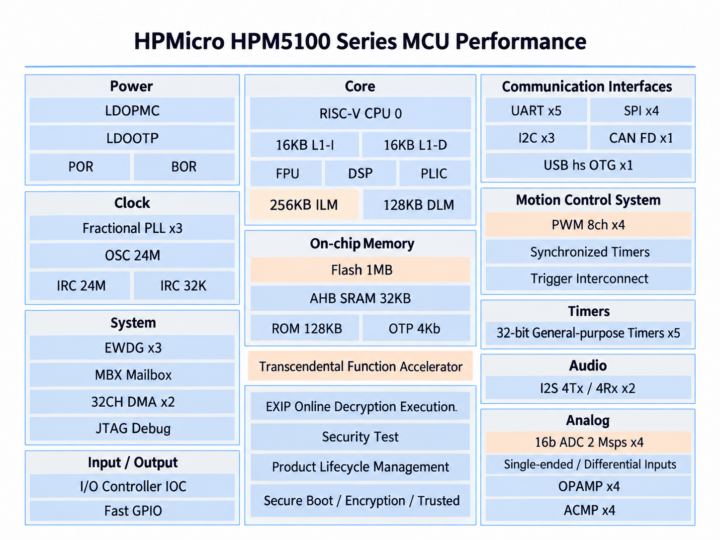
| Attr | Specs | verified |
|---|---|---|
soc | Single-core 32-bit RISC-V processor @ 400 MHz (up to 480 MHz in high-performance mode) | ? unverified |
ram | 416 KB SRAM (256 KB ILM, 128 KB DLM, 32 KB AHB SRAM) | ? unverified |
storage | 1 MB SiP flash, 128 KB Boot ROM, 4 Kbit OTP | ? unverified |
analog | 4x 16-bit SAR ADCs (2 MSPS), 4x Op-Amps/PGA, 4x Analog Comparators | ? unverified |
usb | 1x USB 2.0 High-Speed OTG with integrated PHY | ? unverified |
can_bus | 1x CAN controller supporting CAN FD up to 8 Mbps | ? unverified |
interfaces | 5x UART, 4x SPI, 3x I2C, 2x I2S, Up to 79x GPIO | ? unverified |
pwm | 4x 8-channel PWM modules (32 channels total) | ? unverified |
security | Secure boot, JTAG protection, 128-bit unique ID, AES-128 CTR encrypted execution | ? unverified |
power | 3.0V to 3.6V main supply, Integrated LDO, Low-power modes | ? unverified |
packages | LQFP100 (14x14mm), QFN68 (8x8mm), QFN48 (6x6mm), QFN32 (5x5mm) | ? unverified |
temperature | -40°C to +105°C ambient, +125°C max junction | ? unverified |
sdk | HPMicro HPM SDK (v1.13.0+), FreeRTOS, TinyUSB support | ? unverified |
Mass production of the HPM5100 family began in October 2026. This mixed-signal microcontroller aims to reduce the bill of materials for motor control and sensing systems through its integrated analog peripherals.
+ Strengths
["- Integrates 4x 16-bit SAR ADCs (2 MSPS), 4 configurable op-amps, and 4 comparators, reducing external component needs.","- RISC-V core clocked at 400 MHz (up to 480 MHz in high-performance mode) with 416 KB SRAM and 1 MB SiP flash.","- Comprehensive connectivity including USB 2.0 OTG with integrated PHY, CAN FD (8 Mbps), and 32 PWM channels for motor control."]
− Weaknesses
["- Not specified","- Not specified","- Not specified"]
- Retour d'expérience expert expert — expert-microdb
- Après 3 semaines de dev sur le HPM5151 (QFN48), je confirme la puissance des 400 MHz RISC-V. Le SDK v1.13.0 est stable avec FreeRTOS. Les 4 ADC SAR 16 bits à 2 MSPS sont excellents pour la gestion moteur grâce aux 32 PWM synchronisés. Attention : le mode 480 MHz exige une gestion thermique stricte,… — expert-microdb
- Bon retour. J'utilise le HPM5100 pour un nœud IoT avec USB 2.0 OTG et CAN FD. La sécurité matérielle (AES-128, Secure Boot) simplifie la certification. Les prix à partir de 15,60 ¥ sont agressifs. Par contre, vérifiez bien la dissipation si vous visez les 480 MHz, les limites thermiques sont strict… — membre-forum
- Retour d'expérience expert expert — expert-microdb
- Après 6 mois sur HPM5100 pour un drone, je suis bluffé par les ADC 16 bits à 2MSPS. Les PGA intégrés simplifient grandement le front-end analogique, réduisant la BOM. La fréquence de 400 MHz tient bien, mais attention au 480 MHz : il exige une gestion thermique rigoureuse, sinon throttle. Le SDK v1… — expert-microdb
- Concordo sobre la doc, j'ai galéré avec le CAN FD initial. Pour la sécurité, l'AES-128 matériel est top pour nos produits IoT, mais le démarrage sécurisé ajoute une courbe d'apprentissage si tu débutes. Le format QFN32 est super compact pour l'automobile, mais la soudure est délicate. Le support Fr… — membre-forum
- Retour d'expérience expert expert — expert-microdb
- Après 3 semaines sur le HPM5100, je confirme son potentiel pour la commande moteur. Les 4 ADC SAR 16 bits à 2 MSPS et les PGA intégrés éliminent presque tout le front-end analogique externe, réduisant radicalement la taille du PCB. Le cœur RISC-V tourne à 400 MHz (480 MHz avec alim externe), offran… — expert-microdb
- Intéressant ton retour. J'ai testé l'USB 2.0 OTG avec PHY intégré sur un prototype, c'est effectivement un gain de place notable. Cependant, la doc sur les 32 canaux PWM manque de détails sur les modes synchronisés complexes. Le SDK 1.13.0 est stable, mais j'ai rencontré un bug avec le Secure Boot … — membre-forum
Community feedback and projects
Content not available yet.
Content not available yet.
Content not available yet.
["- Not specified","- Not specified","- Not specified"]
- HPM5100: First Connection and Startup debutant Guide pas à pas pour alimenter votre carte HPM5100 et vérifier sa communication de base.
- Using USB OTG as Mass Storage debutant Apprenez à configurer le HPM5100 pour qu'il soit reconnu comme une clé USB par votre ordinateur.
- HPM5100: First Connection and Startup intermediaire Guide étape par étape pour alimenter, connecter et initialiser la carte HPM5100 via le SDK.
- GPIO Control and Analog Sensor Reading on HPM5100 intermediaire Apprenez à configurer les GPIO et à utiliser les ADC SAR 16 bits du HPM5100 pour lire un capteur et commander un affichage.
- HPM5100: First connection and advanced startup avance Guide avancé pour initialiser correctement le HPM5100, gérer l'alimentation externe et configurer le débogage via USB OTG.
- HPM5100: Advanced GPIO I/O and Sensor Interface Mastery avance Ce tutoriel détaille la configuration avancée des GPIO du HPM5100 pour l'interfaçage optimisé de capteurs numériques et d'affichages, en exploitant les fonctionnalités de multiplexage et les interrupt
- Getting started with analog acquisition on HPM5100 debutant Apprenez à configurer les convertisseurs ADC SAR 16 bits intégrés pour lire une tension analogique simple.
- BLDC Motor Control with HPM5100 intermediaire Utilisez les 32 canaux PWM et les périphériques analogiques intégrés pour piloter un moteur sans balais.
- BLDC Motor FOC Control on HPM5100 avance Utilisation simultanée des ADC SAR 16 bits et des 32 canaux PWM pour une commande vectorielle haute performance.