Particle Boron
⚡ The essentials in 60 seconds
- application_soc — Nordic Semiconductor nRF52840 — ARM Cortex-M4F 32-bit @ 64 MHz, 1 MB flash, 256 KB RAM, Bluetooth 5 (2/1/500/125 kbps), 802.15.4 radio, NFC-A tag, DSP + HW FPU, ARM TrustZone CryptoCell-310 crypto engine (Boron datasheet, Features; GitHub hardware repo
- cellular_modem_model_dependent — (Boron datasheet, Radio specifications): - BRN402/BRN404: u-blox SARA-R410M-02B-00/-03, 3GPP Release 13 LTE Cat M1 half-duplex, power class 3 (23 dBm); NorAm bands 2, 4, 5, 12, 13 (Features section; the datasheet's radio-spec table lists additional bands — its own revision history v012 (2024-03-19) says "Incorrect bands listed for the BRN402 and BRN404" were being fixed, so trust the Features list). - BRN404X: u-blox SARA-R510S-01B, Release 14 LTE Cat M1, bands 2/4/5/12/13 (BRN404X datasheet). - BRN310/BRN314: u-blox SARA-U201, 3GPP Release 7 HSPA/GSM, GSM 850 / E-GSM 900 / DCS 1800 / PCS 1900 (features also list 800/2100 MHz for the 3G bands). - >
- storage — on-board 4 MB external SPI flash (datasheet Features; the older GitHub README says 2 MB — early boards; datasheet is current). Flash layout: nRF52840 — bootloader 48 KB @0xF4000, System 656 KB @0x30000, SoftDevice 192 KB, user app 256 KB @0xB4000 (Device OS 3.1+); external SPI flash — LittleFS 2 MB, FAC 128 KB, OTA 1.5 MB (datasheet, Memory map).
- gpio_20_mixed_signal_all_3_3_v_max — 6 analog inputs (A0–A5), 8 PWM (D2–D8 + A0–A5 per pin table), 1 UART, 1 SPI in the peripherals table, 2 I2C — but the datasheet's own revision notes contradict the table: v007 "Number of accessible I2C ports is 1, not 2" and v008 "Corrected number of SPI ports (2)". >
- rf_antennas — cellular radio has a U.FL connector — an external antenna is required for cellular use; BLE uses an on-board PCB antenna by default with an optional U.FL (firmware-selectable). Certified antennas: PARANTC41EA (LTE-M flex, included in kits), Taoglas FXUB63.07.0150C (ANT-FLXU), ANT-FLXV2 (BLE 2.4 GHz), ANT-NFC (NFC) (datasheet + BRN404X datasheet, Antenna sections).
- sim — Dual SIM support: Nano 4FF and MFF2 (embedded); EtherSIM models (BRN404/BRN314/BRN404X) ship a pre-embedded Particle EtherSIM profile; store kits advertise a "free global embedded SIM card and data plan" (datasheet Features; store product page above). 2018 launch cellular plan: $2.99/month with 3 MB data, $0.40/MB extra (CNX, Feb 14, 2018).
- On this board : 9 tutorials · 10 code
The Particle Boron stands as a cornerstone in the landscape of cellular Internet of Things development, offering a compact, versatile platform designed for engineers and makers who need reliable wide-area connectivity without the complexity of building a full cellular stack from scratch. Announced in February 2018 as part of Particle’s next-generation hardware line alongside the Wi-Fi-capable Argon and the Bluetooth-focused Xenon, the Boron distinguishes itself by integrating cellular radio capabilities directly onto a board that adheres to the popular Adafruit Feather form factor. This choice of mechanical footprint is significant for beginners and experienced developers alike, as it ensures immediate compatibility with a vast ecosystem of "FeatherWings"—add-on boards for sensors, displays, and other peripherals—allowing users to expand the board’s functionality without redesigning their hardware layout. The board measures approximately 5.1 by 2.3 centimeters and weighs just 10 grams, making it suitable for portable and space-constrained applications.
At the heart of the Boron lies the Nordic Semiconductor nRF52840, a powerful 32-bit microcontroller based on the ARM Cortex-M4F architecture. For those less familiar with microcontroller specifications, this means the chip operates at a clock speed of 64 MHz, providing ample processing power for handling sensor data, running logic, and managing communication protocols. It comes equipped with 1 MB of flash memory for storing your program and 256 KB of RAM for temporary data processing. Beyond raw processing power, the nRF52840 includes advanced features such as Bluetooth 5 support, which allows for faster and more efficient short-range wireless communication, and an NFC-A tag for easy device identification or pairing. Security is also a priority, with the inclusion of the ARM TrustZone CryptoCell-310, a hardware engine dedicated to handling encryption tasks, ensuring that data transmitted over the cellular network remains secure.
The defining feature of the Boron is its cellular modem, which enables communication over wide-area networks. It is important to note that the specific modem depends on the model variant, and this distinction is critical for deployment. The current, generally available model is the BRN404X, which utilizes the u-blox SARA-R510S-01B modem to connect to LTE-M networks. LTE-M, or Long-Term Evolution for Machines, is a low-power wide-area network technology designed specifically for IoT devices that need to send small amounts of data over long distances while conserving battery life. The BRN404X is certified for use in North America on specific frequency bands. Earlier models, such as the BRN310 and BRN314, used a u-blox SARA-U201 modem for 2G and 3G networks. However, users must be aware that 2G and 3G networks are being phased out globally, with significant shutdowns occurring in the United States in 2022. Consequently, these older models are deprecated and not recommended for new projects, particularly in regions where these legacy networks no longer exist. Furthermore, the LTE-M models are currently certified only for North America, meaning they cannot be legally or reliably used in Europe or other regions following EU certification standards.
Connectivity and flexibility are further enhanced by the Boron’s dual SIM support. The board features a socket for a standard Nano SIM card and a footprint for an embedded MFF2 eSIM. This allows developers to choose between using a physical SIM from a local carrier or leveraging Particle’s EtherSIM technology, which provides a pre-provisioned data plan that can switch between multiple carriers to ensure the best possible coverage. This "global" connectivity aspect simplifies the deployment of devices that might move between different network regions or require high availability. The board also includes a U.FL connector for an external cellular antenna, which is mandatory for cellular operation, as the on-board PCB antenna is insufficient for reliable wide-area transmission. A certified flexible antenna is typically included in starter kits.
Power management is a sophisticated aspect of the Boron’s design, reflecting its intended use in battery-powered applications. The board includes an integrated Lithium-Polymer (LiPo) battery charger and a fuel gauge, allowing it to run directly from a single-cell LiPo battery ranging from 3.6 to 4.2 volts. It can also be powered via micro-USB, though users should note that the cellular modem can draw significant current during transmission peaks, especially in older 2G/3G models, which may require a robust power source. The board supports deep sleep modes, where the microcontroller and radios are powered down to minimize energy consumption, drawing as little as 70 to 106 microamps in hibernate states. This capability is essential for devices that need to operate for months or years on a small battery. However, developers must be cautious with the EN (Enable) pin, which controls power to the main processor; improper wiring can prevent the board from sleeping correctly or cause it to fail to wake up.
Software development on the Boron is streamlined through Particle’s Device OS, a real-time operating system based on FreeRTOS. This system abstracts much of the low-level hardware complexity, providing a familiar Arduino-like Wiring API for C/C++ programming. This means that developers can write code using standard functions like digitalWrite or analogRead, while the underlying system handles the intricate details of connecting to the cellular network, managing the SIM card, and maintaining a secure connection to the Particle Cloud. The Particle Cloud integration is a key selling point, allowing for over-the-air (OTA) firmware updates, remote monitoring of variables, and triggering of functions from anywhere in the world via a simple REST API. This cloud-native approach reduces the need for developers to build and maintain their own server infrastructure.
Despite its strengths, the Boron comes with certain limitations and considerations. The board is not Linux-based; it is a microcontroller platform, meaning it runs a single user application rather than a full operating system with multiple processes. This makes it highly efficient but limits the types of applications it can run compared to a single-board computer like a Raspberry Pi. Additionally, the physical construction requires careful handling. The U.FL antenna connector is fragile and not designed for frequent plugging and unplugging, and the board lacks conformal coating, making it unsuitable for harsh environments without additional protection. Community reports have also highlighted issues with deep sleep currents in earlier firmware versions and occasional difficulties with USB serial enumeration on certain operating systems, though these are generally addressed in newer Device OS releases.
In summary, the Particle Boron is a robust, cloud-connected development board ideal for creating cellular IoT products in North America. Its combination of the nRF52840 microcontroller, LTE-M connectivity, and Feather-compatible form factor offers a balanced mix of power, connectivity, and expandability. While users must navigate the complexities of cellular certification and network sunsets by choosing the correct model, the board’s mature software ecosystem and hardware design provide a solid foundation for building reliable, battery-powered IoT solutions.

Pinout diagram
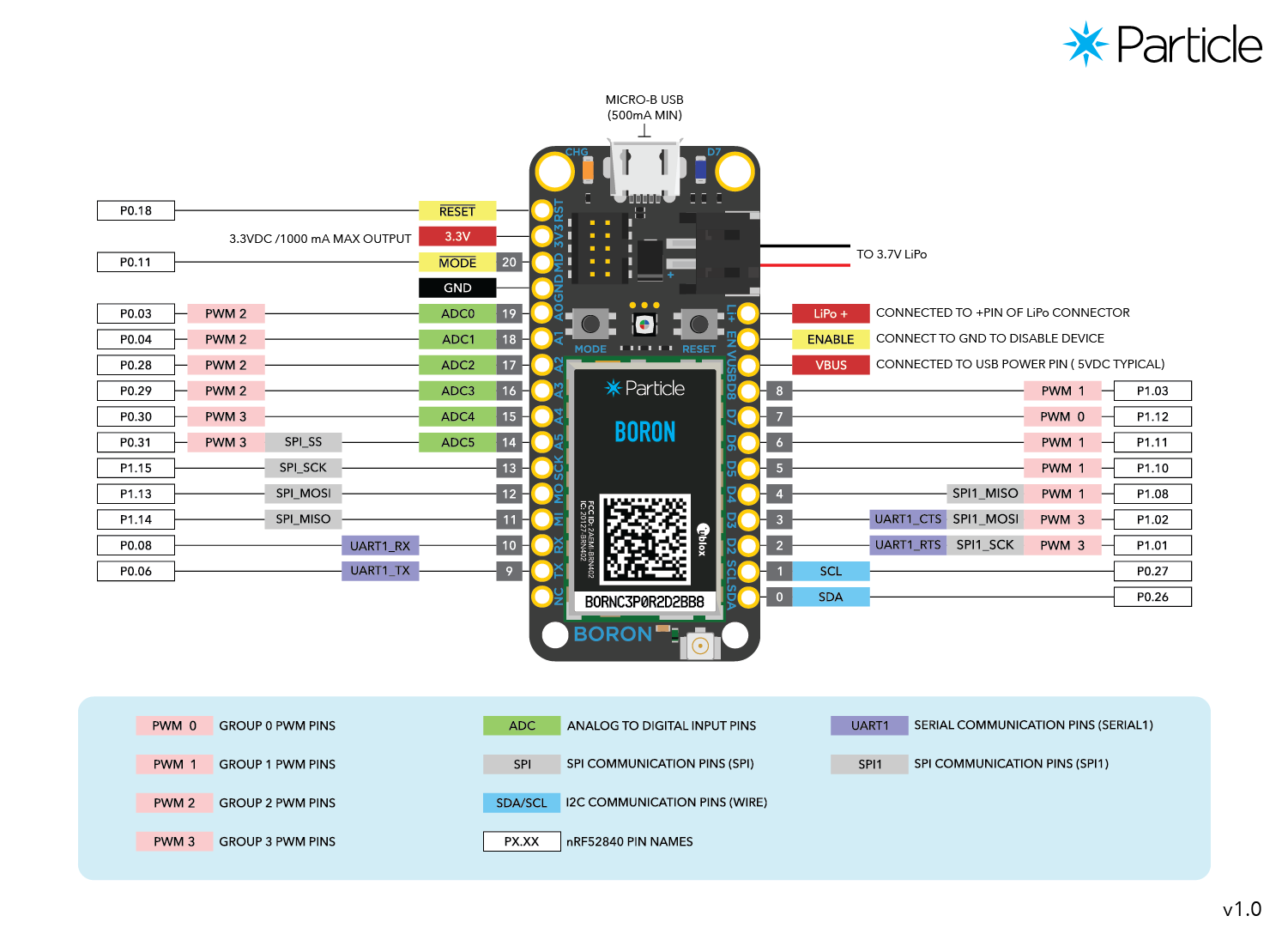
| Attr | Specs | verified |
|---|---|---|
application_soc | Nordic Semiconductor nRF52840 — ARM Cortex-M4F 32-bit @ 64 MHz, 1 MB flash, 256 KB RAM, Bluetooth 5 (2/1/500/125 kbps), 802.15.4 radio, NFC-A tag, DSP + HW FPU, ARM TrustZone CryptoCell-310 crypto engine (Boron datasheet, Features; GitHub hardware repo | ✔ |
cellular_modem_model_dependent | (Boron datasheet, Radio specifications): - BRN402/BRN404: u-blox SARA-R410M-02B-00/-03, 3GPP Release 13 LTE Cat M1 half-duplex, power class 3 (23 dBm); NorAm bands 2, 4, 5, 12, 13 (Features section; the datasheet's radio-spec table lists additional bands — its own revision history v012 (2024-03-19) says "Incorrect bands listed for the BRN402 and BRN404" were being fixed, so trust the Features list). - BRN404X: u-blox SARA-R510S-01B, Release 14 LTE Cat M1, bands 2/4/5/12/13 (BRN404X datasheet). - BRN310/BRN314: u-blox SARA-U201, 3GPP Release 7 HSPA/GSM, GSM 850 / E-GSM 900 / DCS 1800 / PCS 1900 (features also list 800/2100 MHz for the 3G bands). - > | ? unverified |
storage | on-board 4 MB external SPI flash (datasheet Features; the older GitHub README says 2 MB — early boards; datasheet is current). Flash layout: nRF52840 — bootloader 48 KB @0xF4000, System 656 KB @0x30000, SoftDevice 192 KB, user app 256 KB @0xB4000 (Device OS 3.1+); external SPI flash — LittleFS 2 MB, FAC 128 KB, OTA 1.5 MB (datasheet, Memory map). | ? unverified |
gpio_20_mixed_signal_all_3_3_v_max | 6 analog inputs (A0–A5), 8 PWM (D2–D8 + A0–A5 per pin table), 1 UART, 1 SPI in the peripherals table, 2 I2C — but the datasheet's own revision notes contradict the table: v007 "Number of accessible I2C ports is 1, not 2" and v008 "Corrected number of SPI ports (2)". > | ✔ |
rf_antennas | cellular radio has a U.FL connector — an external antenna is required for cellular use; BLE uses an on-board PCB antenna by default with an optional U.FL (firmware-selectable). Certified antennas: PARANTC41EA (LTE-M flex, included in kits), Taoglas FXUB63.07.0150C (ANT-FLXU), ANT-FLXV2 (BLE 2.4 GHz), ANT-NFC (NFC) (datasheet + BRN404X datasheet, Antenna sections). | ? unverified |
sim | Dual SIM support: Nano 4FF and MFF2 (embedded); EtherSIM models (BRN404/BRN314/BRN404X) ship a pre-embedded Particle EtherSIM profile; store kits advertise a "free global embedded SIM card and data plan" (datasheet Features; store product page above). 2018 launch cellular plan: $2.99/month with 3 MB data, $0.40/MB extra (CNX, Feb 14, 2018). | ? unverified |
power | micro-USB (≥500 mA; 2G/3G model needs 2 A USB or a LiPo attached because the SARA-U201 peaks at 1.8 A in 2G mode), Li+ pin 3.6–4.2 V (single-cell LiPo or DC), integrated LiPo charger with battery connector and charge-status LED (ON=charging, OFF=done, 1 Hz blink=fault, fast blink=battery disconnected), 3V3 output from Torex XC9258A buck regulator max 1000 mA — cannot power the board (unlike Photon), EN pin forces deep power-down (70–75 µA) via XC8107 load switch (datasheet, Power / Charge status LED). | ? unverified |
typical_consumption | (datasheet, Power consumption tables, measured @3.6 V battery): - Boron LTE: idle (MCU on, radios off) 3.90 mA; connected-but-idle 17.9 mA typ; transmitting 63.9 mA typ / 184 mA peak; peak current 490 mA; HIBERNATE sleep ~106 µA; ULP GPIO wake ~127 µA. - Boron 2G/3G: connected idle 18.7 mA typ; transmitting 86.1 mA typ / 981 mA peak; HIBERNATE ~146 µA. | ? unverified |
temperature | operating −20 to +60 °C, storage −30 to +75 °C; humidity ≤95 % RH non-condensing (datasheet, Recommended operating conditions / Absolute maximum ratings). | ? unverified |
mechanical | Adafruit Feather footprint and pinout (~5.1 × 2.3 cm), 10 g, 16-pin + 12-pin 0.1" headers, 10-pin SWD debug connector, RGB status LED, Reset + Mode buttons (datasheet; CNX 2018 article; GitHub repo). | ? unverified |
- Manufacturer: Particle (Particle Industries / Particle.io).
- Announced: February 13–14, 2018, together with the Argon (Wi-Fi) and Xenon (BLE/Mesh) as Particle's nRF52840 "next generation hardware" line (Particle blog "Introducing Particle's next generation hardware powered by Particle Mesh", Feb 13, 2018, as linked by CNX Software:
- Launch price: US$29 during the pre-order period (free shipping in the first 24 h), rising to US$39 afterwards (CNX Software, Feb 14, 2018, same article). Expected shipping July 2018; actual shipping slipped to October 2018 (CNX unboxing, Nov 3, 2018:
- Variants / models (Boron datasheet, Model comparison + Ordering information, - BRN310 — Boron 2G/3G (global), u-blox SARA-U201, physical SIM — Deprecated. - BRN314 — Boron 2G/3G (global) + EtherSIM — NRND / Deprecated (the datasheet's model-comparison table header prints "BRN313" while the features and ordering sections say BRN314; treat "BRN313" as a datasheet typo). - BRN402 — Boron LTE Cat M1 (North America), u-blox SARA-R410M, embedded Particle SIM — Deprecated, replacement BRN404X. - BRN404 — Boron LTE Cat M1 (NorAm) + EtherSIM — Deprecated, replacement BRN404X. - BRN404X — Boron LTE Cat M1 (NorAm), u-blox SARA-R510S-01B, EtherSIM — GA (Generally Available) and "Supply Secure"; the only currently recommended model (BRN404X datasheet, - SMT/castellated siblings: the E-Series modules (e.g. E404X) are the production castellated-module counterparts of the Boron ("Boron and E series castellated modules" — CNX Software, May 1, 2020: E404X listed in the Device OS Cellular API page:
- Status (2026-10-13): product line active only as BRN404X (GA). All 2G/3G models are formally Deprecated and the older LTE models Deprecated/NRND with named replacements (datasheet ordering table). The Boron is still sold as the "flagship IoT Development Board for cellular-connected products" in the Particle store (BRN404XKIT product page, fetched 2026-10-13:
- 2G/3G network continuity: Particle's datasheet states the global 2G/3G models are "not recommended for use in the United States due to the shutdown of 2G and 3G networks in 2022", and the country table lists many countries where BRN314 falls back to 2G only — itself being sunset in several markets (Boron datasheet, Radio specifications + Country compatibility). The LTE Cat M1 models are unaffected but are certified for North America only ("Particle LTE Cat M1 devices are not certified for use in Europe or other countries that follow EU certification requirements" — same datasheet).
+ Strengths
- Cellular + Feather + LiPo in one: LTE-M (or 2G/3G) via u-blox modem, LiPo charging with TI PMIC + fuel gauge on-board, Feather-compatible so Adafruit FeatherWings fit (datasheet Features + Fuel gauge schematic section; Feather spec as linked directly from the datasheet:
- EtherSIM / dual SIM: Nano-SIM socket and MFF2 eSIM footprint; EtherSIM models carry a pre-provisioned Particle data plan profile, "generally have a larger number of carriers and more may be added" (datasheet, Model comparison; store page).
- Cloud-native: Particle.publish/subscribe/variable/function with TLS and per-device identity handled by Device OS; every device is a REST resource on — "GET variables, POST a function call, or PUT new firmware" (Cloud API reference).
- Power-management depth: EN pin hardware power-down (~70 µA) used by the community for weekly hard-resets and solar harvesting designs; STOP/ULP/HIBERNATE sleep modes with published µA figures; SystemPowerFeature::DISABLE_CHARGING persists across resets (datasheet, EN pin + Charge status LED notes).
- Security hardware: nRF52840 CryptoCell-310 + ARM TrustZone, hardware per-device key pair used for cloud authentication (GitHub repo README; Cloud API OAuth2 docs).
- NFC-A tag on the MCU plus an optional certified NFC antenna (ANT-NFC, 13.56 MHz, up to 52 mm) (BRN404X datasheet, Certified NFC antenna).
- Supply-secure flagship: BRN404X is flagged "Supply Secure" by Particle; the Boron family underpinned the Particle Tracking System (2020) and remains the reference cellular dev board (CNX 2020 article; store page).
− Weaknesses
- 2G/3G models are network-stranded: US 2G/3G shut down in 2022; Particle explicitly de-recommends BRN310/BRN314 in the US, and the models are Deprecated (datasheet). In the EU, LTE Borons are not certified, so EU users were squeezed between uncertified LTE hardware and sunset 2G — community deployments (e.g. Norway, 2020) noted Cat-M1 rollout was still incomplete and required checking carrier coverage maps (community.particle.io, Boron LTE threads, Nov 2020).
- Charging stopped after Device OS 1.5.0: field reports of Borons silently stopping LiPo charging on DeviceOS 1.5.0 (community:
- Deep-sleep current was mediocre early on: ~0.6–1.2 mA in SLEEP_MODE_DEEP on Device OS 0.9.0, with the community awaiting proper Gen 3 sleep modes (community: datasheet tables still show STOP-mode sleep at ~0.5–0.6 mA typical, and cellular-wake sleep at 12–16 mA (datasheet power tables).
- EN-pin leakage trap: driving a GPIO high (or a pull-up) from externally-powered circuitry while EN is low can keep the nRF52 from ever powering down/resetting; EN must never be tied directly to a 3.3 V GPIO (only pulled low via open-drain/N-MOS) (datasheet, EN pin).
- Battery over-discharge bricks cloud access: with a drained LiPo, boards could come back flashing 10 SOS and require DFU re-claim ("restore mode") (community: similar "stuck after low-power shutdown, no USB enumeration, can't enter DFU" reports followed (
- Occasionally stuck blinking-green after power cycling (cellular registration race), fixed by another power cycle (community:
- USB serial port disappearing under Windows 11 after OTA updates (community:
- Mechanical fragility: U.FL connector "not designed to be constantly plugged and unplugged… you can destroy the radio with improper handling"; micro-USB connector can be ripped off; JST battery connector on the battery side is weak; no conformal coating allowed; no castellated/SMT version — socket-mount recommended, and wave-soldering forbids water-soluble flux (datasheet, Product handling + Assembly).
- LiPo polarity warning: "Not all LiPo batteries follow the same polarity convention!" (datasheet, LiPo note).
- LTE band/band-list errata: datasheet revision v012 (2024-03-19) corrected wrong BRN402/BRN404 band listings; not all bands are enabled in software by default (datasheet revision history + radio specs).
- Supply-chain stress: during the 2021–2022 chip shortage, Boron-family boards (B542) sat at ~56-week lead times, pushing designs back to the sunset-prone 2G/3G Boron (community:
- Verizon caveat: US Verizon support is enterprise plans only (datasheet, Country compatibility footnote 7).
- Retour d'expérience expert expert — expert-microcontroleur
- Retex sur la Boron BRN404X. La promesse cloud est tenue, le handshake TLS est fluide. Mais attention aux pièges physiques documentés. Le connecteur U.FL est extrêmement fragile, ne jouez pas à le débrancher souvent, vous risquez de détruire la radio. Idem pour le port micro-USB qui se dérobe facile… — expert-microcontroleur
- Merci pour le rappel sur l'EN pin, j'ai perdu deux semaines à comprendre pourquoi ma carte ne dormait jamais vraiment, restant autour de 0.6 mA au lieu des valeurs ULP attendues. C'était exactement ton cas de figure avec un niveau haut externe. Autre souci rencontré : après une mise à jour OTA sous… — maker_bidouille
- Concernant la recharge, ça semble stable sur les dernières releases, mais surveille bien la température du PMIC TI. Pour les boîtiers scellés, garde en tête qu'il n'y a pas de version castellée pour la Boron complète, seulement les modules E-Series. Si tu passes en production, prévoir le socket ou … — iot_embedded_fr
Community feedback and projects
- Tips for deploying reliable LTE Boron that stays up community.particle.io
- Using Particle E series in a humid environment community.particle.io
- Boron LTE w/ Solar- Trials community.particle.io
- Boron 404X with third party sim card in Uruguay community.particle.io
- Boron datasheet (BRN310/314/402/404)
- BRN404X datasheet (current GA model)
- Pinout PDF
- Open hardware (schematic, Eagle, gerbers)
- Device OS firmware + API
- Device OS firmware + API
- Cloud API reference
- Cellular carriers list
- Product lifecycle stages / Supply Secure FAQ
- Product lifecycle stages / Supply Secure FAQ
- Community forum
- Launch coverage
- u-blox modem pages
- Adafruit Feather specification
- 2G/3G models are network-stranded: US 2G/3G shut down in 2022; Particle explicitly de-recommends BRN310/BRN314 in the US, and the models are Deprecated (datasheet). In the EU, LTE Borons are not certified, so EU users were squeezed between uncertified LTE hardware and sunset 2G — community deployments (e.g. Norway, 2020) noted Cat-M1 rollout was still incomplete and required checking carrier coverage maps (community.particle.io, Boron LTE threads, Nov 2020).
- Charging stopped after Device OS 1.5.0: field reports of Borons silently stopping LiPo charging on DeviceOS 1.5.0 (community:
- Deep-sleep current was mediocre early on: ~0.6–1.2 mA in SLEEP_MODE_DEEP on Device OS 0.9.0, with the community awaiting proper Gen 3 sleep modes (community: datasheet tables still show STOP-mode sleep at ~0.5–0.6 mA typical, and cellular-wake sleep at 12–16 mA (datasheet power tables).
- EN-pin leakage trap: driving a GPIO high (or a pull-up) from externally-powered circuitry while EN is low can keep the nRF52 from ever powering down/resetting; EN must never be tied directly to a 3.3 V GPIO (only pulled low via open-drain/N-MOS) (datasheet, EN pin).
- Battery over-discharge bricks cloud access: with a drained LiPo, boards could come back flashing 10 SOS and require DFU re-claim ("restore mode") (community: similar "stuck after low-power shutdown, no USB enumeration, can't enter DFU" reports followed (
- Occasionally stuck blinking-green after power cycling (cellular registration race), fixed by another power cycle (community:
- USB serial port disappearing under Windows 11 after OTA updates (community:
- Mechanical fragility: U.FL connector "not designed to be constantly plugged and unplugged… you can destroy the radio with improper handling"; micro-USB connector can be ripped off; JST battery connector on the battery side is weak; no conformal coating allowed; no castellated/SMT version — socket-mount recommended, and wave-soldering forbids water-soluble flux (datasheet, Product handling + Assembly).
- LiPo polarity warning: "Not all LiPo batteries follow the same polarity convention!" (datasheet, LiPo note).
- LTE band/band-list errata: datasheet revision v012 (2024-03-19) corrected wrong BRN402/BRN404 band listings; not all bands are enabled in software by default (datasheet revision history + radio specs).
- Supply-chain stress: during the 2021–2022 chip shortage, Boron-family boards (B542) sat at ~56-week lead times, pushing designs back to the sunset-prone 2G/3G Boron (community:
- Verizon caveat: US Verizon support is enterprise plans only (datasheet, Country compatibility footnote 7).
- Faire clignoter une LED avec la Particle Boron debutant Schéma : IMG-particle-boron-debutant-1-boron-clignotement-led.svg — Particle Boron alimentée par micro-USB, LED externe sur broche D7 avec résistance, états allumé/éteint.
- Bouton MODE et console série sur la Boron debutant Schéma : IMG-particle-boron-debutant-2-boron-bouton-mode-console.svg — Boron vue de dessus avec boutons Reset et MODE, câble USB vers un ordinateur affichant une console série.
- Lire un capteur analogique avec l'ADC du Boron debutant Schéma : IMG-particle-boron-debutant-3-boron-capteur-analogique-adc.svg — pont diviseur photorésistance / résistance sur la broche A0 de la Boron, valeurs 0 à 4095 affichées sur la console.
- Se connecter au réseau cellulaire et publier un événement intermediaire Schéma : IMG-particle-boron-intermediaire-1-boron-reseau-cellulaire-publish.svg — Boron avec antenne U.FL, ondes radio vers une antenne relais LTE-M, puis vers le cloud Particle et un tableau de bord.
- Commander la Boron à distance avec Particle.function intermediaire Schéma : IMG-particle-boron-intermediaire-2-boron-particle-function.svg — ordinateur portable et smartphone envoyant une requête HTTP vers le cloud Particle qui appelle une fonction sur la Boron pilotant un relais.
- Exposer des Variables cloud avec Particle.variable intermediaire Schéma : IMG-particle-boron-intermediaire-3-boron-variables-cloud.svg — Boron publiant des jauges (RSSI, batterie, température) vers le cloud Particle, consultées par une requête HTTP GET depuis un serveur.
- Sommeil profond et réveil programmé sur la Boron avance Schéma : IMG-particle-boron-avance-1-boron-sommeil-profond.svg — Boron endormie (icône lune) branchée sur une LiPo, réveil par RTC après 1 heure, cycle mesure puis publication vers le cloud.
- Gestion de batterie LiPo : jauge, charge et seuils bas avance Schéma : IMG-particle-boron-avance-2-boron-gestion-batterie.svg — Boron reliée à une LiPo avec chargeur intégré, LED de statut de charge, jauges tension et pourcentage lues par FuelGauge.
- Mises à jour OTA et flash local DFU avec Particle CLI avance Schéma : IMG-particle-boron-avance-3-boron-ota-flash-dfu.svg — deux chemins de mise à jour firmware : par le cloud Particle (OTA sans fil) et par USB en mode DFU avec le bouton MODE, vers la mémoire flash du Boron.
Code library — examples written for this board
clignotante.inoArduinobouton-evenement.inoArduinofonction-distance.inoArduinocapteur-dht.inoArduinoruban-neopixel.inoArduinopwm-respiration.inoArduinoveille-cloud.inoArduinoservo-cloud.inoArduinobuzzer-alarme.inoArduinosommeil-basse-consommation.inoArduino
Examples and repos found online
- particle-iot/device-os github.com
- mohitbhoite/boron-lander github.com
- rickkas7/boron-clouddebug github.com
- technobly/Particle-NeoPixel github.com
- nrobinson2000/neopo github.com