STM32H7 Nucleo-144 (flagship: NUCLEO-H743ZI)
⚡ The essentials in 60 seconds
- cpu — 1× Arm Cortex-M7 32-bit RISC @ up to 480 MHz; FPU with Arm double-precision (IEEE 754) and single-precision support; full DSP instruction set; MPU (st.com).
- gpu — none. Graphics accelerators: Chrom-ART (DMA2D) and LCD-TFT controller (LTDC) with XGA resolution (Zephyr board doc).
- flash — 2 MB dual-bank flash (st.com). No external storage controller for raw NAND; SD-micro SDMMC and QSPI for external NOR/PSRAM are on the SoC (Zephyr board doc lists Dual-Mode Quad-SPI).
- ram — up to 1 MB total — 192 KB TCM RAM, up to 864 KB user SRAM, 4 KB backup SRAM (st.com).
- connectivity — Ethernet (IEEE-802.3-2002 MAC, on-board RJ45; Zephyr maps RMII pins PA1/PA2/PA7/PB13/PC1/PC4/PC5/PG11/PG13), 2× CAN FD (external transceiver required), USB OTG Full-Speed + High-Speed device-capable, no Wi-Fi/Bluetooth/radio on board (Zephyr board doc).
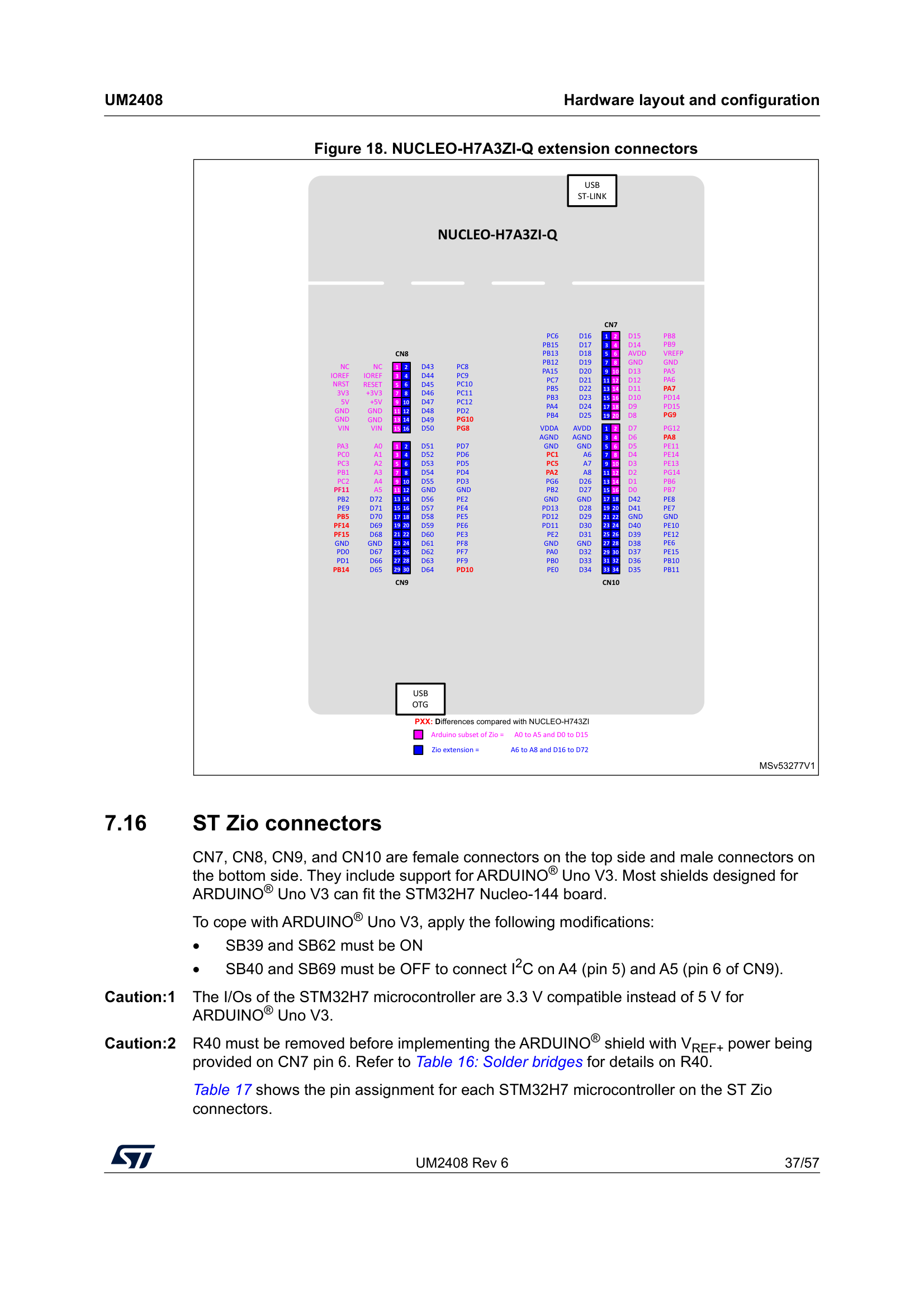
- gpio_expansion — up to 114 GPIO with external interrupt capability; ST Zio connector (Arduino Uno V3 compatible) + ST morpho headers exposing nearly all pins (st.com board page, Zephyr board doc). - Timers: 2× 32-bit + 12× 16-bit general-purpose, 2× PWM motor-control (including HRTIM — example projects exist in CubeH7), 5 low-power timers, 2.1 ns high-resolution timer (Zephyr board doc, CubeH7 examples tree). - Analog: 3× ADC (16-bit, 36 channels, up to 3.6 MSPS), 2× 12-bit DAC, 2 ultra-low-power comparators (st.com, Zephyr board doc). The STM32duino variant exposes 28 Arduino analog channels (A0–A27) on this board (variant_NUCLEO_H743ZI.cppT_H743Z(G-I)T_H747A(G-I)I_H747I(G-I)T_H750ZBT_H753ZIT_H757AII_H757IIT/variant_NUCLEO_H743ZI.cpp), fetched 2026-10-13). - Buses: 6× SPI, 4× I2C, 3× I2S, 4× USART + 4× UART, 2× SAI, 4× SPDIF-RX, HDMI-CEC, camera (DCMI) interface, hardware JPEG codec, 4× DFSDM sigma-delta filters, 16-channel DMA (Zephyr board doc, st.com). - Zephyr default mapping: console UART3 (PD8/PD9) on the ST-LINK virtual COM port at 115200 8N1; USER button PC13; LD1 PB0, LD2 PE1, LD3 PB14; I2C PB8/PB9; ADC1_INP15 PA3; DAC1_OUT1 PA4; Arduino SPI1 on PD14/PA5/PA6/PB5 (Zephyr board doc).
- On this board : 9 tutorials · 10 code
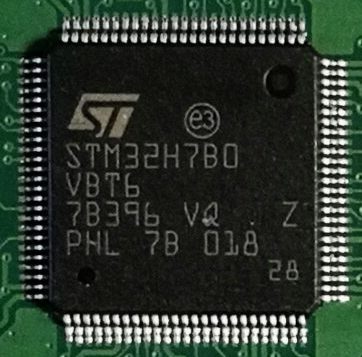
The STM32H7 Nucleo-144 development board, specifically the NUCLEO-H743ZI variant, represents a significant milestone in the world of microcontroller development, serving as a flagship platform for the high-performance STM32H7 series. Manufactured by STMicroelectronics, this board is built around the STM32H743ZI microcontroller, a 32-bit Arm Cortex-M7 processor that operates at speeds of up to 480 MHz. For those new to embedded systems, the Cortex-M7 is a high-end core designed for complex applications requiring fast processing and real-time responsiveness. The 480 MHz clock speed means the processor can execute hundreds of millions of instructions per second, allowing it to handle demanding tasks such as advanced signal processing, complex user interfaces, or high-speed data communication that would overwhelm slower microcontrollers. It is important to note that while the H7 series was originally announced in October 2016 at 400 MHz, current product specifications rate the STM32H743ZI at 480 MHz, though developers should be aware that older documentation or toolchains might still reference the lower frequency.
A key feature of this board is its robust memory architecture, which includes 2 MB of dual-bank flash memory and up to 1 MB of RAM. Flash memory is where your program code is stored permanently, and the "dual-bank" design allows for advanced features like Over-The-Air (OTA) updates, where new firmware can be written to one bank while the system continues to run from the other, ensuring reliability during updates. The RAM is divided into different types, including 192 KB of Tightly Coupled Memory (TCM). TCM is special because it is directly connected to the processor core, offering zero wait states and deterministic performance, which is critical for real-time applications where timing must be precise. The remaining RAM consists of up to 864 KB of user SRAM and 4 KB of backup SRAM, providing ample space for data buffers and variables. The board also features a True Random Number Generator (RNG), which is essential for security applications, although it is worth noting that dedicated cryptographic acceleration cells are not explicitly confirmed for this specific model, unlike some dual-core variants in the same family.
Connectivity is another strong suit of the NUCLEO-H743ZI. The board integrates an Ethernet MAC with an on-board RJ45 connector, allowing it to connect directly to local networks for IoT applications. It also supports two CAN FD interfaces, a communication protocol widely used in automotive and industrial settings for reliable data transmission, though users must add an external transceiver chip to use these ports. For general communication, the board offers USB OTG (On-The-Go) support in both Full-Speed and High-Speed modes, enabling it to act as a device or host. Notably, there is no on-board Wi-Fi or Bluetooth radio, so wireless connectivity requires additional modules. The board exposes a vast array of General Purpose Input/Output (GPIO) pins—up to 114 in total—which are physical pins that can be programmed to read sensors or control actuators. These pins are accessible through two main connectors: the ST Zio connector, which is compatible with Arduino Uno V3 shields, and the ST morpho headers, which provide access to nearly all microcontroller pins for more advanced custom hardware connections.
The analog capabilities of the board are equally impressive, featuring three 16-bit Analog-to-Digital Converters (ADCs) capable of sampling at up to 3.6 million samples per second. This allows for the precise measurement of analog signals from sensors, such as temperature, light, or pressure. There are also two 12-bit Digital-to-Analog Converters (DACs) for generating analog voltages. For timing and control, the board includes a rich set of timers, including high-resolution timers with 2.1 nanosecond precision, which are useful for motor control and power electronics applications. The board also includes multimedia accelerators, such as a Chrom-ART 2D graphics accelerator and an LCD-TFT controller, making it suitable for driving displays, although it does not have a dedicated GPU.
Despite its capabilities, potential buyers should be aware that the NUCLEO-H743ZI has been officially discontinued by STMicroelectronics. The company recommends the NUCLEO-H753ZI as the direct replacement for new designs. This obsolescence is clearly noted in official documentation, including the Zephyr RTOS board guide. Additionally, users must be cautious about pinout differences between the H743ZI and the H743ZI2 variants. While they share the same microcontroller, the wiring to the Arduino headers differs, which can cause issues if the wrong board definition is selected in the software environment. Furthermore, the board's default clock configuration can vary significantly depending on the development environment used. For instance, the Zephyr RTOS may boot the board at 96 MHz by default, while the STM32duino Arduino core configures it to run at the full 480 MHz. Developers must ensure their clock settings are correctly configured to achieve the desired performance, as reaching 480 MHz requires specific voltage regulator settings and flash latency configurations. The board also relies on an external 8 MHz clock source provided by the on-board ST-LINK debugger, so disconnecting certain jumpers can inadvertently stop the system clock.
The software ecosystem for this board is extensive and well-supported. It is compatible with STM32CubeIDE and STM32CubeMX, STMicroelectronics' official tools for generating code and configuring hardware. It is also a first-class citizen in the Zephyr RTOS project, allowing developers to build modern, secure, and scalable applications. For those preferring the Arduino ecosystem, the STM32duino core supports the board, though users should ensure they are using a recent version of the core to avoid known bugs related to pin mapping. MicroPython is also officially supported, offering a Python-based development experience for rapid prototyping. While the board was previously supported by Arm Mbed OS, that platform has been sunset, and users are encouraged to migrate to Zephyr or STM32Cube for long-term support. Overall, the STM32H7 Nucleo-144 remains a powerful and versatile platform for learning and development, provided users are mindful of its discontinued status and the specific configuration requirements needed to unlock its full potential.
Pinout diagram
| Attr | Specs | verified |
|---|---|---|
cpu | 1× Arm Cortex-M7 32-bit RISC @ up to 480 MHz; FPU with Arm double-precision (IEEE 754) and single-precision support; full DSP instruction set; MPU (st.com). | ✔ |
gpu | none. Graphics accelerators: Chrom-ART (DMA2D) and LCD-TFT controller (LTDC) with XGA resolution (Zephyr board doc). | ✔ |
flash | 2 MB dual-bank flash (st.com). No external storage controller for raw NAND; SD-micro SDMMC and QSPI for external NOR/PSRAM are on the SoC (Zephyr board doc lists Dual-Mode Quad-SPI). | ✔ |
ram | up to 1 MB total — 192 KB TCM RAM, up to 864 KB user SRAM, 4 KB backup SRAM (st.com). | ✔ |
connectivity | Ethernet (IEEE-802.3-2002 MAC, on-board RJ45; Zephyr maps RMII pins PA1/PA2/PA7/PB13/PC1/PC4/PC5/PG11/PG13), 2× CAN FD (external transceiver required), USB OTG Full-Speed + High-Speed device-capable, no Wi-Fi/Bluetooth/radio on board (Zephyr board doc). | ✔ |
gpio_expansion | up to 114 GPIO with external interrupt capability; ST Zio connector (Arduino Uno V3 compatible) + ST morpho headers exposing nearly all pins (st.com board page, Zephyr board doc). - Timers: 2× 32-bit + 12× 16-bit general-purpose, 2× PWM motor-control (including HRTIM — example projects exist in CubeH7), 5 low-power timers, 2.1 ns high-resolution timer (Zephyr board doc, CubeH7 examples tree). - Analog: 3× ADC (16-bit, 36 channels, up to 3.6 MSPS), 2× 12-bit DAC, 2 ultra-low-power comparators (st.com, Zephyr board doc). The STM32duino variant exposes 28 Arduino analog channels (A0–A27) on this board (variant_NUCLEO_H743ZI.cppT_H743Z(G-I)T_H747A(G-I)I_H747I(G-I)T_H750ZBT_H753ZIT_H757AII_H757IIT/variant_NUCLEO_H743ZI.cpp), fetched 2026-10-13). - Buses: 6× SPI, 4× I2C, 3× I2S, 4× USART + 4× UART, 2× SAI, 4× SPDIF-RX, HDMI-CEC, camera (DCMI) interface, hardware JPEG codec, 4× DFSDM sigma-delta filters, 16-channel DMA (Zephyr board doc, st.com). - Zephyr default mapping: console UART3 (PD8/PD9) on the ST-LINK virtual COM port at 115200 8N1; USER button PC13; LD1 PB0, LD2 PE1, LD3 PB14; I2C PB8/PB9; ADC1_INP15 PA3; DAC1_OUT1 PA4; Arduino SPI1 on PD14/PA5/PA6/PB5 (Zephyr board doc). | ✔ |
security | True Random Number Generator (RNG) confirmed (st.com). | ✔ |
power | flexible supply — ST-LINK USB VBUS or external sources; board connectors USB Micro-AB, SWD, Ethernet RJ45; on-board 32.768 kHz crystal; internal/external SMPS option "significantly reduces power consumption in Run mode" (st.com board page, Zephyr board doc). MCU VDD range 1.62–3.6 V (Zephyr board doc). | ✔ |
- Manufacturer: STMicroelectronics (st.com board page, fetched 2026-10-13).
- Product: NUCLEO-H743ZI — STM32 Nucleo-144 development board built around the STM32H743ZI MCU (LQFP144) (st.com, Zephyr board doc, both fetched 2026-10-13).
- Family timeline: the STM32H7 series (Cortex-M7F, 40 nm) was announced October 2016, running at 400 MHz at announcement; ST's current product page rates the STM32H743xI/G at up to 480 MHz (en.wikipedia.org/wiki/STM32, st.com chip page, both fetched 2026-10-13).
- Status: OBSOLETE / discontinued. ST has officially discontinued the NUCLEO-H743ZI and recommends the NUCLEO-H753ZI as the replacement — obsolescence notice reproduced in the Zephyr board documentation (Zephyr board doc, fetched 2026-10-13). The H743ZI2 shares the same ST product page (CubeH7 README board links, fetched 2026-10-13).
- Price: launch price not retrievable from the fetched sources (ST estore is JavaScript-rendered).
- Variants (Nucleo-144 H7 line, from the STM32CubeH7 README): NUCLEO-H743ZI, NUCLEO-H743ZI2 (same MCU, different Arduino-header wiring — see Problems), NUCLEO-H753ZI/ZI2 (STM32H753), NUCLEO-H723ZG (STM32H723), NUCLEO-H7A3ZI-Q (STM32H7A3), NUCLEO-H745ZI-Q / NUCLEO-H755ZI-Q (dual-core M7+M4 parts).
+ Strengths
- Fastest classic Cortex-M7 part in the Nucleo line at its era: 480 MHz with double-precision FPU and 2 MB/1 MB memory — the H743ZI was the go-to board for benchmarking MCUs (DMIPS/MCMS figures) (st.com chip page, fetched 2026-10-13).
- Dual-bank 2 MB flash enables bank-swap OTA updates (dual-bank confirmed on st.com).
- TCM RAM (192 KB) for deterministic real-time execution plus AXI/MBX interconnect to the 864 KB user SRAM (st.com).
- Wired-connectivity showcase on one board: Ethernet RJ45 + 2× CAN FD + USB OTG HS/FS, all with official LwIP/FreeRTOS demo projects (Zephyr board doc, CubeH7 Applications).
- Multimedia silicon: Chrom-ART 2D accelerator, hardware JPEG codec, LCD-TFT (LTDC) XGA display controller, camera interface, SAI audio — rare on Nucleo boards (Zephyr board doc).
- SMPS-equipped power tree for lower Run-mode consumption (st.com board page).
- Arduino Uno V3 (via ST Zio) + ST morpho on a 144-pin MCU board — the classic way to run Arduino shields at 480 MHz (st.com board page).
- Backup-SRAM test jumper (SB156) on the board for VBAT experiments (Zephyr board doc).
− Weaknesses
- Board is obsolete (EOL). ST discontinued the NUCLEO-H743ZI and recommends the NUCLEO-H753ZI; the Zephyr board doc carries an explicit obsolescence notice (Zephyr board doc, fetched 2026-10-13). Buy the H753ZI (or H7A3ZI-Q) for new designs.
- H743ZI vs H743ZI2 pinout trap. The two boards share the same MCU and ST product page but wire the Arduino header differently — the STM32duino core keeps two distinct digitalPin[] tables, and picking the wrong board in the IDE silently remaps every D/A pin (variant_NUCLEO_H743ZI.cppT_H743Z(G-I)T_H747A(G-I)I_H747I(G-I)T_H750ZBT_H753ZIT_H757AII_H757IIT/variant_NUCLEO_H743ZI.cpp), fetched 2026-10-13).
- Frequency confusion (400 vs 480 MHz). The H7 series was announced at 400 MHz in October 2016 (Wikipedia); the same parts are now rated 480 MHz (st.com). Older datasheets/errata notes and stale toolchains may still clock-limit at 400 MHz.
- Default clocks differ wildly per toolchain — check before benchmarking. Zephyr boots the board at 96 MHz PLL (from the 8 MHz HSE) by default (Zephyr board doc), while the STM32duino variant's SystemClock_Config runs 480 MHz SYSCLK (HSE 8 MHz, PLLM=1, PLLN=120, PLLR=2) with regulator at voltage scale 0 and AHB at HCLK/2 (240 MHz) (variant_NUCLEO_H743ZI.cppT_H743Z(G-I)T_H747A(G-I)I_H747I(G-I)T_H750ZBT_H753ZIT_H757AII_H757IIT/variant_NUCLEO_H743ZI.cpp)). Reaching 480 MHz requires VOS scale 0 and correct flash latency — CubeMX-generated projects that keep a lower scale silently cap the clock.
- HSE is an external clock (bypass), not a crystal. The Arduino variant configures RCC_HSE_BYPASS (8 MHz supplied to the MCU), so cutting the ST-LINK jumpers can kill the clock source on some configurations (variant_NUCLEO_H743ZI.cppT_H743Z(G-I)T_H747A(G-I)I_H747I(G-I)T_H750ZBT_H753ZIT_H757AII_H757IIT/variant_NUCLEO_H743ZI.cpp)).
- Silicon errata apply. ST publishes errata sheet ES0392 covering the STM32H742/H743/H750/H753 devices (744 KB PDF served under both the H743-inclusive slug and the H742/H750/H753 slug, both HTTP 200 on 2026-10-13). Read it before using DMA/cache-heavy or Ethernet corner cases.
- Core bug history: the H743ZI variant shipped with a digitalPin[] typo fixed only in core PR #1383; H7 support itself landed in PR #392 after long request threads (#227) — old core versions are unsafe on this board (GitHub issue search "H743ZI", fetched 2026-10-13).
- CAN/CANFD needs an external transceiver — the board exposes the pins (PD0/PD1) but no transceiver (Zephyr board doc).
- Mbed path is dead. Online Mbed builds for this board stopped with the July 2026 Mbed sunset; migrate to Zephyr, Cube, or Mbed CE (os.mbed.com, fetched 2026-10-13).
- Retour d'expérience expert expert — expert-microcontroleur
- J'ai passe pas mal de temps sur la NUCLEO-H743 pour des projets de controle moteur. Sur le papier, c'est une bete : le MCU STM32H743 tourne a 480 MHz avec une FPU double precision, et les 2 MB de RAM et 1 MB de Flash offrent un confort inegale dans la gamme Nucleo classique. Les performances brutes… — expert-microcontroleur
- Merci pour le retour. Le cote EOL m'inquiete pas trop pour mon usage perso, je trouve encore des cartes sur les marketplaces d'occasion. Par contre, tu dis que les 2 MB de RAM sont confortables. J'ai du mal a voir l'interet concret par rapport a des cartes moins cheres. Est-ce que tu as rencontre d… — dev-embarque-99
- Ah tiens, je viens de voir que ma carte est en fin de vie. Je l'utilise pour un petit projet d'acquisition de données audio. Les 480 MHz sont top pour le traitement DSP en temps reel, honnetement je ne vois pas de latence. Par contre, si la carte est EOL, est-ce que le support logiciel va continuer… — maker_bricoleur
Community feedback and projects
- Nucleo-144 STM32H743ZI doing nothing forum.arduino.cc
- Problem with DAC and DMA and CLOCK - STM32H723ZG community.st.com
- NUCLEO-H743ZI with Adafruit OV5640 camera not reading/writing I2C community.st.com
- TouchGFX, FreeRTOS and LWIP using STM32H743XI troubles community.st.com
Content not available yet.
- Board is obsolete (EOL). ST discontinued the NUCLEO-H743ZI and recommends the NUCLEO-H753ZI; the Zephyr board doc carries an explicit obsolescence notice (Zephyr board doc, fetched 2026-10-13). Buy the H753ZI (or H7A3ZI-Q) for new designs.
- H743ZI vs H743ZI2 pinout trap. The two boards share the same MCU and ST product page but wire the Arduino header differently — the STM32duino core keeps two distinct digitalPin[] tables, and picking the wrong board in the IDE silently remaps every D/A pin (variant_NUCLEO_H743ZI.cppT_H743Z(G-I)T_H747A(G-I)I_H747I(G-I)T_H750ZBT_H753ZIT_H757AII_H757IIT/variant_NUCLEO_H743ZI.cpp), fetched 2026-10-13).
- Frequency confusion (400 vs 480 MHz). The H7 series was announced at 400 MHz in October 2016 (Wikipedia); the same parts are now rated 480 MHz (st.com). Older datasheets/errata notes and stale toolchains may still clock-limit at 400 MHz.
- Default clocks differ wildly per toolchain — check before benchmarking. Zephyr boots the board at 96 MHz PLL (from the 8 MHz HSE) by default (Zephyr board doc), while the STM32duino variant's SystemClock_Config runs 480 MHz SYSCLK (HSE 8 MHz, PLLM=1, PLLN=120, PLLR=2) with regulator at voltage scale 0 and AHB at HCLK/2 (240 MHz) (variant_NUCLEO_H743ZI.cppT_H743Z(G-I)T_H747A(G-I)I_H747I(G-I)T_H750ZBT_H753ZIT_H757AII_H757IIT/variant_NUCLEO_H743ZI.cpp)). Reaching 480 MHz requires VOS scale 0 and correct flash latency — CubeMX-generated projects that keep a lower scale silently cap the clock.
- HSE is an external clock (bypass), not a crystal. The Arduino variant configures RCC_HSE_BYPASS (8 MHz supplied to the MCU), so cutting the ST-LINK jumpers can kill the clock source on some configurations (variant_NUCLEO_H743ZI.cppT_H743Z(G-I)T_H747A(G-I)I_H747I(G-I)T_H750ZBT_H753ZIT_H757AII_H757IIT/variant_NUCLEO_H743ZI.cpp)).
- Silicon errata apply. ST publishes errata sheet ES0392 covering the STM32H742/H743/H750/H753 devices (744 KB PDF served under both the H743-inclusive slug and the H742/H750/H753 slug, both HTTP 200 on 2026-10-13). Read it before using DMA/cache-heavy or Ethernet corner cases.
- Core bug history: the H743ZI variant shipped with a digitalPin[] typo fixed only in core PR #1383; H7 support itself landed in PR #392 after long request threads (#227) — old core versions are unsafe on this board (GitHub issue search "H743ZI", fetched 2026-10-13).
- CAN/CANFD needs an external transceiver — the board exposes the pins (PD0/PD1) but no transceiver (Zephyr board doc).
- Mbed path is dead. Online Mbed builds for this board stopped with the July 2026 Mbed sunset; migrate to Zephyr, Cube, or Mbed CE (os.mbed.com, fetched 2026-10-13).
- Premiers pas sur le Nucleo-144 STM32H743ZI : core STM32duino, ST-LINK et premier Blink debutant Schéma : IMG-stm32h7-nucleo-debutant-1-stm32h743zi-arduino-first-steps.svg — Nucleo-144 STM32H743ZI vue de dessus avec le connecteur ST Zio (Arduino Uno V3), les deux rangées ST morpho, la LED LD1 et le connecteur USB de l'ST-LINK/V2-1 mis en évidence, flat vector style, étiquettes en français, fond blanc.
- GPIO, ADC 16 bits et DAC sur le Nucleo STM32H743ZI : bouton, LED et potentiomètre debutant Schéma : IMG-stm32h7-nucleo-debutant-2-stm32h743zi-gpio-adc-dac.svg — Nucleo-144 STM32H743ZI sur plaque de prototypage, bouton USER (PC13), LED LD1 (PB0), potentiomètre sur A0 et sortie DAC1_OUT1 (PA4) reliée à un oscilloscope, connecteurs ST Zio et morpho annotés, flat vector style, étiquettes en français, fond blanc.
- MicroPython sur le Nucleo STM32H743ZI : le REPL 480 MHz via le port série ST-LINK debutant Schéma : IMG-stm32h7-nucleo-debutant-3-stm32h743zi-micropython-repl.svg — Nucleo-144 STM32H743ZI reliée en USB à un ordinateur portable, fenêtre de REPL MicroPython affichant « >>> », LED verte de la carte allumée, câble USB unique vers le connecteur ST-LINK, flat vector style, étiquettes en français, fond blanc.
- Zephyr RTOS sur le Nucleo STM32H743ZI : west build, flash et le piège des 96 MHz intermediaire Schéma : IMG-stm32h7-nucleo-intermediaire-1-stm32h743zi-zephyr-rtos.svg — terminal affichant « west build -b nucleo_h743zi » et « west flash », flèche vers la Nucleo-144 STM32H743ZI avec sa LED LD1 allumée, câble USB vers l'ST-LINK/V2-1, horloge barrée annotée « 96 MHz par défaut », flat vector style, étiquettes en français, fond blanc.
- STM32Cube HAL à 480 MHz sur le STM32H743ZI : VOS0, latence flash et HSE bypass intermediaire Schéma : IMG-stm32h7-nucleo-intermediaire-2-stm32h743zi-cube-hal-480mhz.svg — chaîne d'horloge du STM32H743ZI : HSE 8 MHz (bypass) → PLL1 → SYSCLK 480 MHz, régulateur en échelle VOS0 et latence flash FLASH_LATENCY_4 annotés, Nucleo-144 à côté avec LD1 (PB0), flat vector style, étiquettes en français, fond blanc.
- FreeRTOS sur le Nucleo STM32H743ZI : le projet officiel CubeH7, tâches et file d'attente intermediaire Schéma : IMG-stm32h7-nucleo-intermediaire-3-stm32h743zi-freertos-tasks.svg — trois tâches FreeRTOS (capteur, affichage, log) échangeant via une file d'attente au-dessus de la Nucleo-144 STM32H743ZI, chronogramme d'ordonnancement préemptif à droite, flat vector style, étiquettes en français, fond blanc.
- Serveur web sur l'Ethernet du STM32H743ZI : démo LwIP officielle, RMII et errata avance Schéma : IMG-stm32h7-nucleo-avance-1-stm32h743zi-ethernet-lwip.svg — Nucleo-144 STM32H743ZI avec câble Ethernet RJ45 branché, flèches vers les broches RMII (PA1, PA2, PA7, PB13, PC1, PC4, PC5, PG11, PG13), navigateur web affichant une page de télémétrie, flat vector style, étiquettes en français, fond blanc.
- Mise à jour OTA par bascule de banque sur le STM32H743ZI : 2 Mo de flash double banque avance Schéma : IMG-stm32h7-nucleo-avance-2-stm32h743zi-dual-bank-ota.svg — flash 2 Mo du STM32H743ZI divisée en banque 1 (firmware actif) et banque 2 (image en cours d'écriture), flèche de bascule de banque (bank swap) et petit bloc « backup SRAM 4 Ko » avec le jumper SB156, flat vector style, étiquettes en français, fond blanc.
- TCM, DMA et cache sur le STM32H743ZI : placer ses données pour un temps réel déterministe avance Schéma : IMG-stm32h7-nucleo-avance-3-stm32h743zi-tcm-dma-cache.svg — carte mémoire du STM32H743ZI : 192 Ko de TCM RAM en accès cycle unique à côté du Cortex-M7, 864 Ko de SRAM utilisateur reliés par l'interconnect AXI/MBX, contrôleur DMA à 16 canaux traversant les zones cacheables, flat vector style, étiquettes en français, fond blanc.
Code library — examples written for this board
clignotante.cCbouton-hal.cCusart-printf.cCadc-temperature.cCpwm-timer-led.cCservo-pwm.cCi2c-oled.cCwatchdog-iwdg.cCrtc-reveil.cCusart-reception.cC
Examples and repos found online
- STMicroelectronics/STM32CubeH7 github.com
- stm32duino/Arduino_Core_STM32 github.com
- zephyrproject-rtos/zephyr github.com