Teensy 4.1
⚡ The essentials in 60 seconds
- mcu — NXP i.MX RT1062, part MIMXRT1062DVJ6 (196-pin MAPBGA) — the same Cortex-M7 core and 600 MHz speed as the Teensy 4.0 (which uses the smaller DVL6 100-pin package); the larger package is what unlocks the 4.1's extra I/O, Ethernet, SDIO and USB host (SparkFun overview, techspecs).
- cpu — ARM Cortex-M7, 600 MHz rated (24 MHz crystal × PLL), overclockable to 912 MHz (techspecs). Dual-issue superscalar (2 instructions/clock achieved ~40–50 % of the time on numerically heavy Arduino C++ per PJRC benchmarks), branch prediction (first ARM MCU with it), DSP extensions, hardware FPU for both 32-bit float and 64-bit double (store page, Processor).
- cache_tcm — two 32 KB caches (instruction + data, 65536 bytes total per techspecs) plus Tightly Coupled Memory: 64-bit ITCM instruction bus and dual 32-bit DTCM data buses (store page).
- flash — 8 MByte external QSPI NOR (Winbond W25Q64JV, datasheet); 7936 KB usable — the top 256 KB is reserved for EEPROM emulation and the LED-blink restore program; techspecs lists 1984 Mbytes/sec flash bandwidth. Part of flash can hold files via LittleFS (store page, Memory).
- ram — 1024 KB total — 512 KB (RAM1) tightly coupled for single-cycle CPU access, 512 KB (RAM2) optimized for DMA. Large buffers go to RAM2 via DMAMEM; heap (malloc/new/Arduino String) lives in RAM2 (store page, Memory).
- eeprom — 4284 bytes emulated (writes briefly stall code execution from flash) (techspecs, store page). 16 bytes of battery-backed RTC RAM (LPGPR0–LPGPR3).
- On this board : 9 tutorials · 10 code
The Teensy 4.1 stands as a high-performance microcontroller development board designed for makers and engineers who require significant processing power alongside extensive connectivity options. Manufactured by PJRC, a company known for its custom electronic designs, this board represents the full-featured sibling of the Teensy 4.0. While it shares the same powerful core, the 4.1 distinguishes itself with a larger physical footprint that accommodates a much richer set of input and output interfaces. Since March 2025, production has transitioned to SparkFun Electronics, ensuring continued availability and support for this popular platform. The board was initially released in 2020, marking a significant leap forward for the Teensy product line by offering a robust solution for complex projects that demand more than what smaller microcontrollers can provide.
At the heart of the Teensy 4.1 lies the NXP i.MX RT1062 microcontroller, specifically the MIMXRT1062DVJ6 variant in a 196-pin package. This choice of silicon is critical because it unlocks capabilities that were not available on the smaller package used in the Teensy 4.0. The processor is an ARM Cortex-M7 core running at a rated speed of 600 MHz, which is exceptionally fast for a microcontroller. To put this in perspective, the Cortex-M7 architecture includes advanced features like dual-issue superscalar execution, meaning it can process two instructions per clock cycle under optimal conditions, and hardware branch prediction, which helps the processor guess the next steps in a program to avoid delays. This core also features a floating-point unit capable of handling both 32-bit and 64-bit calculations, making it suitable for demanding mathematical tasks such as audio processing or complex sensor fusion. For those needing even more speed, the board supports overclocking up to 912 MHz, though this requires careful thermal management.
Memory architecture is another area where the Teensy 4.1 shines. It features a sophisticated memory system that includes tightly coupled memory, which allows the CPU to access data with zero wait states, ensuring maximum efficiency. The board comes with 1 megabyte of total RAM, split into two sections: one optimized for direct CPU access and another optimized for direct memory access operations. This distinction is important for developers because it allows for efficient handling of large data buffers, such as those used in audio streaming or image processing, without slowing down the main program execution. Additionally, the board includes 8 megabytes of external flash memory, providing ample space for storing code and data files. A unique feature is the ability to expand memory further by soldering optional PSRAM chips onto the bottom of the board, which can increase the available RAM significantly for memory-intensive applications.
The input and output capabilities of the Teensy 4.1 are extensive, featuring 55 digital I/O pins, with 42 of them easily accessible on a standard solderless breadboard. This is a substantial increase over its predecessor, allowing for more sensors, actuators, and peripherals to be connected simultaneously. The board supports 35 PWM pins, which are used to generate variable-width pulses for controlling motors, dimming LEDs, or creating analog-like signals. It also includes 18 analog input channels, although it is important to note that these inputs are not 5-volt tolerant and operate strictly within a 0 to 3.3-volt range. Unlike some other boards in the Teensy family, the 4.1 does not include a digital-to-analog converter, so users needing analog audio output must rely on other methods such as the I2S interface or the MQS output.
Connectivity is perhaps the most defining characteristic of this board. It features two USB ports, both operating at high-speed 480 Mbit/s. One port functions as a standard device connection for programming and communication with a computer, while the second port operates as an independent USB host. This allows the Teensy 4.1 to control USB peripherals such as keyboards, mice, MIDI devices, and audio DACs directly, a capability that is rare in this class of microcontroller. For networked applications, the board includes an on-board 10/100 Mbit Ethernet controller with a PHY chip. While the Ethernet jack itself is not included and must be added via a separate connector kit, this feature enables the board to serve as a web server or telemetry node with robust wired connectivity. There is also a variant of the board without the Ethernet chip for those who do not need it and want to save on cost.
Audio performance is a major strength of the Teensy 4.1, supported by dedicated hardware interfaces including I2S and TDM ports that can handle multiple channels of high-quality audio. The board also features S/PDIF input and output, allowing it to integrate into professional audio setups. The combination of the fast Cortex-M7 core and these audio interfaces makes the Teensy 4.1 a popular choice for DIY synthesizers, audio effects processors, and multi-channel sound systems. The board’s ability to handle complex audio processing in real-time is further enhanced by its DMA capabilities, which allow data to move between peripherals and memory without burdening the CPU.
Power management on the Teensy 4.1 is designed with flexibility in mind, but it requires careful attention. The board operates at 3.3 volts logic levels, and users must ensure that no signals exceeding this voltage are applied to the pins, as they are not 5-volt tolerant. Power can be supplied via USB or an external 5-volt source, but care must be taken not to feed power into the VIN pin while USB is connected, as this can cause conflicts. The board includes a dedicated power-on/off pin that allows for software-controlled power management, which is useful for battery-powered projects. The CPU core voltage is dynamically adjusted based on the operating frequency, helping to optimize power consumption during different stages of operation.
Despite its many strengths, the Teensy 4.1 has some limitations and considerations. The lack of 5-volt tolerance means that level shifters are often required when interfacing with older or 5-volt logic devices. The absence of a built-in DAC means that generating analog signals requires additional hardware or creative use of PWM filtering. Additionally, the board’s complexity means that it is best suited for users who are comfortable with programming microcontrollers and understanding their hardware constraints. The programming environment is primarily based on the Arduino IDE with the Teensyduino add-on, which provides a rich library of optimized code for the board’s features. Support for other environments like PlatformIO and CircuitPython is also available, though CircuitPython does not fully support all hardware features.
In summary, the Teensy 4.1 is a powerful and versatile development board that bridges the gap between simple hobbyist microcontrollers and more complex embedded systems. Its combination of high-speed processing, extensive I/O, dual USB capabilities, and strong audio and networking features makes it an ideal choice for advanced projects in robotics, audio synthesis, industrial control, and IoT applications. While it demands a higher level of technical understanding than simpler boards, the rewards in performance and flexibility are significant for those ready to take on the challenge.
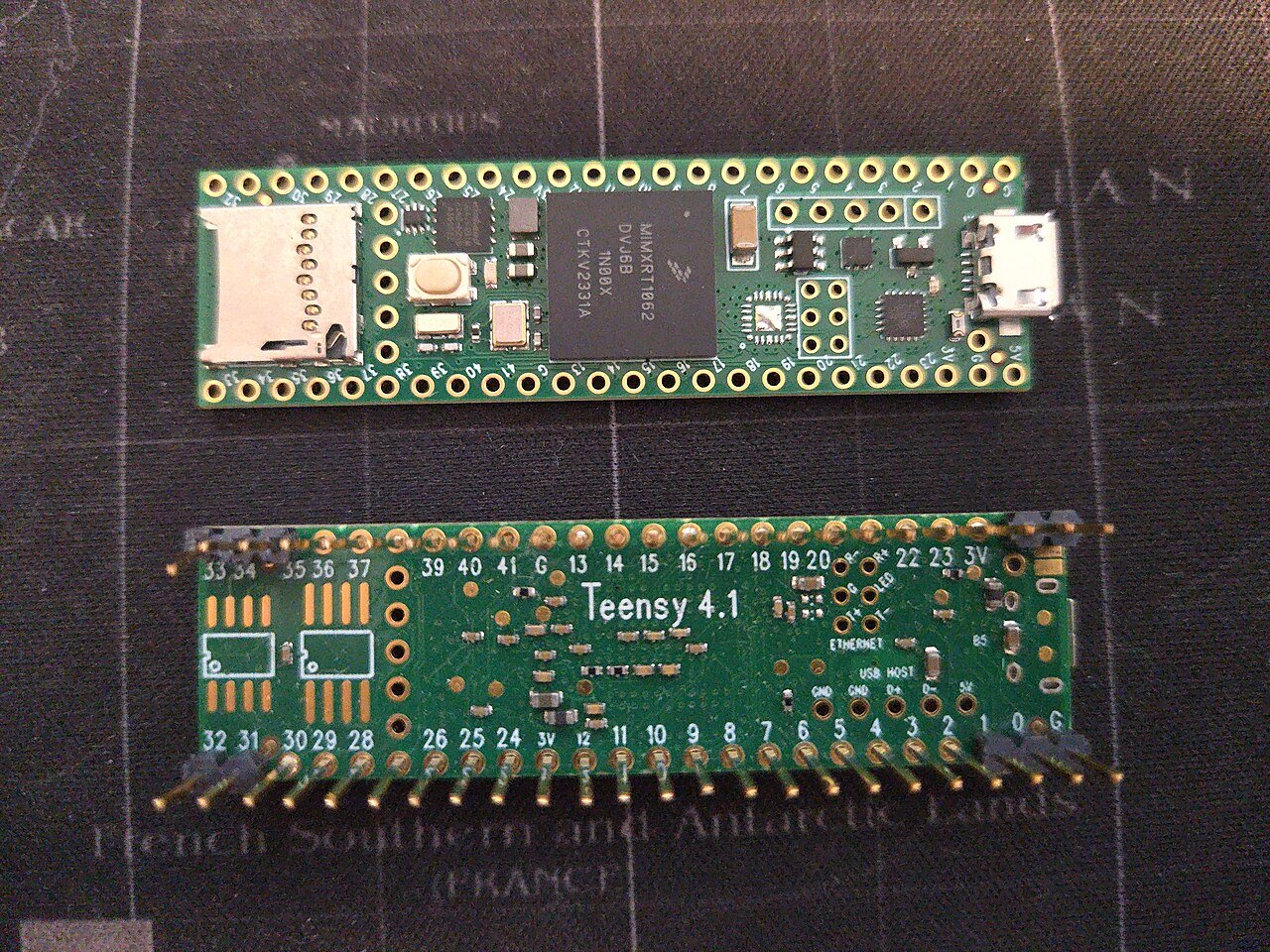
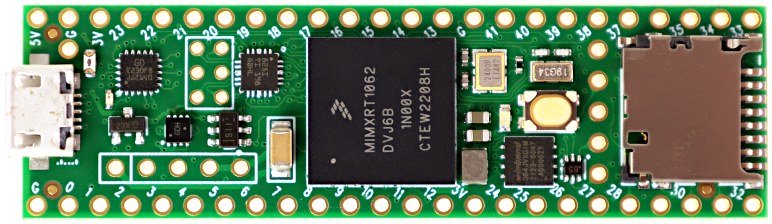
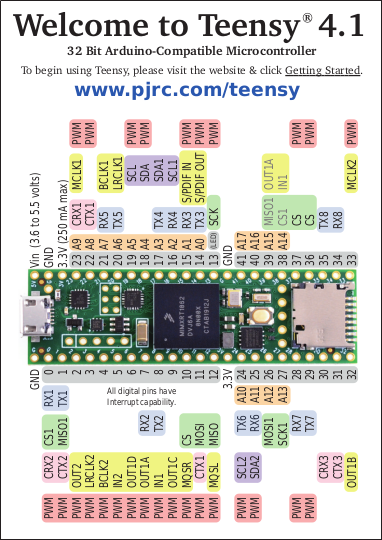
Pinout diagram
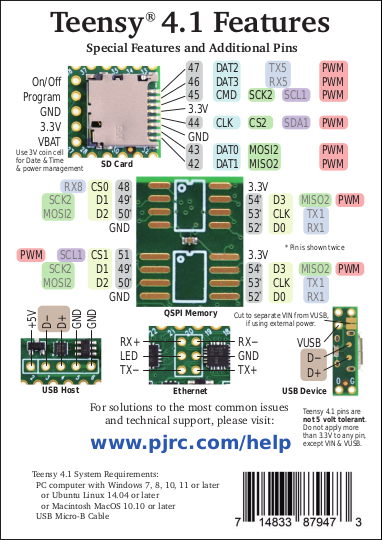
| Attr | Specs | verified |
|---|---|---|
mcu | NXP i.MX RT1062, part MIMXRT1062DVJ6 (196-pin MAPBGA) — the same Cortex-M7 core and 600 MHz speed as the Teensy 4.0 (which uses the smaller DVL6 100-pin package); the larger package is what unlocks the 4.1's extra I/O, Ethernet, SDIO and USB host (SparkFun overview, techspecs). | ✔ |
cpu | ARM Cortex-M7, 600 MHz rated (24 MHz crystal × PLL), overclockable to 912 MHz (techspecs). Dual-issue superscalar (2 instructions/clock achieved ~40–50 % of the time on numerically heavy Arduino C++ per PJRC benchmarks), branch prediction (first ARM MCU with it), DSP extensions, hardware FPU for both 32-bit float and 64-bit double (store page, Processor). | ✔ |
cache_tcm | two 32 KB caches (instruction + data, 65536 bytes total per techspecs) plus Tightly Coupled Memory: 64-bit ITCM instruction bus and dual 32-bit DTCM data buses (store page). | ✔ |
flash | 8 MByte external QSPI NOR (Winbond W25Q64JV, datasheet); 7936 KB usable — the top 256 KB is reserved for EEPROM emulation and the LED-blink restore program; techspecs lists 1984 Mbytes/sec flash bandwidth. Part of flash can hold files via LittleFS (store page, Memory). | ✔ |
ram | 1024 KB total — 512 KB (RAM1) tightly coupled for single-cycle CPU access, 512 KB (RAM2) optimized for DMA. Large buffers go to RAM2 via DMAMEM; heap (malloc/new/Arduino String) lives in RAM2 (store page, Memory). | ✔ |
eeprom | 4284 bytes emulated (writes briefly stall code execution from flash) (techspecs, store page). 16 bytes of battery-backed RTC RAM (LPGPR0–LPGPR3). | ✔ |
qspi_memory_expansion | two empty footprints on the bottom for 8-pin QSPI chips — both accept PJRC's 8 MB PSRAM (up to 16 MB PSRAM total per SparkFun); placed with the EXTMEM keyword and extmem_malloc. If only one PSRAM chip is fitted it must go on the smaller pads; the larger pads take certain LittleFS-supported QSPI flash chips (store page, Memory). | ✔ |
digital_i_o | 55 pins, 42 easily accessible on a solderless breadboard (vs 40/24 on Teensy 4.0). The 4.1 adds a second row of higher-numbered pins beyond the 4.0's set — e.g. PWM-capable pins 24, 25, 46, 47 and 53 appear in the official PWM timer map (store page, Timing). Output HIGH = 3.3 V; pins are NOT 5 V tolerant — do not drive any pin above 3.3 V (a change from Teensy 3.2). Store page: recommended max output current 4 mA/pin; the techspecs table lists 10 mA — design to the store page's conservative figure. All 55 pins support pull-up/pull-down/keeper resistors and pin-change interrupts (store page, Digital Pins). | ✔ |
pwm | 35 PWM pins (store page); 22 PWM groups can run distinct frequencies (analogWriteFrequency); techspecs counts 3× 32-bit + 32× 16-bit PWM timers (FlexPWM1-4 + QuadTimer1-4, 49 timers total). QuadTimer4 channels are reserved by OctoWS2811/Audio ADC timing (store page, Timing). | ✔ |
analog | 18 analog inputs on 2 ADCs, default 10-bit; hardware allows 12 bits "but in practice only up to 10 bits are normally usable due to noise". Range fixed 0–3.3 V — analogReference has no effect; analog pins are not 5 V tolerant. 4 analog comparators. No PGA, no capacitive touch, and NO DAC (unlike Teensy 3.5/3.6) (store page, Analog Pins, techspecs). | ✔ |
comms | 8 serial ports (all independent, all with FIFOs, none shared with USB), 3 SPI (first port FIFO for sustained speed), 3 I2C (100/400/1000 kbit/s), 3 CAN (one with CAN-FD; transceiver chip required), FlexIO (bit-bang UART/I2C/SPI/I2S/PWM — e.g. TriantaduoWS2811). | ✔ |
usb | two ports, both 480 Mbit/s — main port as device (Serial, MIDI/MIDIx4/MIDIx16, Audio sound card, Keyboard, Mouse, Joystick, Touchscreen, MTP disk, Flight Sim, RawHID, several simultaneously) + second port as independent USB host (480/12/1.5 Mbit/s, hubs supported, USBHost_t36 library, special USB host cable required). | ✔ |
ethernet | on-board 10/100 Mbit controller + TI DP83825I PHY (datasheet) with DMA; only an RJ45 magjack connector kit must be added. Not gigabit. (Ethernet can alternatively be added to any Teensy via W5500/Wiz820 SPI shields.) | ✔ |
sd_card | bottom-mounted socket on a native 4-bit SDIO port — SD.begin(BUILTIN_SDCARD) — no SPI bus sharing (store page, Memory/SD Card). | ✔ |
digital_audio | 2 I2S/TDM ports (up to 8 channels I2S / 16 TDM), 1 S/PDIF input + 1 S/PDIF output independent of the I2S ports, MQS (Medium Quality Sound) pulsed output for small speakers, PT8211 DAC kit support (store page, Audio). | ✔ |
dma | 32 general-purpose channels, plus dedicated DMA engines inside USB device, USB host, SD and Ethernet peripherals (store page, Special Features). | ✔ |
security | hardware cryptographic acceleration (symmetric ciphers + hash — no library currently exposes it), true random number generator (Entropy library), i.MX RT Bus Encryption Engine for on-the-fly decryption of encrypted code, encrypted EHEX firmware updates on locked boards (store page). | ✔ |
other_peripherals | RTC with on-board 32.768 kHz crystal (unlike Teensy 3.2 — nothing to solder; VBAT coin cell keeps time), on-die temperature sensor (InternalTemperature library), 4 interval timers (IntervalTimer class), 4 quadrature decoders, IEEE1588 timers (no software support yet per techspecs), Power On/Off pin, nested vectored interrupt controller with priority nesting. | ✔ |
power | 5 V on VUSB/VIN (these are connected — don't feed VIN while USB is plugged unless you cut the VUSB/VIN pads on the bottom). Onboard 3.3 V regulator; recommended max 250 mA external 3.3V load; the board is not meant to be powered through its 3.3V pin (forum mod thread). CPU core voltage is software-controlled via a DC-DC buck: 1.25 V @ 600 MHz, 1.15 V ≤ 528 MHz, 0.95 V @ 24 MHz; overclocking raises it automatically. USB host port power goes through a current-limited switch + capacitor for hot-plug inrush. On/Off pin: hold button 4 s to cut 3.3 V, press 0.5 s to reboot; state retained with VBAT coin cell (store page, Power). | ✔ |
typical_consumption | ≈ 100 mA at 600 MHz (SparkFun overview; the PJRC store "Power Consumption" section states the same ~100 mA figure but words it as "Teensy 4.0 consumes approximately 100 mA"). Lower speeds reduce consumption. | ✔ |
dimensions_format | 2.4 in × 0.7 in Teensy 3.6-style long breadboard format (SparkFun); 59 finished holes Ø 0.965 mm + 6 at Ø 0.762 mm (store page, Dimensions). | ✔ |
- Manufacturer: PJRC (Custom Electronic Design & Development Inc., "Paul's Junior Research Company"), USA — pjrc.com store page. Since March 2025, Teensy 4.1 is manufactured by SparkFun Electronics ("SparkFun is now manufacturing Teensy products" banner on the PJRC store page; SparkFun-manufactured regulatory filings dated after March 2025 on the same page) — SparkFun product page.
- Product line: Teensy 4.x. The 4.1 is the full-featured sibling of the Teensy 4.0: same 600 MHz Cortex-M7 core, but in the larger, longer breadboard form factor (2.4 in × 0.7 in, Teensy 3.6 outline) with far more I/O and on-board peripherals (SparkFun overview, techspecs).
- Release year: 2020. The first Wayback Machine capture of the PJRC store page is dated 2020-05-11 (HTTP 200) — Wayback CDX index.
- Launch price:
- Status: Active / current product. PJRC recommends the 4.1 (or 4.0) as the migration path for the discontinued Teensy 3.2 (Teensy 3.2 store page).
- Variants (all listed on the store page): - TEENSY41 — standard, with DP83825 Ethernet PHY (RJ45 connector kit sold separately). - TEENSY41_NE — without Ethernet chip (lower cost build for non-Ethernet designs). - TEENSY41_LOCK / TEENSY41_NE_LOCK — lockable versions for commercial products: code security + encrypted EHEX firmware updates (Code Security section). - With or without pre-soldered pin headers (separate SKUs per the FCC/ISED filings). - Silicon revisions: boards before July 2021 use MIMXRT1062DVJ6A; after July 2021 MIMXRT1062DVJ6B (see Problems).
+ Strengths
- The "everything" Teensy: same record-breaking 600 MHz Cortex-M7 as the 4.0, but the 196-pin package breaks out Ethernet PHY, native SDIO, USB host, 55 I/O, 8 UARTs, 3 CAN, 8 MB flash — a true hub for connected devices (SparkFun).
- Audio-first ecosystem: the Teensy Audio Library streams 16-bit/44.1 kHz multi-channel sound using the M7's DSP instructions, designed graphically with the Audio System Design Tool; the Audio Shield rides the I2S ports (up to 8 ch I2S / 16 ch TDM across 2 ports), plus independent S/PDIF in/out and the surprisingly good MQS speaker output (store page, Audio).
- Serious MIDI: class-compliant USB MIDI with 4 or 16 virtual cables (MIDIx4/MIDIx16) — the de-facto DIY synth/controller brain (USB MIDI page).
- LED engines: OctoWS2811 on the 4.1 supports any number of parallel WS2812 pins (not limited to 8 as on Teensy 3.x); WS2812Serial runs up to 8 non-blocking DMA instances; SmartMatrix + SmartLED Shield v4/v5 drives HUB75 panels from 32x16 up to 128x64 (Pixelmatix T4 docs).
- Dual USB at 480 Mbit/s (device + independent host simultaneously) — rare at this price/class; host mode speaks to keyboards, MIDI devices, audio DACs via USBHost_t36.
- Memory engineering knobs: FASTRUN (code in ITCM, default), DMAMEM (RAM2), EXTMEM (soldered PSRAM), FLASHMEM, PROGMEM/F; extmem_malloc for PSRAM heap (store page, Memory).
- Dynamic clock scaling that doesn't break anything: changing CPU speed on the fly keeps baud rates, audio sample rates and delay/millis correct (SparkFun).
- Power On/Off management: dedicated pin fully switches the 3.3 V rail (battery-friendly, state kept by VBAT) — unusual on MCU boards (store page, Power).
- FlexIO + Pixel Processing Pipeline (PPP) for custom protocols and framebuffer color-space/blend/resize ops; peripheral cross-triggering; 4 quadrature decoders (store page).
- Commercial code protection: encrypted firmware + EHEX secure updates (lockable SKUs) — most hobby MCUs offer nothing comparable end-to-end (store page).
− Weaknesses
- No 5 V tolerance — unlike the beloved Teensy 3.2, no pin (digital or analog) tolerates >3.3 V; level-shift 5 V signals (store page, Digital Pins).
- No DAC — the 3.5/3.6's two 12-bit DACs are gone; analog audio out requires I2S codecs, the MQS pin, or PT8211 (techspecs).
- analogReference silently does nothing — input range is hard-fixed 0–3.3 V (store page, Analog Pins).
- ADC noise floor: 12-bit hardware, but "in practice only up to 10 bits are normally usable due to noise" (store page).
- VIN/VUSB connected: applying 5 V to VIN while USB is plugged can back-power your computer; the bottom pads can be cut to separate them (cut carefully) (store page, Power).
- 3.3 V pin is output-only by design — feeding external 3.3 V requires a board modification (forum thread).
- Silicon errata by board date: boards before April 2021 carry i.MX RT1062 Rev A silicon (errata rev 13 PDF); after July 2021 Rev B (MIMXRT1062DVJ6B) which fixes "obscure hardware bugs with CAN bus and USB device isochronous mode" (errata rev 11 PDF, store page, Design Changes).
- Slow-start below 3.8 V on early boards: units before August 2022 could fail to start when VUSB-VIN was under ~3.8 V; fixed by changing R7 to 470 K (store page, Design Changes).
- Pin 13 LED trap: when pin 13 is an input, INPUT_PULLUP must not be used — the LED biases the pin (store page, Digital Pins).
- No hardware reset: no reset pin exists; plan software recovery or power cycling (store page, Programming).
- Crypto hardware is a library orphan: the symmetric-cipher/hash accelerator "currently has no library support"; only the RNG is usable (Entropy library) (store page, Special Features).
- IEEE1588 timers: no software support ("currently there is no software supporting these timers") (techspecs).
- Ethernet needs extra parts: the DP83825 PHY is on-board but the RJ45 magnetics ship as a solder-it-yourself kit; the NE variant has no PHY at all. 10/100 only.
- PSRAM pad gotcha: a single PSRAM chip must be soldered to the smaller footprint; wrong pads = non-functional (store page, Memory).
- Pinout card errata: cards printed before September 2021 wrongly showed pin 53 as PWM-capable (store page, Pins).
- Running component changes: June 2022 moved JTAG to new pin locations (forum thread 71167); March 2023 changed the SD socket (J2) (forum thread 71669) — check your board date before following old wiring guides.
- PPP software immature: the Pixel Processing Pipeline is "still very experimental" (forum thread).
- CircuitPython gaps: official build "does not fully support all of Teensy 4.1's hardware" (store page, Software).
- EEPROM writes stall execution from flash (brief timing hiccups on every EEPROM.update of a page) (store page, Memory).
- Overclocking heat/power: 912 MHz is supported (techspecs) with automatic core-voltage raise; PJRC's own power notes say dropping to ≤528 MHz reduces consumption — sustained max-OC designs need thermal planning.
- Retour d'expérience expert expert — expert-microcontroleur
- Petit retour d'experience après pas mal de bidouilles sur la Teensy 4.1. C'est une bete de course avec son Cortex-M7 a 600 MHz (overclockable a 912 MHz si vous gerer la chauffe), mais attention aux pieges classiques. Le point noir majeur est l'absence totale de tolerance 5V : contrairement a une Te… — expert-microcontroleur
- Salut, merci pour le recap. J'ai une Teensy 4.1 recente et je bute sur l'ADC. Je m'attendais a du 12 bits vu la doc, mais j'ai des valeurs super bruitees. J'ai lu quelque part que c'est normal ? J'ai essaye analogReference mais il ne se passe rien. C'est un bug de mon code ou c'est matériel ? Car l… — maker_du_dimanche
- Ce n'est pas un bug de ton code, c'est une limitation materielle documentee. La fiche precise que bien que le hardware soit 12 bits, en pratique seuls 10 bits sont utilisables a cause du bruit electrique. Donc ne t'attend pas a une precision chirurgicale sans filtrage actif très lourd sur l'alim et… — expert-microcontroleur
Community feedback and projects
- Arduino Desktop hackaday.io
- RC Transmitter hackaday.io
- I2C Overshoot with Teensy 4.1 and TCA9406 Level Shifter electronics.stackexchange.com
- Teensy 4.1 / 4.0 When to use FlexPWM vs QuadTimer pins to strobe LEDs arduino.stackexchange.com
- FCC_ISED_Teensy_41_pins.pdf pdf
- anverso pdf
- reverso pdf
- PHY Ethernet DP83825I pdf
- flash W25Q64JV pdf
- Official product page (specs, power, programming, design changes)
- SparkFun (current manufacturer) overview
- Tech specs comparison table (all Teensy models)
- front
- back
- i.MX RT1060 annotated reference manual (PJRC)
- i.MX RT1060 datasheet (PJRC)
- Rev A
- Rev B
- W25Q64JV flash
- DP83825I Ethernet PHY
- Cortex-M7 TRM
- Teensyduino download
- Teensy Loader
- CircuitPython board page
- Audio
- Ethernet
- USBHost_t36
- OctoWS2811
- SmartMatrix
- Snooze (low power)
- InternalTemperature
- ADC
- MIDIcontroller
- PJRC forum
- cores repo
- Wikipedia — List of Arduino boards and compatible systems (Teensy section)
- No 5 V tolerance — unlike the beloved Teensy 3.2, no pin (digital or analog) tolerates >3.3 V; level-shift 5 V signals (store page, Digital Pins).
- No DAC — the 3.5/3.6's two 12-bit DACs are gone; analog audio out requires I2S codecs, the MQS pin, or PT8211 (techspecs).
- analogReference silently does nothing — input range is hard-fixed 0–3.3 V (store page, Analog Pins).
- ADC noise floor: 12-bit hardware, but "in practice only up to 10 bits are normally usable due to noise" (store page).
- VIN/VUSB connected: applying 5 V to VIN while USB is plugged can back-power your computer; the bottom pads can be cut to separate them (cut carefully) (store page, Power).
- 3.3 V pin is output-only by design — feeding external 3.3 V requires a board modification (forum thread).
- Silicon errata by board date: boards before April 2021 carry i.MX RT1062 Rev A silicon (errata rev 13 PDF); after July 2021 Rev B (MIMXRT1062DVJ6B) which fixes "obscure hardware bugs with CAN bus and USB device isochronous mode" (errata rev 11 PDF, store page, Design Changes).
- Slow-start below 3.8 V on early boards: units before August 2022 could fail to start when VUSB-VIN was under ~3.8 V; fixed by changing R7 to 470 K (store page, Design Changes).
- Pin 13 LED trap: when pin 13 is an input, INPUT_PULLUP must not be used — the LED biases the pin (store page, Digital Pins).
- No hardware reset: no reset pin exists; plan software recovery or power cycling (store page, Programming).
- Crypto hardware is a library orphan: the symmetric-cipher/hash accelerator "currently has no library support"; only the RNG is usable (Entropy library) (store page, Special Features).
- IEEE1588 timers: no software support ("currently there is no software supporting these timers") (techspecs).
- Ethernet needs extra parts: the DP83825 PHY is on-board but the RJ45 magnetics ship as a solder-it-yourself kit; the NE variant has no PHY at all. 10/100 only.
- PSRAM pad gotcha: a single PSRAM chip must be soldered to the smaller footprint; wrong pads = non-functional (store page, Memory).
- Pinout card errata: cards printed before September 2021 wrongly showed pin 53 as PWM-capable (store page, Pins).
- Running component changes: June 2022 moved JTAG to new pin locations (forum thread 71167); March 2023 changed the SD socket (J2) (forum thread 71669) — check your board date before following old wiring guides.
- PPP software immature: the Pixel Processing Pipeline is "still very experimental" (forum thread).
- CircuitPython gaps: official build "does not fully support all of Teensy 4.1's hardware" (store page, Software).
- EEPROM writes stall execution from flash (brief timing hiccups on every EEPROM.update of a page) (store page, Memory).
- Overclocking heat/power: 912 MHz is supported (techspecs) with automatic core-voltage raise; PJRC's own power notes say dropping to ≤528 MHz reduces consumption — sustained max-OC designs need thermal planning.
- Premiers pas sur le Teensy 4.1 : Teensyduino, Teensy Loader et premier Blink debutant Schéma : Teensy 4.1 vue de dessus (format long 2,4 × 0,7 pouce), avec la LED orange (broche 13), le bouton Program, la LED rouge du bootloader, le port micro-USB principal et le second port USB (hôte) ; à côté, la fenêtre Teensy Loader.
- GPIO et PWM sur le Teensy 4.1 : 55 broches en 3,3 V, ni 5 V tolérées ni traîne debutant Schéma : rangées de broches du Teensy 4.1 sur plaque de prototypage — 42 broches facilement accessibles sans breadboard, dont les broches supplémentaires 24, 25, 46, 47 et 53 absentes du Teensy 4.0 ; rappel « 3,3 V max, non tolérantes 5 V » sur chaque broche.
- Entrées analogiques du Teensy 4.1 : 18 broches, 2 ADC, 0-3,3 V fixes et zéro DAC debutant Schéma : les 18 entrées analogiques du Teensy 4.1 réparties sur les deux ADC, l'échelle de tension figée à 0-3,3 V, et l'absence de sortie DAC comparée aux Teensy 3.5/3.6 (MQS et codecs I2S en remplacement).
- Logger sur carte SD via le port SDIO natif du Teensy 4.1 intermediaire Schéma : le connecteur SD monté sous le Teensy 4.1, relié au bus SDIO 4 bits indépendant du SPI ; à côté, le contrôleur i.MX RT1062 avec ses 32 canaux DMA généraux et le DMA dédié du périphérique SD.
- Serveur web embarqué : l'Ethernet natif 10/100 du Teensy 4.1 (DP83825) intermediaire Schéma : le Teensy 4.1 avec son PHY TI DP83825I embarqué et le connecteur RJ45 magnétique (kit à souder) branché à ses pieds ; flèches vers le câble Ethernet et le navigateur d'un PC sur le réseau local.
- Boîte à rythmes USB MIDI : classes MIDI, MIDIx16 et port hôte USBHost_t36 intermediaire Schéma : le Teensy 4.1 avec ses deux ports USB 480 Mbit/s simultanés — le port principal en périphérique MIDI 16 câbles vers le DAW, le second en hôte branché sur un clavier USB via le câble hôte spécial.
- Ingénierie mémoire du Teensy 4.1 : TCM, DMAMEM, EXTMEM, flash QSPI et EEPROM avance Schéma en coupes du i.MX RT1062 du Teensy 4.1 : caches I/D 32 Ko, 512 Ko de RAM1 en TCM accès cycle unique, 512 Ko de RAM2 optimisée DMA (tas malloc), flash QSPI externe 8 Mo (7 936 Ko utilisables) et les deux empreintes QSPI sous la carte pour PSRAM.
- DSP audio temps réel sur le Teensy 4.1 : bibliothèque Audio, I2S/TDM, S/PDIF et MQS avance Schéma : le Teensy 4.1 avec l'Audio Shield empilé sur ses ports I2S ; à droite, le graphe d'un patch de la bibliothèque Audio (entrée ligne → filtre → sortie) dessiné dans l'outil de conception graphique.
- Mur de LEDs et panneaux HUB75 : OctoWS2811, WS2812Serial et SmartMatrix sur le 4.1 avance Schéma : le Teensy 4.1 pilotant à gauche une matrice de rubans WS2812 sur plusieurs broches parallèles via OctoWS2811, à droite un panneau HUB75 64x64 branché sur un SmartLED Shield v5 ; les flèches DMA soulignent la quasi-absence de charge CPU.
Code library — examples written for this board
clignotante.inoArduinotouche-capacitive.inoArduinoanalogique-12-bits.inoArduinomidi-piano.inoArduinopwm-respiration.inoArduinoservo-angle.inoArduinobouton-led.inoArduinoruban-neopixel.inoArduinooled-i2c.inoArduinobuzzer-melodie.inoArduino
Examples and repos found online
- PaulStoffregen/cores github.com
- PaulStoffregen/Audio github.com
- PaulStoffregen/USBHost_t36 github.com