AIWorld P1 AI Module for BPI-M2 Ultra and Berry
⚡ The essentials in 60 seconds
- soc — Allwinner V40
- camera — OV5640
- imu — ICM20602
- os — Linux (Vecoo)
- software_support — OpenCV v3.2
- compatibility — BPI-M2 Ultra / Berry
- On this board : 9 tutorials · 10 code
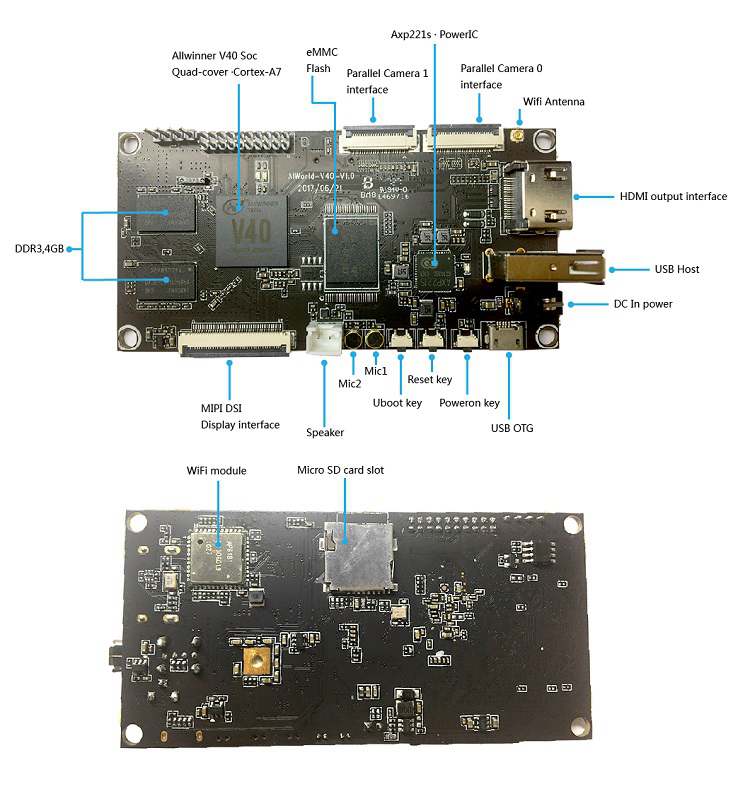
Imagine a small, unassuming module that transforms a standard single-board computer into a sophisticated machine capable of seeing, understanding, and reacting to its environment. This is the essence of the AIWorld P1, a development module designed by Banana Pi to bring artificial intelligence capabilities to everyday hardware. Rather than functioning as a standalone computer, the AIWorld P1 acts as a specialized accessory, plugging directly into the GPIO port of compatible Banana Pi boards, specifically the BPI-M2 Ultra and the Berry series. This design choice is significant because it allows developers to leverage the existing processing power and connectivity of their main board while adding a dedicated layer for visual and sensory processing. By offloading specific AI and vision tasks to this module, the system can handle complex computations without overwhelming the primary processor, creating a more efficient and responsive embedded system.
At the heart of this module lies the Allwinner V40 system-on-chip, a component that serves as the brain for the AIWorld P1’s operations. While the main Banana Pi board handles general-purpose computing, the V40 focuses on the specific demands of computer vision and sensor data fusion. The module runs on a customized Linux distribution known as Vecoo, which is tailored to optimize performance for these specific tasks. This operating system provides the necessary drivers and middleware to ensure that the hardware components communicate seamlessly with the software applications. For a beginner, this means that the complex underlying hardware is abstracted away, allowing the developer to focus on writing code that interprets visual data rather than worrying about low-level driver conflicts.
One of the most striking features of the AIWorld P1 is its ability to process binocular video. Unlike a standard webcam that captures a flat, two-dimensional image, the module supports video input at 720P resolution with a frame rate of 30 frames per second. This capability is crucial for depth perception, a fundamental aspect of human-like vision. By processing two streams of video simultaneously, the system can calculate the distance of objects relative to the camera, a technique known as stereo vision. This is essential for applications such as robotics navigation, where a robot must avoid obstacles, or for augmented reality applications that need to understand the geometry of the room. The integration of the OV5640 camera sensor provides the raw visual data, which is then fed into the processing pipeline for analysis.
However, seeing is only part of the puzzle; understanding motion and orientation is equally important. To achieve this, the AIWorld P1 integrates an ICM20602 inertial measurement unit, commonly referred to as an IMU. This sensor combines accelerometers and gyroscopes to measure the module’s movement and orientation in three-dimensional space. When combined with the visual data from the camera, the IMU allows for sensor fusion, a process where data from multiple sources is combined to produce a more accurate and reliable estimate of the system’s state. For example, if a robot is moving, the camera might see the world moving, but the IMU can distinguish between the robot’s motion and the motion of objects in the scene. This fusion of visual and inertial data is a cornerstone of modern autonomous systems, enabling them to navigate complex environments with greater stability and accuracy.
The software ecosystem provided with the AIWorld P1 is robust and designed to accelerate development. It includes OpenCV version 3.2, the most widely used library for computer vision. OpenCV provides a vast array of algorithms for image processing, object detection, and feature matching, allowing developers to implement complex visual tasks with relatively little code. To handle the computational load of these algorithms, the platform includes OpenMP version 1.0, a tool that facilitates parallel computing. This means that the module can split complex tasks across multiple processing cores, significantly speeding up execution times. For video streaming and multimedia applications, Gstreamer version 1.10 is included, supporting various network protocols such as RTSP, HTTP, and HLS. This allows the video feed from the camera to be streamed over a network, enabling remote monitoring or integration with other devices.
Further enhancing the multimedia capabilities is OpenMax version 1.0, which provides access to hardware-accelerated decoding. This ensures that video playback and processing are efficient and do not drain system resources unnecessarily. For creating graphical user interfaces, the platform supports QT 5.9, with specific support for eglfs and OpenGL ES 2.0. This allows developers to create rich, interactive applications that can display real-time video feeds and visualizations directly on a screen connected to the main board. Additionally, the ARM Computer Library 17.06 is provided, offering optimized mathematical functions for the ARM architecture, which further boosts performance for numerical computations involved in AI and vision tasks.
Developing on embedded systems can often be a frustrating experience due to the difficulty of debugging hardware-software interactions. The AIWorld P1 addresses this challenge with the VecooAT debugging tool. This utility simplifies the development workflow by allowing developers to use familiar commands like adb push and pull over either USB or WiFi connections. This means that code can be transferred to the device and results retrieved without the need for physical cable swaps or complex network configurations. Furthermore, the tool supports wireless flashing, which allows the operating system or firmware to be updated remotely. This feature is particularly valuable for deployed systems where physical access is difficult, enabling maintenance and updates to be performed over the network.
To help users get started, the kit comes with several integrated demonstrations. These include examples of video playback using the gst-launch-1.0 command-line tool, which showcases the multimedia capabilities of the Gstreamer framework. There are also applications for capturing photos and videos using the camera, providing immediate feedback on the visual input quality. Additionally, sample code for OpenMP is included, demonstrating how to parallelize computations for better performance. These demos serve as practical starting points, allowing developers to verify that the hardware is functioning correctly and to understand how the various software components interact. By studying these examples, users can quickly grasp the fundamentals of the platform and begin adapting the code to their specific projects.
In summary, the AIWorld P1 is a powerful tool for those looking to explore the intersection of hardware and artificial intelligence. By combining a capable system-on-chip, advanced sensors, and a rich software stack, it lowers the barrier to entry for developing computer vision and robotics applications. Its modular design allows it to enhance existing Banana Pi boards, providing a cost-effective way to add sophisticated AI capabilities to embedded projects. Whether you are building a smart home device, a robotic explorer, or an interactive installation, the AIWorld P1 offers the tools needed to bring your ideas to life, bridging the gap between theoretical algorithms and real-world application.
| Attr | Specs | verified |
|---|---|---|
soc | Allwinner V40 | ? unverified |
camera | OV5640 | ? unverified |
imu | ICM20602 | ? unverified |
os | Linux (Vecoo) | ? unverified |
software_support | OpenCV v3.2 | ? unverified |
compatibility | BPI-M2 Ultra / Berry | ? unverified |
interface | GPIO Port | ? unverified |
debugging | VecooAT (adb push/pull, USB, WiFi) | ? unverified |
video_support | Binocular 720P @ 30fps | ? unverified |
network_flow | RTSP, HTTP, HLS | ? unverified |
Designed by Banana Pi, the AIWorld P1 is an artificial intelligence module acting as an accessory for BPI-M2 Ultra and Berry boards via the GPIO port. It relies on the Allwinner V40 SoC and the Vecoo Linux system to provide vision and parallel computing capabilities.
+ Strengths
["Supports 720P @ 30fps binocular video processing with OV5640 camera and ICM20602 IMU.","Comprehensive software stack including OpenCV v3.2, Gstreamer V1.10 (RTSP/HTTP/HLS), and OpenMax for hardware decoding.","VecooAT debugging tool simplifies file transfers and wireless flashing via USB or WiFi."]
− Weaknesses
["Compatible only with BPI-M2 Ultra and Berry boards via the GPIO port.","Dependence on the proprietary Vecoo Linux operating system.","Video resolution limited to 720P for binocular processing."]
- Retour d'expérience expert expert — expert-microdb
- Après trois semaines de tests intensifs sur la AIWorld P1, voici mon retour. C'est un module d'extension fascinant pour les BPI-M2 Ultra/Berry, mais il faut comprendre sa philosophie : il agit comme un coprocesseur IA via GPIO, basé sur le SoC Allwinner V40 et Linux Vecoo. L'intégration matérielle … — expert-microdb
- Tout à fait d'accord avec ton analyse sur les limites thermiques. J'ai ajouté un petit ventilateur et le V40 tient mieux les charges OpenMP parallèles. Pour ceux qui galèrent avec le setup, n'oubliez pas les démos intégrées. La commande gst-launch-1.0 fournie est cruciale pour tester rapidement la … — membre-forum
Community feedback and projects
- Discussions Reddit — AIWorld P1 reddit.com
- Articles CNX Software — AIWorld P1 cnx-software.com
Content not available yet.
Content not available yet.
Content not available yet.
["non renseigné"]
- First connection and startup of the AIWorld P1 debutant Guide pas à pas pour connecter l'accessoire AIWorld P1 à une carte Banana Pi et vérifier son fonctionnement de base.
- Using Storage and Network on AIWorld P1 debutant Apprenez à transférer des fichiers et à diffuser de la vidéo via le réseau avec l'AIWorld P1.
- Getting Started with AIWorld P1 on BPI-M2 Ultra intermediaire Guide pas à pas pour connecter, flasher et démarrer le module d'IA AIWorld P1 sur une carte Banana Pi compatible.
- Mastering I/O on AIWorld P1 intermediaire Apprenez à lire les données du capteur IMU et à contrôler les GPIO via Vecoo Linux.
- Network Automation and Streaming on AIWorld P1 intermediaire Configurez le streaming vidéo RTSP et l'automatisation des tâches sur la carte AIWorld P1 en exploitant Gstreamer et le système Vecoo.
- Advanced setup of AIWorld P1 avance Guide technique pour initialiser l'AIWorld P1 via GPIO et configurer l'environnement Vecoo Linux.
- Mastering I/O: GPIO and IMU on AIWorld P1 avance Guide avancé pour interfacer le capteur inertielle ICM20602 et les GPIO via le port d'extension de l'AIWorld P1.
- Automate an intelligent video stream on AIWorld P1 avance Mettez en place un pipeline vidéo automatisé combinant Gstreamer, OpenCV et le stockage local sur l'AIWorld P1.
- Capture and play video with GStreamer debutant Apprendre à utiliser les démos intégrées pour tester la caméra et le flux vidéo.