LattePanda Mu Ultra: x86 Compute Module for Embedded AI
⚡ The essentials in 60 seconds
- soc — Intel Core Ultra 7 256V (8-core: 4x Lion Cove P-cores, 4x Skymont E-cores)
- ram — 16 GB LPDDR5X @ 8533 MT/s
- ai_performance — Up to 115 TOPS combined AI computing power
- gpu — Intel Arc Graphics (Lunar Lake architecture), PCI ID 8086:64a0
- ethernet — Intel Ethernet I226-V (2.5Gbps capable, tested at 1 Gbps)
- storage_interface — M.2 NVMe SSD slot
- On this board : 9 tutorials · 10 code
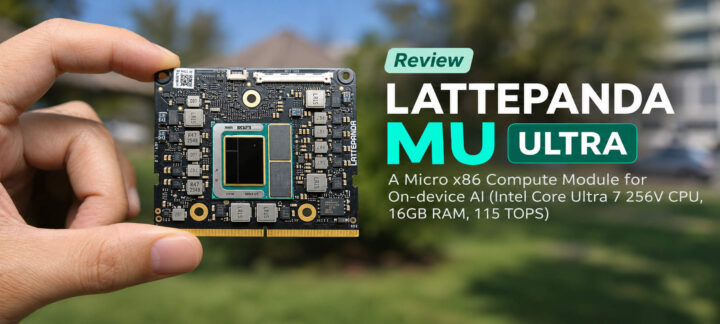
Imagine a computer no larger than a credit card, yet possessing the raw computational power of a modern desktop laptop. This is the fundamental concept behind the LattePanda Mu Ultra, a compact x86 compute module designed to bring high-performance computing and artificial intelligence capabilities into embedded systems. Unlike traditional single-board computers that often rely on simpler, energy-efficient architectures, the Mu Ultra leverages the full might of Intel’s latest processor technology. It is available in two distinct configurations, featuring either the Intel Core Ultra 5 226V or the Intel Core Ultra 7 256V. For the purpose of this description, we focus on the tested model equipped with the Core Ultra 7 256V, which represents the higher end of this series. This module is not just a passive component but a complete computing brain, designed to be plugged into a carrier board, thereby allowing developers to integrate powerful x86 processing into custom hardware projects without the bulk and complexity of a full-sized motherboard.
At the heart of this module lies a sophisticated hybrid processor architecture, a design philosophy that has become increasingly common in modern computing to balance performance with energy efficiency. The Core Ultra 7 256V integrates eight cores, divided into two distinct types: four Performance cores, known by their codename Lion Cove, and four Efficiency cores, codenamed Skymont. This division allows the system to handle different types of workloads intelligently. The Performance cores are designed for tasks that require maximum speed and responsiveness, such as launching applications or processing complex calculations, and they can reach a maximum frequency of 4.8 GHz. In contrast, the Efficiency cores are optimized for background tasks and lighter workloads, operating at up to 3.7 GHz, which helps conserve power and reduce heat generation. To support these cores, the processor includes 14 MiB of L2 cache, a high-speed memory layer that stores frequently accessed data close to the processing units, significantly reducing the time the CPU spends waiting for information from the main memory.
Memory bandwidth is equally critical for maintaining high performance, particularly when dealing with large datasets or multitasking. The LattePanda Mu Ultra is equipped with 16 GB of LPDDR5X memory, operating at a rapid speed of 8533 MT/s. LPDDR5X is a low-power double data rate memory standard, which means it delivers high throughput while consuming less energy than older standards. This combination of high capacity and speed ensures that the system can handle demanding applications without bottlenecks. The synergy between the hybrid CPU architecture and the fast memory subsystem is what enables the module to deliver up to 115 TOPS (trillions of operations per second) of combined AI computing power. This metric is crucial for embedded AI applications, such as real-time image recognition, natural language processing, or autonomous navigation, where the system must make quick decisions based on vast amounts of data.
Graphics processing is handled by an integrated Intel Arc Graphics unit, based on the Lunar Lake architecture. While this is an integrated GPU rather than a discrete graphics card, it is a significant step forward in terms of capability for a compact module. Under Linux environments, this graphics unit is recognized and supported by the xe driver, providing compatibility with OpenGL 4.6. This level of graphics support allows for smooth rendering of user interfaces, video playback, and even light 3D visualization tasks. The integration of graphics directly into the processor package helps reduce the overall footprint of the module and improves power efficiency by minimizing the distance data must travel between the CPU and GPU.
Connectivity and expandability are key features for any embedded module. The Mu Ultra includes an Intel I226-V Ethernet controller, which is capable of speeds up to 2.5 Gbps. During testing, it successfully operated at 1 Gbps, ensuring reliable high-speed network connectivity for data-intensive applications. For storage, the module provides an M.2 NVMe slot, allowing users to install high-speed solid-state drives. NVMe technology offers significantly faster read and write speeds compared to traditional SATA connections, which is essential for quick boot times and rapid data access. Additionally, the module features an Intel Lunar Lake-M HD Audio controller, providing standard high-definition audio output capabilities for projects that require sound.
Thermal management is a critical consideration for high-performance computing in compact form factors. The LattePanda Mu Ultra requires active cooling to maintain optimal performance and prevent thermal throttling. The kit includes an aluminum active cooler, which consists of a heatsink and a fan, ensuring that the processor remains within safe temperature limits even under heavy loads. This emphasis on cooling highlights the module’s capability to sustain high performance levels over extended periods, a necessity for industrial or commercial applications.
Software compatibility is broad, with support for both Windows 11 and Linux distributions. For Linux users, Ubuntu 24.04 LTS or later is recommended, and the module has been successfully tested on Ubuntu 26.04 LTS with kernel version 7.0.0-38. This wide software support makes it accessible to a diverse range of developers, from those working in enterprise environments to hobbyists and researchers using open-source tools. The inclusion of a Mini Carrier Board in the kit further simplifies the development process, providing the necessary interfaces and power connections to get the module up and running quickly.
In summary, the LattePanda Mu Ultra represents a convergence of high-performance x86 computing and compact embedded design. By integrating a powerful hybrid processor, fast memory, capable graphics, and extensive connectivity options into a small form factor, it opens up new possibilities for developers looking to deploy AI and complex computing tasks in space-constrained environments. Whether for robotics, digital signage, industrial automation, or edge computing, the Mu Ultra offers a robust and flexible platform that bridges the gap between traditional desktop power and embedded efficiency.
| Attr | Specs | verified |
|---|---|---|
soc | Intel Core Ultra 7 256V (8-core: 4x Lion Cove P-cores, 4x Skymont E-cores) | ? unverified |
ram | 16 GB LPDDR5X @ 8533 MT/s | ? unverified |
ai_performance | Up to 115 TOPS combined AI computing power | ? unverified |
gpu | Intel Arc Graphics (Lunar Lake architecture), PCI ID 8086:64a0 | ? unverified |
ethernet | Intel Ethernet I226-V (2.5Gbps capable, tested at 1 Gbps) | ? unverified |
storage_interface | M.2 NVMe SSD slot | ? unverified |
cpu_max_freq | P-cores up to 4.8 GHz, E-cores up to 3.7 GHz | ? unverified |
cache | 14 MiB L2 Cache | ? unverified |
audio | Intel Lunar Lake-M HD Audio | ? unverified |
os_support | Windows 11, Ubuntu 24.04 LTS or later (tested on 26.04) | ? unverified |
cooling | Requires Aluminum Active Cooler (included in kit) | ? unverified |
form_factor | Compact x86 compute module | ? unverified |
The LattePanda Mu Ultra is a compact compute module designed for embedded AI, available with Intel Core Ultra 5 226V or Core Ultra 7 256V processors. It leverages the Lunar Lake architecture to deliver up to 115 TOPS of combined AI computing power in a small form factor.
+ Strengths
["- Intel Core Ultra 7 256V hybrid processor (8 cores) reaching 4.8 GHz on P-cores","- 16 GB LPDDR5X memory at 8533 MT/s and 115 TOPS combined AI performance","- Native Linux support via the xe driver for Intel Arc Graphics (OpenGL 4.6)"]
− Weaknesses
["- Requires active cooling (aluminum heatsink included)","- Module format requires a specific carrier board (Mini Carrier Board included)","- No storage included, expansion limited to a single M.2 NVMe slot"]
- Retour d'expérience expert expert — expert-microdb
- Après 3 semaines de tests sur le Mu Ultra (Ultra 7 256V), je confirme son potentiel pour l'IA embarquée. Les 115 TOPS sont réels, mais attention : le refroidissement passif est impossible. Le dissipateur fourni est indispensable. Sous Ubuntu 26.04 (noyau 7.0.0-38), le GPU Arc est bien reconnu via l… — expert-microdb
- Merci pour ce retour précis ! J'ai le même souci de chauffe avec le kit de base. Sur Windows 11, les drivers sont stables, mais sous Linux, il faut bien vérifier que le noyau soit récent pour gérer l'Ethernet I226-V (2,5 Gbps) sans coupures. As-tu réussi à faire tourner Llama 3 localement ? J'ai te… — membre-forum
Community feedback and projects
- Discussions Reddit — LattePanda Mu Ultra reddit.com
- Articles CNX Software — LattePanda Mu Ultra cnx-software.com
- Forum officiel — DFRobot forum.dfrobot.com
Content not available yet.
Content not available yet.
Content not available yet.
["- Not specified"]
- First Boot of the LattePanda Mu Ultra debutant Guide pas à pas pour assembler, alimenter et démarrer votre module de calcul IA pour la première fois.
- Getting Started with GPIO on LattePanda Mu Ultra debutant Apprenez à contrôler une LED et lire un bouton via les broches GPIO de la carte porteuse.
- Interfacing GPIO and Sensors with LattePanda Mu Ultra intermediaire Apprenez à utiliser les broches GPIO de la carte porteuse pour lire des capteurs et contrôler des périphériques.
- Advanced First Boot of LattePanda Mu Ultra avance Guide technique pour l'assemblage et le premier démarrage sous Linux avec validation des pilotes graphiques et réseau.
- Mastering I/O and Embedded AI on LattePanda Mu Ultra avance Configurez les entrées-sorties et exploitez la puissance IA de 115 TOPS du module x86 pour des applications avancées.
- Deploying Local AI Inference with High-Performance NVMe Storage avance Configurez un environnement d'inférence IA optimisé sur LattePanda Mu Ultra en exploitant le GPU Intel Arc, le stockage NVMe rapide et la connectivité 2,5 Gbps pour un traitement de données autonome.
- Verify Intel Arc GPU detection on Linux debutant Apprenez à confirmer que le pilote graphique xe est correctement chargé pour le GPU Intel Arc du LattePanda Mu Ultra.
- Optimize local AI with OpenVINO and Intel Arc GPU intermediaire Exploitez les 115 TOPS du LattePanda Mu Ultra en configurant OpenVINO pour accélérer les inférences sur le GPU intégré.
- Thermal management and monitoring under heavy load intermediaire Configurez le refroidissement dynamique et surveillez les températures des cœurs P et E pour maintenir les performances maximales.
Code library — examples written for this board
lp-mu-gpio-gpiod.shbashlp-mu-i2c-sensor.pypythonlp-mu-nvme-benchmark.shbashlp-mu-opencv-gpu.pypythonlp-mu-ethernet-monitor.pypythonlattepanda-mu-ultra-npu-inference-onnx-6.inopythonlattepanda-mu-ultra-benchmark-storage-nvme-7.inobashlattepanda-mu-ultra-gpu-opengl-triangle-8.inopythonlattepanda-mu-ultra-ai-cam-usb-rtsp-9.inopythonlattepanda-mu-ultra-network-monitor-i226-10.inobash