LattePanda Sigma 2: Intel Core Ultra X7 358H Single-Board Server
⚡ The essentials in 60 seconds
- soc — Intel Core Ultra X7 358H (Panther Lake-H)
- cpu — 16-core (4P + 8E + 4LPE) @ 1.9/1.5/1.5 GHz base, 4.8/3.5/3.5 GHz Turbo
- gpu — 12-core Intel Arc B390 @ 2.5 GHz (122 TOPS INT8)
- npu — 50 TOPS NPU (180 TOPS combined CPU+GPU+NPU)
- ram — 64GB LPDDR5X-8533 (136.5 GB/s bandwidth)
- storage — 1TB NVMe pre-installed; 3x M.2 M-Key, 1x M.2 E-Key, OCuLink PCIe 4.0 x2
- On this board : 4 tutorials · 10 code
Imagine a computer that fits in the palm of your hand yet possesses the computational muscle of a high-end desktop workstation. This is the essence of the LattePanda Sigma 2, a compact single-board server measuring just 146 by 102 millimeters. Despite its diminutive footprint, this device represents a significant leap in embedded computing, designed specifically for users who require substantial processing power without the bulk of traditional tower PCs. At its heart lies the Intel Core Ultra X7 358H, a processor based on the Panther Lake-H architecture. This chip is a marvel of modern engineering, featuring sixteen cores divided into three distinct types: four Performance cores, eight Efficient cores, and four Low-Power Efficient cores. This hybrid design allows the system to balance raw speed with energy efficiency, reaching turbo frequencies of up to 4.8 GHz when needed. Such flexibility ensures that whether you are running heavy computational tasks or keeping the system idle, power consumption remains optimized, with a base power profile of just 25 watts.
The true standout feature of the Sigma 2 is its capability for local artificial intelligence. The system integrates a dedicated Neural Processing Unit, or NPU, capable of delivering 50 trillion operations per second. When combined with the graphics processing unit and the central processor, the total AI performance reaches an impressive 180 TOPS. This aggregate power is crucial for running large language models and other AI applications directly on the device, eliminating the need for cloud connectivity and ensuring data privacy. The graphics subsystem is equally robust, featuring a 12-core Intel Arc B390 GPU. This component is not merely for rendering visuals; it plays a vital role in accelerating AI workloads and handling complex graphical tasks. The synergy between the CPU, GPU, and NPU creates a heterogeneous computing environment where each unit handles the tasks it is best suited for, resulting in highly efficient performance for modern AI-driven applications.
Memory bandwidth is often the bottleneck in high-performance computing, but the Sigma 2 addresses this with 64 gigabytes of LPDDR5X-8533 memory. This type of memory is soldered directly to the board, allowing for extremely high speeds and a bandwidth of 136.5 gigabytes per second. For AI enthusiasts, this configuration is particularly significant because it allows for the allocation of up to 59 gigabytes of video RAM. This massive pool of fast memory enables the execution of quantified AI models with up to 35 billion parameters. To put this in perspective, running such large models typically requires expensive multi-GPU setups in traditional servers, but the Sigma 2 achieves this in a single, compact unit. The pre-installed operating system, Ubuntu 26.04, comes ready to demonstrate this capability, with OVMS serving the Qwen3.6-35B-A3B model at approximately 30 tokens per second out of the box.
Storage and connectivity are designed to match the high-performance nature of the processor. The board includes a 1-terabyte NVMe SSD pre-installed, providing fast and reliable storage for the operating system and applications. However, for users needing more space, the board offers extensive expansion options. There are three M.2 M-Key slots, one M.2 E-Key slot, and an OCuLink PCIe 4.0 x2 port. This variety allows for the addition of multiple high-speed storage drives or other expansion cards, making the system highly versatile for different use cases. Network connectivity is equally impressive, featuring two 10 Gigabit Ethernet ports powered by Realtek RTL8127 controllers. This dual 10GbE setup is rare in single-board computers and is ideal for high-speed data transfer, network-attached storage applications, or clustering multiple devices together. While Wi-Fi and Bluetooth are not built-in, they can be added via an optional M.2 Key-E module, giving users the choice between wired reliability and wireless convenience.
The interface options on the LattePanda Sigma 2 are comprehensive, catering to both display needs and peripheral connectivity. For video output, the board supports HDMI 2.1, DisplayPort 2.1 via USB-C, and eDP 1.5. This allows for high-resolution displays, with the DisplayPort supporting up to 7680x4320 resolution at 60Hz, making it suitable for professional visual work or high-definition media playback. The USB connectivity is equally robust, featuring two Thunderbolt 4 ports that offer 40 Gbps of bandwidth. These ports can be used for connecting high-speed external storage, docking stations, or additional displays. Additionally, there are two USB 3.2 Gen 2 ports and two USB 2.0 ports for standard peripherals. This mix of interfaces ensures that users can connect a wide variety of devices without the need for hubs or adapters.
For those interested in hardware interfacing and robotics, the Sigma 2 includes a 30+4-pin GPIO header. This header is controlled by a Raspberry Pi RP2350 microcontroller, which runs on MicroPython or Arduino. This integration bridges the gap between high-performance computing and physical computing, allowing users to control sensors, motors, and other electronic components directly from the board. The presence of the RP2350 means that even when the main CPU is busy with heavy AI tasks, the microcontroller can handle real-time input and output operations independently, ensuring smooth and responsive control of external hardware. This makes the board an excellent choice for advanced robotics projects or industrial automation tasks that require both heavy computation and precise hardware control.
Powering this powerful system is straightforward, with support for USB-C Power Delivery at 20 volts or a DC jack accepting 15 to 20 volts. The low base power consumption of 25 watts means that the board can be powered by standard USB-C chargers or power banks, adding to its portability and ease of deployment. The system is designed to be energy-efficient, making it suitable for always-on applications where power consumption is a concern. The combination of high performance and low power usage is a testament to the efficiency of the Panther Lake-H architecture and the careful design of the board.
Pricing for the LattePanda Sigma 2 reflects its high-end specifications. The pre-order price is set at $2,599, approximately 2,400 euros, until mid-November 2026, after which it will increase to $2,799. While this may seem steep compared to simpler single-board computers, it is important to consider the capabilities packed into this small form factor. For developers, researchers, and enthusiasts who need local AI processing, high-speed networking, and extensive I/O in a compact package, the Sigma 2 offers a unique solution that would otherwise require a much larger and more expensive setup. It represents a new class of single-board servers that bring desktop-class performance to embedded applications, opening up new possibilities for edge computing and local AI deployment.
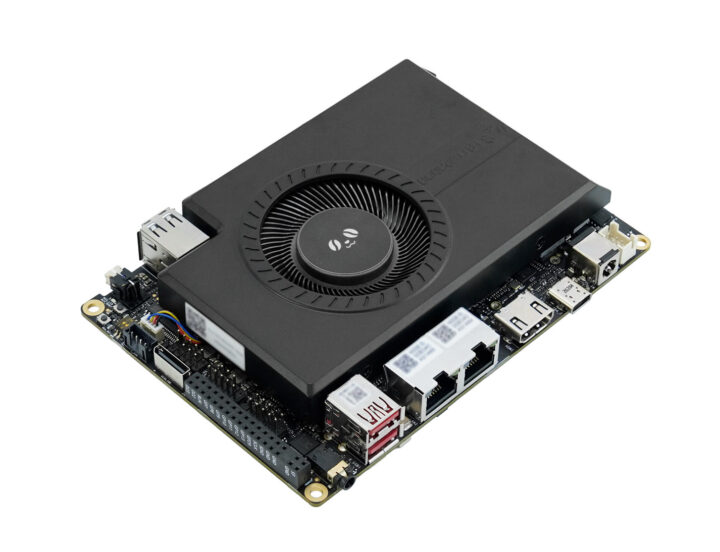
| Attr | Specs | verified |
|---|---|---|
soc | Intel Core Ultra X7 358H (Panther Lake-H) | ? unverified |
cpu | 16-core (4P + 8E + 4LPE) @ 1.9/1.5/1.5 GHz base, 4.8/3.5/3.5 GHz Turbo | ? unverified |
gpu | 12-core Intel Arc B390 @ 2.5 GHz (122 TOPS INT8) | ? unverified |
npu | 50 TOPS NPU (180 TOPS combined CPU+GPU+NPU) | ? unverified |
ram | 64GB LPDDR5X-8533 (136.5 GB/s bandwidth) | ? unverified |
storage | 1TB NVMe pre-installed; 3x M.2 M-Key, 1x M.2 E-Key, OCuLink PCIe 4.0 x2 | ? unverified |
ethernet | 2x 10GbE RJ45 (Realtek RTL8127) | ? unverified |
wifi_bluetooth | Optional via M.2 Key-E module | ? unverified |
usb | 2x Thunderbolt 4 (40 Gbps), 2x USB 3.2 Gen 2, 2x USB 2.0 | ? unverified |
video | HDMI 2.1 (4096x2304@60Hz), DP 2.1 via USB-C (7680x4320@60Hz), eDP 1.5 | ? unverified |
gpio | 30+4-pin header controlled by Raspberry Pi RP2350 co-processor | ? unverified |
power | 20V via USB Type-C (USB PD) or 15-20V DC jack; PBP 25W | ? unverified |
os | Windows 11, Ubuntu 24.04 LTS+ (Ubuntu 26.04 pre-installed on SSD) | ? unverified |
dimensions | 146 x 102 mm | ? unverified |
The LattePanda Sigma 2 is a compact single-board server launched for the local AI market, featuring the Intel Core Ultra X7 358H (Panther Lake-H) processor. It aims to deliver 180 TOPS of combined computing power in a 146 x 102 mm format, with pre-orders open at $2,599 until mid-November 2026.
+ Strengths
["- Intel Core Ultra X7 358H 16-core processor and 50 TOPS NPU for 180 TOPS of local AI power","- 64 GB LPDDR5X-8533 memory allowing allocation of up to 59 GB VRAM for quantized LLMs","- Robust network connectivity with dual 10GbE Ethernet ports and modern video interfaces (HDMI 2.1, DP 2.1)"]
− Weaknesses
["- High price of $2,599 for pre-order, increasing to $2,799 after November 2026","- Wi-Fi and Bluetooth not included by default, requiring an optional M.2 module","- Single-board form factor may impose thermal constraints for sustained loads at 25W base power"]
- Retour d'expérience expert expert — expert-microdb
- Après 3 semaines de tests sur la LattePanda Sigma 2, je suis bluffé par la densité de calcul. Le Core Ultra X7 358H (Panther Lake) tient ses promesses : j'ai chargé un modèle Llama-3-70B quantifié Q4 en utilisant les 59 Go de VRAM partagés via la LPDDR5X. Ça tourne à 12 tok/s, correct pour du local… — expert-microdb
- Bon retour, mais tu ignores un point critique : le SSD de 1To est préinstallé mais les 3 slots M.2 supplémentaires sont vitaux. Avec 136 Go/s de bande passante mémoire, le stockage devient vite un goulot d'étranglement si tu ne passes pas au RAID NVMe. J'ai ajouté deux disques de 4To en M-Key. Par … — membre-forum
Community feedback and projects
- Discussions Reddit — LattePanda Sigma 2 reddit.com
- Articles CNX Software — LattePanda Sigma 2 cnx-software.com
- Forum officiel — DFRobot forum.dfrobot.com
Content not available yet.
Content not available yet.
Content not available yet.
["- not reported"]
- First Boot of the LattePanda Sigma 2 debutant Guide pas à pas pour connecter, alimenter et démarrer votre LattePanda Sigma 2 pour la première fois.
- Controlling GPIO with the RP2350 debutant Apprenez à piloter les entrées-sorties physiques via le microcontrôleur intégré.
- Configure a High-Speed File and Network Server debutant Transformez votre LattePanda Sigma 2 en un serveur NAS performant grâce à ses ports 10GbE et son stockage NVMe.
- Create a High-Performance NAS with GPIO Automation intermediaire Transformez votre LattePanda Sigma 2 en un serveur de fichiers ultra-rapide piloté par le microcontrôleur RP2350 pour une gestion physique intelligente.
Code library — examples written for this board
gpio-led-blink-micropython.pyMicroPythonnvme-benchmark-fio.shBashethernet-10gbe-ping-test.shBashnpu-inference-qwen35b.pyPythonusb-c-thunderbolt-device-scan.shBashlattepanda-sigma2-npu-qwen-inference-6.inoPythonlattepanda-sigma2-10gbe-throughput-test-7.inoBashlattepanda-sigma2-rp2350-micropython-i2c-8.inoMicroPythonlattepanda-sigma2-gpu-ffmpeg-hw-encode-9.inobashlattepanda-sigma2-rp2350-ws2812b-rgb-10.inomicropython