Libre Computer Amlogic boards — libre-amlogic (flagship: Le Potato AML-S905X-CC)
⚡ The essentials in 60 seconds
- soc — Amlogic S905X (Meson GXL family), quad-core Arm Cortex-A53 (ARMv8-A, 64-bit) @ 1.5 GHz, with Amlogic Video Engine 10 VPU.
- gpu — Arm Mali-450 MP5 (penta-core, Utgard generation). Mainline 3D support is the open-source lima DRM driver, present in the kernel tree (drivers/gpu/drm/lima).
- ram — 1 GB or 2 GB DDR3 (v1); Sweet Potato v2 uses 2 GB DDR4 (CNX 2017 / CNX 2023).
- storage — microSD slot (UHS, SDR104-capable; mainline DTS: 4-bit bus, max-frequency = <50000000>, cap-sd-highspeed) + removable eMMC module socket (8-bit, HS200 in the mainline DTS: mmc-hs200-1_8v, 200 MHz; CNX advertises HS400 modules — see note). Sweet Potato v2 adds 16 MB SPI NOR with boot-select switch.
- networking — 10/100M Ethernet only (no WiFi, no Bluetooth onboard — a key cost-cut vs. Raspberry Pi). Sweet Potato v2 adds an optional PoE header (CNX 2023).
- usb — 4× USB 2.0 host ports (CNX 2017 spec list and the mainline U-Boot board doc both say 4×; v2 adds an extra USB 2.0 header).
- On this board : 9 tutorials · 10 code
The Libre Computer Le Potato, officially designated as the AML-S905X-CC, stands as a pivotal entry in the world of single-board computers, representing a strategic shift toward affordable, open-source-friendly hardware. Launched in 2017 through a successful Kickstarter campaign by Shenzhen Libre Technology Co., Ltd, this board was designed to offer a compelling alternative to the Raspberry Pi 3, particularly for users seeking a lower price point without sacrificing essential performance metrics. The original launch price of twenty-five dollars for the one-gigabyte model and thirty-five dollars for the two-gigabyte version was a direct challenge to the market, establishing the "Potato" moniker as community shorthand for budget-friendly ARM-based devices. While the board is part of a broader family of Amlogic-based products, including the newer Sweet Potato and the high-performance Alta, the Le Potato remains the flagship that defined the company’s identity and its commitment to mainline Linux support.
At the heart of the Le Potato lies the Amlogic S905X system-on-chip, a quad-core processor based on the Arm Cortex-A53 architecture. This means it utilizes four processing cores that are efficient and capable of handling 64-bit instructions, running at a clock speed of 1.5 gigahertz. For those unfamiliar with these terms, the clock speed indicates how many cycles the processor can execute per second, directly influencing how quickly tasks are completed. The chip is paired with either one or two gigabytes of DDR3 memory, depending on the specific variant purchased. Graphics are handled by an Arm Mali-450 MP5 GPU, a penta-core unit that, while not cutting-edge, is well-supported by the open-source Lima driver in the mainline Linux kernel. This commitment to open-source drivers is a defining feature of the board, allowing it to run standard Linux distributions without relying on proprietary, closed-source software blobs for basic functionality.
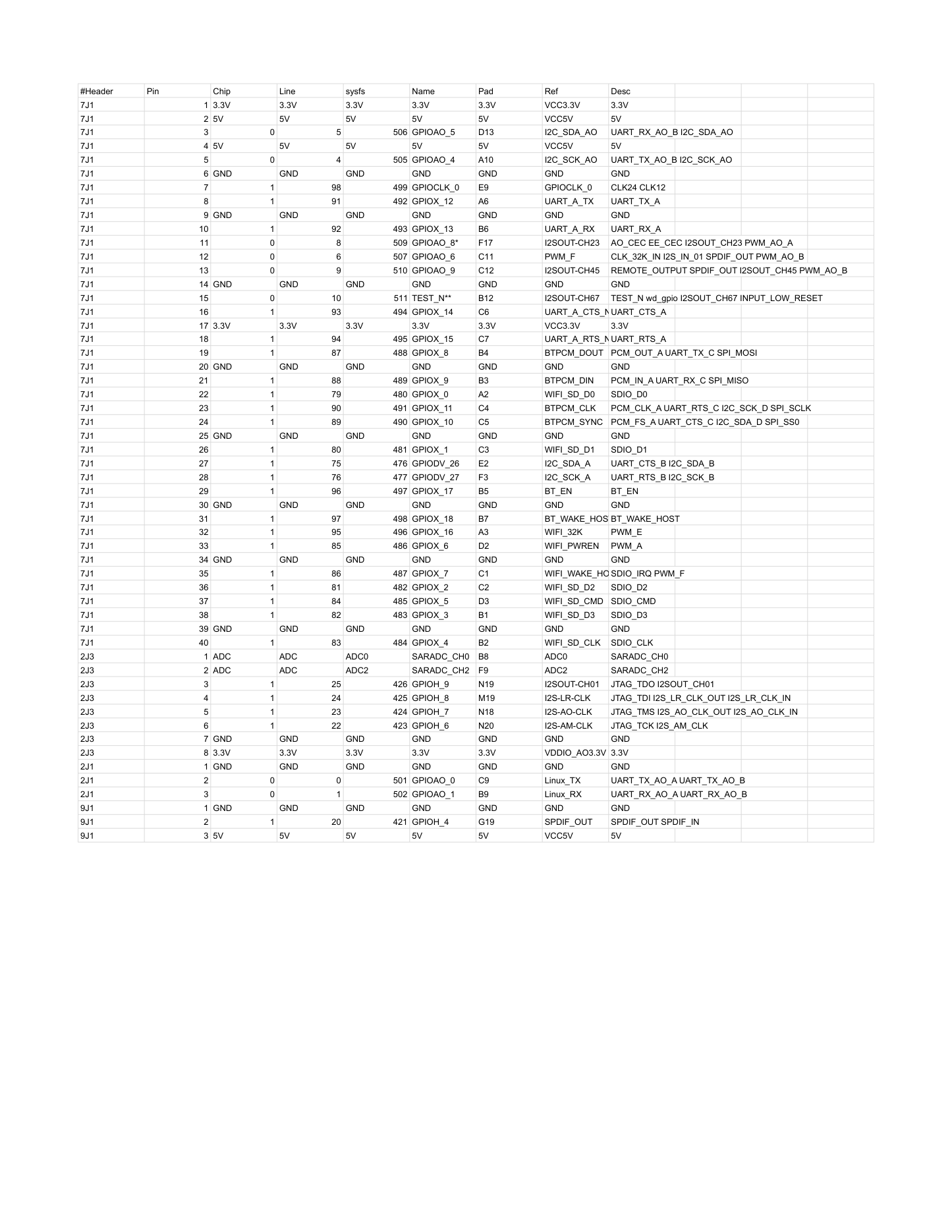
The physical design of the Le Potato is intentionally familiar to anyone who has used a Raspberry Pi. It adopts the same board layout and includes a forty-pin general-purpose input-output header that is mechanically compatible with Raspberry Pi accessories. This header provides access to various communication protocols such as I2C, SPI, UART, and PWM, allowing the board to interface with sensors, displays, and other electronic components. However, users must be aware that the logic level for these pins is 3.3 volts, and they are not tolerant of 5-volt signals, a critical distinction when connecting external hardware. Unlike the Raspberry Pi, the Le Potato does not support the wiringPi library, and the manufacturer explicitly recommends using libgpiod for GPIO control. This requires a slight learning curve for those accustomed to Raspberry Pi tutorials, but it aligns the board with modern, standardized Linux GPIO practices.
Connectivity options on the Le Potato reflect its budget-oriented positioning. It features four USB 2.0 host ports, which are sufficient for connecting keyboards, mice, and storage devices, but it lacks the faster USB 3.0 standard found on more expensive boards. Networking is provided by a 10/100 megabit Ethernet port, which is adequate for many home server or media center applications but may be a bottleneck for high-bandwidth tasks. Notably, there is no onboard Wi-Fi or Bluetooth, meaning users must rely on external USB adapters if wireless connectivity is required. For video output, the board supports HDMI 2.0, capable of driving displays at 4K resolution at 60 hertz, alongside a legacy composite video jack on the original v1 model. Audio is handled via HDMI, a 3.5-millimeter jack, and dedicated SPDIF and I2S headers for higher-quality audio setups.
Storage flexibility is another strong point. The board includes a microSD card slot for primary boot and storage, but it also features a socket for removable eMMC modules. These modules offer significantly faster read and write speeds compared to standard SD cards, making them ideal for operating systems and applications that require frequent disk access. However, it is important to note that the eMMC module does not have an independent boot path out of the box; it must be flashed from a running system using tools provided by Libre Computer. This design choice simplifies the hardware but adds a step to the initial setup process.
Software support for the Le Potato is robust, with a strong emphasis on mainline Linux. The board has been supported in the official Linux kernel since version 4.13, ensuring that it receives regular updates and security patches. Popular operating systems include Debian, Ubuntu, and specialized distributions like LibreELEC and CoreELEC for media center use. Armbian, a popular community-driven Linux distribution for ARM boards, also provides dedicated images for the Le Potato, offering a streamlined installation experience. The boot process involves a proprietary chain from Amlogic, but Libre Computer provides tools and documentation to manage this, including the EtherealOS installer, which allows users to download and install operating systems directly from the internet.
Despite its strengths, the Le Potato has some known limitations. The Amlogic S905X chip is known to run hot under load, and users are advised to attach a heatsink to prevent thermal throttling. Power supply quality is also critical; marginal power supplies can cause silent hangs or reboots, a common issue with micro-USB powered boards. Additionally, hardware video decoding on mainline Linux images may not be fully optimized, often requiring software decoding for high-resolution content, although media-specific distributions like CoreELEC include their own optimized stacks. Users should also be aware that the board does not expose a unique serial number in software, which can be a consideration for fleet management or licensing purposes.
In summary, the Libre Computer Le Potato is a versatile and cost-effective single-board computer that bridges the gap between hobbyist experimentation and practical deployment. Its mainline Linux support, Raspberry Pi-compatible form factor, and flexible storage options make it a compelling choice for developers and enthusiasts. While it lacks some modern conveniences like Wi-Fi and USB 3.0, its price point and open-source ethos make it a valuable tool for learning, prototyping, and building custom electronic projects. Whether used as a media center, a home server, or a platform for robotics, the Le Potato remains a testament to the power of open hardware and community-driven development.
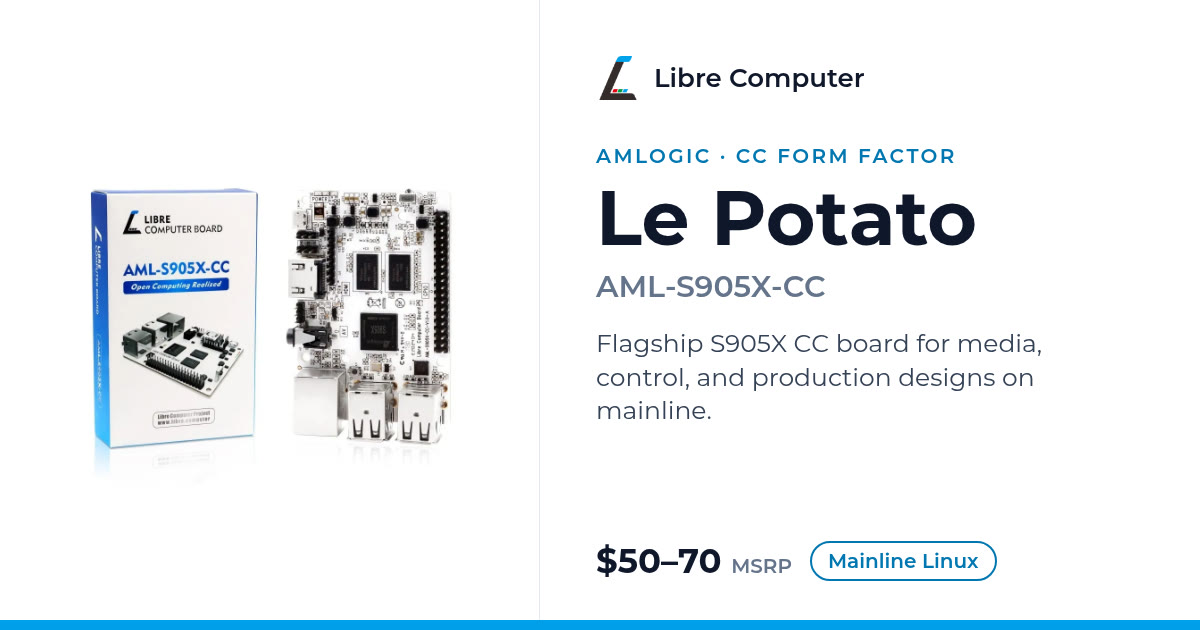
Pinout diagram
| Attr | Specs | verified |
|---|---|---|
soc | Amlogic S905X (Meson GXL family), quad-core Arm Cortex-A53 (ARMv8-A, 64-bit) @ 1.5 GHz, with Amlogic Video Engine 10 VPU. | ? unverified |
gpu | Arm Mali-450 MP5 (penta-core, Utgard generation). Mainline 3D support is the open-source lima DRM driver, present in the kernel tree (drivers/gpu/drm/lima). | ✔ |
ram | 1 GB or 2 GB DDR3 (v1); Sweet Potato v2 uses 2 GB DDR4 (CNX 2017 / CNX 2023). | ? unverified |
storage | microSD slot (UHS, SDR104-capable; mainline DTS: 4-bit bus, max-frequency = <50000000>, cap-sd-highspeed) + removable eMMC module socket (8-bit, HS200 in the mainline DTS: mmc-hs200-1_8v, 200 MHz; CNX advertises HS400 modules — see note). Sweet Potato v2 adds 16 MB SPI NOR with boot-select switch. | ? unverified |
networking | 10/100M Ethernet only (no WiFi, no Bluetooth onboard — a key cost-cut vs. Raspberry Pi). Sweet Potato v2 adds an optional PoE header (CNX 2023). | ? unverified |
usb | 4× USB 2.0 host ports (CNX 2017 spec list and the mainline U-Boot board doc both say 4×; v2 adds an extra USB 2.0 header). | ? unverified |
video_out | HDMI 2.0 (4K/60 per U-Boot docs); v1 also has a 3.5 mm TRRS AV jack with CVBS (480i/576i) — removed on v2. CVBS and HDMI are described in the DTS (composite-video-connector, hdmi-connector). | ? unverified |
audio | HDMI audio, AV-jack stereo, SPDIF header, I2S header; onboard DIO2133 analog amplifier for the headphone jack (explicit DTS node dio2133: analog-amplifier). | ? unverified |
gpio_expansion | - 40-pin Raspberry-Pi-compatible header ("7J1" in the schematic; every line is named 7J1 Header PinN in the mainline DTS) with I2C, SPI, PWM, UART, 5 V, 3.3 V. - GPIO banks GPIOAO / GPIOH / GPIOE / GPIODV / GPIOX (bank names visible in the DTS gpio-line-names). Logic level 3.3 V; no exposed pin is 5 V-tolerant — official answer: "No exposed pins are 5V tolerant on any SBC. Do not put 5V on GPIO pins." (hub.libre.computer topic 3242). - Separate ADC + I2S header (CNX 2017); the GX SoC's SARADC is exposed via the mainline meson-saradc IIO driver. - IR receiver onboard; jumper selects HDMI CEC vs GPIO on one header pin (CNX 2017). - LEDs: green system-status LED (DTS: panic-indicator) and blue LED (DTS default trigger: heartbeat) — DTS. - Debug console: UART on the header, stdout-path = "serial0:115200n8" in the DTS; Armbian uses SERIALCON="ttyAML0" (lepotato.conf). | ✔ |
power | 5 V via micro-USB OTG port (v1; the official kit shipped a 5 V/2.5 A PSU — CNX unboxing); Sweet Potato v2 uses USB-C 5 V/3 A (CNX 2023). Power can also be fed via the header (community practice, hub "Powering the Le Potato" thread). | ✔ |
form_factor | Raspberry Pi 3 board layout/size (CNX 2017). | ? unverified |
- Manufacturer: Shenzhen Libre Technology Co., Ltd, trading as Libre Computer (campaign managed with LoveRPi / Da Xue) — CNX Software, 2017-06-30.
- Year introduced: Kickstarter launched June 2017, delivery from August 2017 (CNX, 2017-06-30); Armbian's board config records INTRODUCED="2017" (armbian/build lepotato.conf).
- Launch price: US$25 (1 GB) / US$35 (2 GB) on Kickstarter — the aggressive price vs. the Raspberry Pi 3 was the whole point (CNX, 2017-06-30); retail settled at ~US$35 for the 2 GB model, the same price as the Sweet Potato v2 in 2023 (CNX, 2023-09-08).
- Status: Active / still supported as of late 2025: Libre Computer's own September 2025 EtherealOS announcement lists the AML-S905X-CC among supported boards (CNX, 2025-09-04), Armbian still publishes lepotato images (archive last refreshed 2026-08-12, ), and the vendor wrote in September 2025 that "Armbian has images specifically for Le Potato" (hub.libre.computer topic 4979).
- Variants (Amlogic family, model strings verified from mainline kernel DTS): - AML-S905X-CC "Le Potato" (v1, 2017) — model = "Libre Computer AML-S905X-CC" (meson-gxl-s905x-libretech-cc.dts) - AML-S905X-CC-V2 "Sweet Potato" (design 2020, sold 2023; DDR4, 16 MB SPI NOR, USB-C power, optional PoE, no AV jack) — model = "Libre Computer AML-S905X-CC V2" (meson-gxl-s905x-libretech-cc-v2.dts), CNX 2023 - AML-S805X-AC (entry-level, Amlogic S805X) — model = "Libre Computer AML-S805X-AC" (meson-gxl-s805x-libretech-ac.dts) - AML-S905D3-CC "La Frite" → "Solitude" (Cottonwood family, 2023) — model = "Libre Computer AML-S905D3-CC Solitude" (meson-sm1-s905d3-libretech-cc.dts), official hub announcement, 2023-09-13 - AML-A311D-CC "Renegade Elite" → "Alta" (Cottonwood family, 2023) — model = "Libre Computer AML-A311D-CC Alta" (meson-g12b-a311d-libretech-cc.dts), official hub announcement, 2023-09-14 - AML-S905D-PC / AML-S912-PC — Amlogic-based mini-PCs (meson-gxl-s905d-libretech-pc.dts, meson-gxm-s912-libretech-pc.dts) - RAM variants of Le Potato: 1 GB or 2 GB DDR3 (CNX 2017); the 2 GB part is what the mainline board DTS describes (reg = <0x0 0x0 0x0 0x80000000> = 2 GiB).
+ Strengths
- Price/performance aggressiveness: $25–35 at launch vs. $35 Pi 3, with 4K/60 HDMI 2.0 and a 1.5 GHz A53 quad — the reason "Potato" became community shorthand for budget ARM SBCs (the official name is "Le Potato"; the community just drops the "Le"). The whole product line keeps the same under-$35–50 posture (Sweet Potato $35, Solitude "<$50" per hub 2900).
- Mainline-first vendor: in-tree DTS since the Linux 4.13 era, mainline U-Boot, distro-maintained kernels; the model/compatible strings (libretech,aml-s905x-cc) are stable ABI in torvalds/linux.
- Raspberry Pi 3 form factor + 40-pin Pi header — cases/HAT-adjacent hardware mostly carry over mechanically, and the pin header is software-standard (libgpiod).
- Removable eMMC module socket (8-bit, HS200/HS400 modules) — genuinely fast removable storage at a time when SD was the only option on rivals (CNX 2017, DTS).
- Multimedia extras for the price: DIO2133 headphone amp, SPDIF + I2S headers, CVBS out (v1), IR receiver, HDMI-CEC-capable pin.
- Family breadth (Amlogic): S805X (AML-S805X-AC) → S905X (Le/Sweet Potato) → S905D3 (Solitude) → A311D (Alta, with a Verisilicon VIP-Nano NPU, "5 TOPS+", though toolchains are proprietary — hub topic 3538). The 2023 "Cottonwood" family name is official (Alta/Solitude posts, hub 2905) and has a shared kernel include (meson-libretech-cottonwood.dtsi).
- Standardized boot: UEFI/EBBR support means generic ARM64 PC-style images can boot; LOST/EtherealOS gives "download an OS from the Internet" UX similar to Khadas OOWOW / Radxa ROOBI (CNX 2023, CNX 2025).
- *What it is not:* no WiFi/BT, no USB3, no GbE, no PoE (v1), no M.2/PCIe — the price is paid in I/O, not in SoC.
− Weaknesses
- Marginal power supplies cause silent hangs/reboots. Official diagnosis: "Hanging without an error message is usually a power issue"; the same thread documents lockups under stress-ng, hot SoC, and advice to scope the 5 V rail (hub topic 2188); dedicated thread "Powering the Le Potato". Micro-USB connectors + thin cables are the usual culprit — prefer short quality cables or header power.
- Boot-failure reports are the most common support topic: "Le Potato Boot Failure (Reboot Loop)", "No boot — red + blue lights only", "Two S905X-CC units both showing only red and blue light", "AML-S905x-CC (Le Potato) fails to boot" (hub topic list; long troubleshooting thread: hub topic 46). Causes in-thread: bad SD cards, marginal PSU, wrong image/bootloader combination.
- No wiringPi, and don't ask. Official pinned policy: Raspberry Pi GPIO libraries are "proprietary… not well designed", will not be ported; use libgpiod; the deprecated sysfs GPIO interface is discouraged (hub topic 601). Expect a learning curve coming from RPi tutorials.
- gpiod Python package conflicts: module 'gpiod' has no attribute 'Chip' — pip-installed gpiod collides with the distro python3-libgpiod; uninstall the pip one (official troubleshooting in hub topic 601).
- I2C is not enabled by default on the 40-pin header; enable the DT overlay first (official how-to: "How to Enable I2C on AML-S905X-CC Le Potato", hub search); CircuitPython users must pass the I2C bus explicitly (hub topic 286).
- SoC runs hot bare. Users report the package "nuclear hot" without a heatsink; boards ship without one (hub topic 2188).
- Legacy vs mainline boot incompatibility: old Amlogic 3.14/4.9 "box" images and modern mainline images cannot be updated in place; installtointernal-style scripts break mainline boot (LibreELEC Amlogic wiki).
- HDMI quirks: "No video after login" reports and overscan adjustment questions (hub topics); EDID-related screen jitter with small panels (hub topic 800).
- No unique serial number readable in software (users wanting Pi-style CPUID are out of luck) (hub topic 492).
- eMMC boot requires flashing from a running system (no ROM boot from eMMC out of the box; see LEFT tool in §3).
- Hardware video decode on mainline:
- eMMC speed claim mismatch: CNX advertises HS400 modules, but the mainline DTS configures HS200 (mmc-hs200-1_8v, 200 MHz). Real-world eMMC speed depends on the kernel path used.
- Retour d'expérience expert expert — expert-pi-like
- Bonjour à tous. Je reviens vers vous avec un retour d'expérience sur la Le Potato (AML-S905X-CC). C'est une carte intéressante pour son prix, mais il y a des pièges classiques. Le plus gros souci reste l'alimentation : si vous avez des redémarrages silencieux ou des freezes sous charge, c'est presq… — expert-pi-like
- Merci pour ces infos. J'ai justement un problème de boot avec ma Le Potato. J'ai les lumières rouges et bleues mais rien à l'écran, même après avoir changé de carte SD. J'ai lu que c'était un souci courant. Est-ce que ça peut venir du fait que j'ai essayé une image 'box' Android récente alors que j… — maker-debutant-01
- Salut maker-debutant-01. Oui, mélanger les images legacy (type Android/Amlogic 3.14/4.9) avec les images mainline est une mauvaise idée. Les anciens scripts 'installtointernal' cassent le boot modern. Tu ne peux pas mettre à jour une image legacy vers mainline en place. Tu dois flasher une image co… — linux-tinker
Community feedback and projects
- Solution: HDMI not displaying on Le Potato after initial boot and setup forum.armbian.com
- Le Potato and Armbian Home Assistant 26.2.1 forum.armbian.com
- Amlogic S905X -- Cannot install Armbian to internal eMMC forum.armbian.com
- Le Potato Development Board Review - Part 1: Hardware and Accessories www.cnx-software.com
Content not available yet.
- Product page
- t/601
- t/812
- t/46
- Official forum ("Libre Computer Hin")
- meson-gxl-s905x-libretech-cc.dts
- meson-gxl-s905x-libretech-cc-v2.dts
- meson-libretech-cottonwood.dtsi
- U-Boot board doc
- board config
- image archive
- docs
- Vendor GitHub org
- hub search
- launch/crowdfunding 2017
- Sweet Potato 2023
- EtherealOS 2025
- mainline Ubuntu 2022
- LibreELEC Amlogic wiki
- lima GPU driver (mainline)
- Marginal power supplies cause silent hangs/reboots. Official diagnosis: "Hanging without an error message is usually a power issue"; the same thread documents lockups under stress-ng, hot SoC, and advice to scope the 5 V rail (hub topic 2188); dedicated thread "Powering the Le Potato". Micro-USB connectors + thin cables are the usual culprit — prefer short quality cables or header power.
- Boot-failure reports are the most common support topic: "Le Potato Boot Failure (Reboot Loop)", "No boot — red + blue lights only", "Two S905X-CC units both showing only red and blue light", "AML-S905x-CC (Le Potato) fails to boot" (hub topic list; long troubleshooting thread: hub topic 46). Causes in-thread: bad SD cards, marginal PSU, wrong image/bootloader combination.
- No wiringPi, and don't ask. Official pinned policy: Raspberry Pi GPIO libraries are "proprietary… not well designed", will not be ported; use libgpiod; the deprecated sysfs GPIO interface is discouraged (hub topic 601). Expect a learning curve coming from RPi tutorials.
- gpiod Python package conflicts: module 'gpiod' has no attribute 'Chip' — pip-installed gpiod collides with the distro python3-libgpiod; uninstall the pip one (official troubleshooting in hub topic 601).
- I2C is not enabled by default on the 40-pin header; enable the DT overlay first (official how-to: "How to Enable I2C on AML-S905X-CC Le Potato", hub search); CircuitPython users must pass the I2C bus explicitly (hub topic 286).
- SoC runs hot bare. Users report the package "nuclear hot" without a heatsink; boards ship without one (hub topic 2188).
- Legacy vs mainline boot incompatibility: old Amlogic 3.14/4.9 "box" images and modern mainline images cannot be updated in place; installtointernal-style scripts break mainline boot (LibreELEC Amlogic wiki).
- HDMI quirks: "No video after login" reports and overscan adjustment questions (hub topics); EDID-related screen jitter with small panels (hub topic 800).
- No unique serial number readable in software (users wanting Pi-style CPUID are out of luck) (hub topic 492).
- eMMC boot requires flashing from a running system (no ROM boot from eMMC out of the box; see LEFT tool in §3).
- Hardware video decode on mainline:
- eMMC speed claim mismatch: CNX advertises HS400 modules, but the mainline DTS configures HS200 (mmc-hs200-1_8v, 200 MHz). Real-world eMMC speed depends on the kernel path used.
- Faire clignoter une LED en C avec libgpiod sur Le Potato debutant Schéma : IMG-libre-amlogic-debutant-1-libre-amlogic-debutant-clignotement-led-c.svg — Le Potato AML-S905X-CC, broche 3 du connecteur 40 broches (GPIOAO_5) vers LED et résistance 330 Ω puis masse.
- Lire un bouton poussoir avec libgpiod (pull-up interne) debutant Schéma : IMG-libre-amlogic-debutant-2-libre-amlogic-debutant-bouton-libgpiod.svg — Bouton entre la broche 11 (GPIOX_3) et la masse sur Le Potato, pull-up interne activé par libgpiod.
- GPIO en Python avec python3-libgpiod sur Le Potato debutant Schéma : IMG-libre-amlogic-debutant-3-libre-amlogic-debutant-python-gpiod.svg — Même montage LED que le tuto C (broche 3, GPIOAO_5) piloté cette fois par un script Python via le module gpiod.
- Fondu LED progressif avec PWM sous sysfs (meson) intermediaire Schéma : IMG-libre-amlogic-intermediaire-1-libre-amlogic-intermediaire-pwm-fondu-led.svg — LED sur une broche PWM du connecteur 40 broches du Le Potato via résistance, fondu piloté par /sys/class/pwm après activation de l'overlay.
- Capteur BME280 (I2C) sur Le Potato : overlay et lecture intermediaire Schéma : IMG-libre-amlogic-intermediaire-2-libre-amlogic-intermediaire-i2c-bme280.svg — BME280 câblé en I2C (SDA/SCL 3,3 V) sur le connecteur 40 broches du Le Potato après activation de l'overlay I2C.
- Console série (ttyAML0) et SSH sur Le Potato intermediaire Schéma : IMG-libre-amlogic-intermediaire-3-libre-amlogic-intermediaire-ssh-console-serie.svg — Câble USB-série relié aux broches TX/RX/GND du connecteur 40 broches du Le Potato (115200 8N1) et PC connecté en SSH sur le port Ethernet 10/100.
- Boot SD/eMMC et récupération (pyamlboot) sur Amlogic S905X avance Schéma : IMG-libre-amlogic-avance-1-libre-amlogic-avance-boot-sd-usb-recovery.svg — Chaîne de boot du Le Potato : microSD (U-Boot à l'offset 8 Ko) prioritaire sur l'eMMC, puis récupération USB via le bootrom Amlogic et pyamlboot.
- GPU Mali-450 (lima) et vidéo sur Le Potato : ce qui marche vraiment avance Schéma : IMG-libre-amlogic-avance-2-libre-amlogic-avance-acceleration-video-gpu.svg — Le Potato AML-S905X-CC : Mali-450 MP5 accéléré par le pilote mainline lima (OpenGL ES 2 via /dev/dri), décodage vidéo matériel non garanti sous mainline (décodeur logiciel à prévoir).
- Overlays device tree sur Le Potato : activer I2C, PWM, SPI avance Schéma : IMG-libre-amlogic-avance-3-libre-amlogic-avance-overlays-device-tree.svg — Activation d'overlays device tree sur Le Potato : armbianEnv.txt et armbian-config injectent des overlays meson-gxl (I2C/PWM/SPI) dans le device tree mainline meson-gxl-s905x-libretech-cc.
Code library — examples written for this board
clignotante.pyPythonbouton-gpio.pyPythoncapteur-i2c.shBashsurveillance-temperature.shBashcapteur-dht11.pyPythonservo-pwm-sysfs.shBashserveur-web-capteur.pyPythonreseau-ethernet.shBashjournal-cron.shBashveilleur-systemd.pyPython
Examples and repos found online
- libre-computer-project/libretech-linux github.com
- libre-computer-project/libretech-wiring-tool github.com
- libre-computer-project/pyamlboot github.com
- ppaluchowski64/LibreConnect github.com
- libre-computer-project/libretech-overlays github.com