M5Stack ToughC5 Weatherproof IoT Dev Kit (ESP32-C5)
⚡ The essentials in 60 seconds
- soc — ESP32-C5HR8 RISC-V 32-bit single-core, up to 240MHz
- ram — 8MB PSRAM (Octal)
- storage — 16MB Flash, microSD card slot
- wifi_bluetooth — 2.4 & 5 GHz Dual-Band Wi-Fi 6, BLE 5, IEEE 802.15.4 (Zigbee, Thread)
- video — 2.0" LCD Capacitive Touch Screen, 320x240, ILI9342C IPS, 853nit
- usb — 1x USB Type-C (Debugging/Program Download)
- On this board : 9 tutorials · 10 code
Imagine a small, rugged box designed to live outdoors, exposed to the elements, yet capable of making intelligent decisions and communicating with the wider digital world. This is the M5Stack ToughC5, an IoT development kit built around the ESP32-C5HR8 module. To understand what makes this device special, we must first look at its brain. Unlike many microcontrollers that rely on older architectures, the ToughC5 uses a RISC-V 32-bit single-core processor. For those unfamiliar with the term, RISC-V is an open standard instruction set architecture, meaning it is not owned by a single corporation, fostering a more open ecosystem of software and hardware development. This processor runs at speeds up to 240 MHz, providing ample processing power for most Internet of Things applications, from reading sensors to controlling actuators. It is supported by 16 MB of Flash memory, which serves as the long-term storage for your program code, and 8 MB of Octal PSRAM. PSRAM, or Pseudo Static Random Access Memory, is a type of fast, volatile memory that allows the device to handle larger datasets and more complex user interfaces than standard RAM would permit, without the high cost or power consumption of traditional SRAM.
One of the most striking features of the ToughC5 is its connectivity. In the world of IoT, communication is key, and this board is a true multi-protocol hub. It supports Wi-Fi 6, the latest generation of wireless networking, operating on both 2.4 GHz and 5 GHz bands. Wi-Fi 6 offers better performance in crowded environments and improved power efficiency compared to older standards. But the ToughC5 goes further by also integrating Bluetooth Low Energy 5 and IEEE 802.15.4, which is the underlying standard for popular mesh networking protocols like Zigbee and Thread. This means a single device can potentially talk to a wide variety of other smart devices, whether they are using Wi-Fi, Bluetooth, or low-power mesh networks. The antennas for these signals are carefully designed as FPC antennas, compact and efficient, ensuring reliable signal transmission even within the sealed housing.
A significant challenge in IoT development is often the user interface. How do you interact with a device that might be mounted on a wall or placed in a garden? The ToughC5 solves this with a 2.0-inch color LCD touchscreen. This is not just any screen; it is a capacitive touch panel, offering a smooth, smartphone-like interaction experience. The display uses an IPS ILI9342C panel, which provides wide viewing angles and accurate colors, with a resolution of 320x240 pixels. Crucially for outdoor use, it boasts a brightness of 853 nits, making it readable even in direct sunlight. For audio feedback, a passive buzzer is included, allowing the device to emit beeps or simple tones to alert the user or indicate status changes.
Power management is another critical aspect of any battery-powered or remote device. The ToughC5 is designed for flexibility, supporting multiple power sources. You can power it via USB Type-C at 5V, which is convenient for development and testing. However, for field deployment, it can accept a wider voltage range of 6-24V through its RS485 interface, or run on a standard 3.7V Li-ion battery. This versatility is managed by dedicated power management chips, the M5PM1 and M5IOE1, which efficiently handle power distribution and charging. The board also features a Real-Time Clock (RTC) module, the RX8130CE, backed by a CR2032 coin cell battery. This ensures that the device keeps accurate time even when the main power is disconnected, which is essential for logging data or scheduling tasks. In terms of energy efficiency, the device is remarkably frugal, consuming only 10.41 microamps in shutdown mode, allowing it to run for extended periods on battery power.
The physical design of the ToughC5 reflects its intended use case. The housing is made from PC+ABS plastic, treated with anti-UV powder to prevent degradation from sunlight exposure. It is rated for waterproof protection against weather elements, though it is important to note that it is not designed for immersion in water. The compact dimensions of 75.9 x 58.0 x 42.5 mm and a weight of 119 grams make it easy to mount in various locations. For connecting external sensors and actuators, the board provides four HY2.0-4P connectors, which can be configured for RS485, I2C, GPIO, or UART communication. These small, robust connectors are ideal for field environments. Additionally, two M12 cable routing holes allow for secure, strain-relieved cable entry, further enhancing the durability of the installation.
In summary, the M5Stack ToughC5 is a comprehensive solution for developers looking to create robust, outdoor IoT applications. By combining a modern RISC-V processor, advanced multi-protocol connectivity, a bright and interactive display, and flexible power options in a weather-resistant package, it lowers the barrier to entry for building complex, connected devices. Whether you are monitoring environmental conditions, controlling industrial equipment, or creating smart agricultural systems, the ToughC5 provides the hardware foundation needed to bring your ideas to life in the real world. Its design emphasizes ease of use while maintaining the ruggedness required for professional deployments, making it a versatile tool for both hobbyists and engineers.
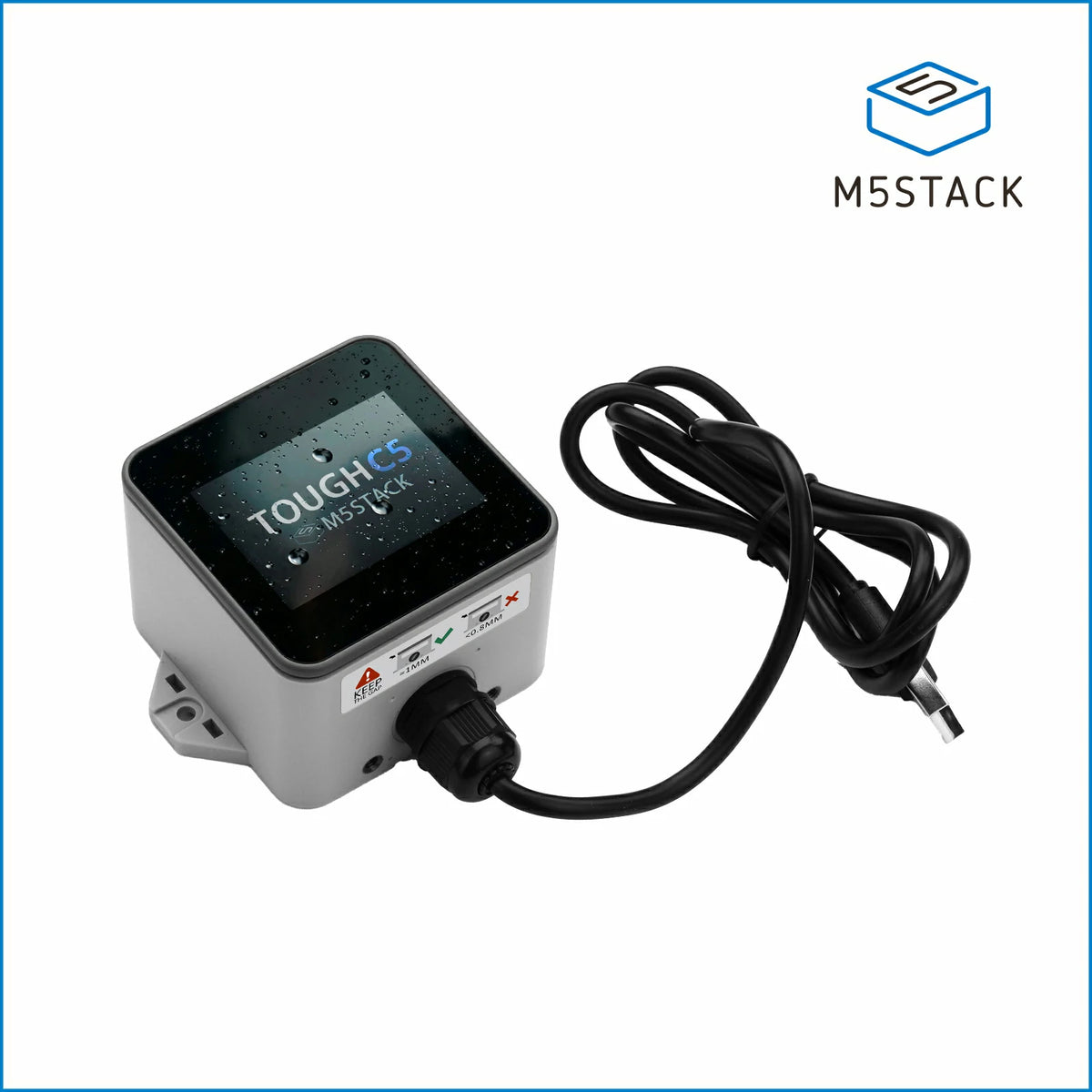
| Attr | Specs | verified |
|---|---|---|
soc | ESP32-C5HR8 RISC-V 32-bit single-core, up to 240MHz | ? unverified |
ram | 8MB PSRAM (Octal) | ? unverified |
storage | 16MB Flash, microSD card slot | ? unverified |
wifi_bluetooth | 2.4 & 5 GHz Dual-Band Wi-Fi 6, BLE 5, IEEE 802.15.4 (Zigbee, Thread) | ? unverified |
video | 2.0" LCD Capacitive Touch Screen, 320x240, ILI9342C IPS, 853nit | ? unverified |
usb | 1x USB Type-C (Debugging/Program Download) | ? unverified |
gpio | HY2.0-4P x 4 (RS485/I2C/GPIO/UART), 2x M12 Body Cable Routing Holes | ? unverified |
power | USB DC 5V, RS485 DC 6-24V, Battery DC 3.7V, M5PM1 + M5IOE1 PMU | ? unverified |
rtc | RX8130CE RTC with CR2032 Coin Cell Battery (DC 3V@220mAh) | ? unverified |
audio | Onboard passive buzzer @8530 | ? unverified |
dimensions | 75.9 x 58.0 x 42.5 mm | ? unverified |
weight | 119.0 g | ? unverified |
housing | PC + ABS (with UV powder), Waterproof (IP rated, not for immersion) | ? unverified |
antenna | FPC Antenna 2.4 GHz & 5 GHz, IPEX-2nd Gen, 14.3x5.3mm | ? unverified |
power_consumption | Shutdown: 10.41uA, Full load: 320mA (at DC 4.2V) | ? unverified |
The M5Stack ToughC5 is an outdoor-ready IoT controller based on the ESP32-C5HR8 module. It targets industrial and smart home applications requiring multi-protocol connectivity and weather resistance.
+ Strengths
["- Dual-band Wi-Fi 6 (2.4/5 GHz), BLE 5, and IEEE 802.15.4 (Zigbee/Thread) connectivity","- UV-treated PC+ABS housing providing weather resistance (not submersible)","- 2.0-inch capacitive touch IPS LCD with high brightness of 853 nits"]
− Weaknesses
["- Not submersible despite weatherproof rating","- Full load power consumption of 320 mA at 4.2 V","- Internal FPC antenna limited to 2.4 GHz and 5 GHz bands"]
- Retour d'expérience expert expert — expert-microdb
- Après 3 mois sur site, le ToughC5 tient ses promesses pour l'outdoor. L'écran IPS à 853 nits reste lisible en plein soleil, un vrai plus. La triple connectivité (Wi-Fi 6, BLE 5, 802.15.4) simplifie l'intégration Zigbee/Thread sans dongle externe. Attention toutefois à la gestion thermique du RISC-V… — expert-microdb
- +1 pour l'écran, c'est rare à ce niveau de luminosité. Par contre, as-tu testé l'alimentation via l'entrée RS485 6-24V ? Je m'inquiète un peu de la stabilité avec une batterie LiPo 3,7V directe vu les pics de consommation Wi-Fi 6. Les puces M5PM1/M5IOE1 gèrent bien les transitoires ? Ça pourrait êt… — membre-forum
- Retour d'expérience expert expert — expert-microdb
- Après 3 mois en extérieur, je confirme : le ToughC5 est robuste. L'écran IPS (853 nits) reste lisible au soleil, un vrai plus. La triple connectivité (Wi-Fi 6, BLE, Zigbee) simplifie l'intégration dans nos réseaux domotiques mixtes. L'alimentation RS485 6-24V est idéale pour nos panneaux solaires. … — expert-microdb
- Bon retour. Juste une précision sur la mémoire : 8 Mo de PSRAM Octal c'est correct pour du buffering, mais limité pour du ML embarqué lourd. Le RISC-V mono-cœur à 240 MHz gère bien le multi-protocole via M5StackFlow, mais évite les tâches CPU intensives simultanées. Le RTC RX8130CE est précis, mais… — membre-forum
Community feedback and projects
Content not available yet.
Content not available yet.
Content not available yet.
["- Not specified"]
- Getting Started with M5Stack ToughC5 debutant Apprenez à alimenter et démarrer votre contrôleur IoT étanche ToughC5 pour la première fois.
- Mastering GPIO and Display on ToughC5 debutant Apprenez à contrôler les broches d'entrée/sortie et à afficher des données sur l'écran tactile du M5Stack ToughC5.
- Simple Connected Weather Station with ToughC5 debutant Apprenez à afficher l'heure et la température sur l'écran tactile du ToughC5 en utilisant le RTC intégré et un capteur externe.
- Getting Started with M5Stack ToughC5 intermediaire Guide intermédiaire pour la première alimentation, le flashage et la vérification de base du kit IoT étanche ToughC5.
- Driving GPIO and LCD on ToughC5 intermediaire Configurez les entrées-sorties et pilotez l'écran tactile IPS de 2,0 pouces pour une interface homme-machine robuste.
- Autonomous IoT Weather Station with ToughC5 intermediaire Configurez le ToughC5 pour collecter des données environnementales via RS485 et les afficher sur l'écran tactile.
- First connection and startup of M5Stack ToughC5 avance Guide étape par étape pour la première mise sous tension et le démarrage initial du contrôleur IoT étanche.
- Advanced IoT Automation: Zigbee, Touch Screen, and Power Management avance Créez un hub domotique autonome sur ToughC5 combinant réseau Zigbee, interface tactile et optimisation de la veille profonde.
- Power Optimization with Deep Sleep and RTC Wake-up on ToughC5 avance Configurez le mode veille profonde du M5Stack ToughC5 pour atteindre une consommation de 10,41 µA tout en garantissant un réveil précis grâce au RTC RX8130CE.
Code library — examples written for this board
toughc5_gpio_button_buzzer.inoC++ (Arduino)toughc5_wifi6_scanner.inoC++ (Arduino)toughc5_rtc_battery_log.inoC++ (Arduino)toughc5_ili9342c_touch_ui.inoC++ (Arduino)toughc5_rs485_modbus_master.inoC++ (Arduino)toughc5-rs485-modbus-master.inoArduino C++toughc5-rtc-sleep-wake.inoArduino C++toughc5-wifi6-scan-connect.inoArduino C++toughc5-ble-sensor-hub.inoArduino C++toughc5-touch-ui-dashboard.inoArduino C++