Arduino Mega ADK (Rev3)
⚡ The essentials in 60 seconds
- mcu — Atmel (now Microchip) ATmega2560, 8-bit AVR, 16 MHz crystal oscillator — identical main MCU to the Mega 2560 (board page Tech Specs).
- the_differentiator_usb_host_chip — MAX3421E (Maxim/Analog Devices) USB host/ peripheral controller, giving the board a Type-A USB host port (board page Tech Specs).
- memory — 256 KB flash (8 KB used by the bootloader → 253,952 bytes sketch space per boards.txt), 8 KB SRAM, 4 KB EEPROM (board page, Memory).
- digital_i_o — 54 pins, 5 V logic, 40 mA per pin (absolute max), internal pull-ups 20–50 kΩ; the prose section of the board page says "each of the 50 digital pins" while the Tech Specs table and intro say 54 — the table value (54, 15 of them PWM) is the consistent one (board page).
- pwm — 15 channels (8-bit analogWrite): pins 2–13 and 44–46 (board page, Input and Output).
- analog — 16 inputs, 10-bit (0–1023), 5 V reference by default, adjustable via AREF/analogReference (board page).
- On this board : 9 tutorials · 10 code
The Arduino Mega ADK, short for Android Open Accessory Development Kit, stands as a unique artifact in the history of electronic prototyping, representing a specific moment when the worlds of microcontrollers and mobile operating systems first attempted a deep, hardware-level handshake. Released in 2011, this board was not merely a new variant of the popular Arduino Mega 2560 but served as the official reference implementation for Google’s Android Open Accessory protocol. While the underlying hardware is rooted in the robust Atmel ATmega2560 microcontroller, the board’s defining feature is its ability to act as a USB host rather than just a USB device. This distinction is crucial for understanding its purpose. In standard computer connections, a peripheral like a mouse or a keyboard is the "device," while the computer is the "host." The Mega ADK reverses this typical Arduino paradigm by allowing the microcontroller to take control of the USB bus, enabling it to communicate with an Android smartphone, which then acts as the peripheral device. This architecture allowed developers to connect sensors, actuators, and other hardware directly to Android phones without requiring the phone to be rooted or modified, effectively turning the smartphone into a display and processing unit for external electronics.
At the heart of this board lies the ATmega2560, an 8-bit AVR microcontroller running at 16 MHz. For those unfamiliar with these terms, the "8-bit" designation refers to the width of the data chunks the processor handles at once, indicating a simpler, less power-hungry architecture compared to modern 32-bit chips, while the 16 MHz clock speed dictates how many cycles the processor can execute per second. This chip provides 256 KB of flash memory for storing your code, 8 KB of SRAM for temporary data, and 4 KB of EEPROM for long-term storage. The board exposes a vast array of input and output options, including 54 digital pins, 16 analog inputs, and 15 PWM channels. These pins allow the board to interact with the physical world by reading sensors or controlling motors and lights. The "PWM" channels, or Pulse Width Modulation, allow the board to simulate analog output signals by rapidly switching a digital pin on and off, which is useful for controlling the brightness of LEDs or the speed of motors. The board also features four hardware serial ports, known as UARTs, which are dedicated communication lines that allow the microcontroller to talk to other devices, such as GPS modules or Bluetooth radios, independently of the main USB connection.
What truly sets the Mega ADK apart is the inclusion of the MAX3421E USB host controller chip. This component manages the complex electrical and logical protocols required to initiate USB communication. Through a standard USB Type-A port, the board can recognize and communicate with Android devices running version 3.1 or later, with support backported to version 2.3.4. This capability enabled the creation of accessories that could send data to and receive commands from Android apps. The board was distributed as part of a kit at the Google I/O 2011 developer conference and was sold through the Arduino Store, though it is now considered end-of-life and retired. Despite its retirement, the board remains selectable in the current Arduino software environment, and its open-source nature means that schematics and reference designs are still available for study and repair. The board’s design includes specific power considerations; because it powers the connected phone, users must be mindful of current limits. When powered via USB, the total current available for both the board and the phone is limited to 500 mA. To utilize the full potential of the board, especially when driving additional sensors or actuators, an external power supply providing up to 1500 mA is recommended.
The software ecosystem for the Mega ADK has evolved significantly since its launch. Initially, it relied on a specific ADK software package that included the AndroidAccessory library and a demo application called DemoKit. Today, the most reliable way to use this board is through the maintained USB Host Shield 2.0 library, which supports the MAX3421E chip and provides a modern interface for Android communication. This library allows the board to function not only as an Android accessory but also as a generic USB host, capable of reading data from keyboards, mice, game controllers, and barcode scanners. This dual utility gives the board a second life beyond its original Android-focused purpose. However, users should be aware of certain hardware quirks. For instance, digital pin 7 is internally connected to the reset line of the USB host controller and should not be used for general input or output, a detail that can cause subtle bugs if overlooked. Additionally, the board shares the SPI communication bus with the USB host controller, which can create conflicts if other SPI devices are connected without careful management of chip select signals.
The Mega ADK represents a fascinating intersection of hardware and software history. It was born from a collaboration between Arduino and Google, aiming to bridge the gap between the maker community and the mobile app ecosystem. While the Android Open Accessory protocol has since been largely superseded by other methods of connectivity, and Google’s official documentation for the ADK has been archived, the hardware itself remains a capable and educational tool. It demonstrates the principles of USB host operation, serial communication, and embedded system design in a tangible way. For hobbyists and students, it offers a window into the early days of mobile-integrated electronics, while for practical applications, it continues to serve as a robust, low-cost solution for adding USB host capabilities to projects that do not require the complexity of a full Linux-based single-board computer. Its legacy is preserved not just in the code libraries that still support it, but in the countless projects that used it to bring physical interactivity to the digital world of Android.
Pinout diagram
| Attr | Specs | verified |
|---|---|---|
mcu | Atmel (now Microchip) ATmega2560, 8-bit AVR, 16 MHz crystal oscillator — identical main MCU to the Mega 2560 (board page Tech Specs). | ✔ |
the_differentiator_usb_host_chip | MAX3421E (Maxim/Analog Devices) USB host/ peripheral controller, giving the board a Type-A USB host port (board page Tech Specs). | ✔ |
memory | 256 KB flash (8 KB used by the bootloader → 253,952 bytes sketch space per boards.txt), 8 KB SRAM, 4 KB EEPROM (board page, Memory). | ✔ |
digital_i_o | 54 pins, 5 V logic, 40 mA per pin (absolute max), internal pull-ups 20–50 kΩ; the prose section of the board page says "each of the 50 digital pins" while the Tech Specs table and intro say 54 — the table value (54, 15 of them PWM) is the consistent one (board page). | ✔ |
pwm | 15 channels (8-bit analogWrite): pins 2–13 and 44–46 (board page, Input and Output). | ✔ |
analog | 16 inputs, 10-bit (0–1023), 5 V reference by default, adjustable via AREF/analogReference (board page). | ✔ |
serial | 4 hardware UARTs — Serial 0 (RX0/TX1, shared with the USB chip), Serial1 (19/18), Serial2 (17/16), Serial3 (15/14) (board page, Communication). | ✔ |
buses | SPI on 50 (MISO) / 51 (MOSI) / 52 (SCK) / 53 (SS) + ICSP header; TWI/I²C on 20 (SDA) / 21 (SCL); external interrupts 2, 3, 18, 19, 20, 21 (board page). | ✔ |
max3421e_wiring_official | SPI bus + digital 7 = RST — "Please do not use Digital pin 7 as input or output because is used in the communication with MAX3421E"; not broken out on headers: PJ3 (GP_MAX), PJ6 (INT_MAX), PH7 (SS) (board page, Input and Output). | ✔ |
usb_to_serial_chip | ATmega8U2 programmed as USB-to-serial converter (Rev2+ with the HWB pull-down; re-flashable via DFU) — note this is the 8U2, unlike the Mega 2560 Rev3's 16U2 (board page, Programming). Official USB IDs: 0x2341:0x003f, 0x2341:0x0044, 0x2A03:0x003f, 0x2A03:0x0044 (boards.txt, megaADK section). | ✔ |
power | USB or external (2.1 mm center-positive jack / VIN), auto-selected. Because the board is a USB host, the phone draws charging current from it: over USB power only 500 mA total is available for phone + board; with external supply the regulator delivers up to 1500 mA (750 mA for phone + board, 750 mA for sensors/actuators; use a 1.5 A supply) (board page, Power NB). - Input range: the prose says "external supply of 5.5 to 16 volts", the Tech Specs table says 6–20 V (limits), 7–12 V recommended; <7 V risks an unstable 5 V rail, >12 V can overheat the linear regulator (board page). - 3V3 pin: 50 mA max; VIN/5V pins documented; back-powering via 5V/3.3V "can damage your board" (board page, Power). - Resettable 500 mA polyfuse on the host USB port (board page, USB Overcurrent Protection). | ✔ |
size_weight | PCB max 4 × 2.1 in (101.52 × 53.3 mm), 36 g, three mounting holes; 160 mil gap between digital pins 7 and 8 — and pin 7 is already consumed by the MAX3421E (board page, Physical Characteristics / Tech Specs). | ✔ |
- Manufacturer: Arduino, in collaboration with Google. The Mega ADK is the production board behind Google's Android Open Accessory Development Kit (ADK): the official (archived) ADK 2011 guide describes the ADK as "a reference implementation of an Android Open Accessory, based on the Arduino open source electronics prototyping platform" and lists "the Arduino Store provides the Arduino Mega ADK … based on the ATmega2560 and supports the ADK firmware" (archived ADK 2011 guide, developer.android.com via web.archive.org).
- Year: 2011 — "A limited number of kits were produced and distributed at the Google I/O 2011 developer conference", after which the Arduino Mega ADK sold through the Arduino Store (archived ADK 2011 guide).
- Status: End-of-life / retired. The board page now lives under the retired section of the official docs (docs.arduino.cc/retired/boards/arduino-mega-adk-rev3) and the store product page returns 404 (store.arduino.cc/products/arduino-mega-adk-rev3, fetched 2026-10-13). The board is still selectable in the current Arduino AVR core (boards.txt).
- Launch price:
- SKU: A000069 (front matter of the official board page, docs.arduino.cc/retired/boards/arduino-mega-adk-rev3).
- Variants / revisions (board page): - Rev1 — ATmega8U2 USB-serial chip; DFU jumper near the "map of Italy" on the back. - Rev2 — adds a resistor pulling the 8U2 HWB line to ground to ease DFU mode. - Rev3 (A000069) — 1.0 pinout: SDA/SCL near AREF, IOREF near RESET (shield voltage adaptation), stronger reset circuit. - Related hardware: Google's own ADK 2012 board was a different design (ARM Cortex-M3, sensors, audio dock), not a Mega ADK revision (archived ADK 2012 guide). Third-party ADK-compatible boards were listed by Google (Modern Device, Seeed Studio, RT Corp, Troido, DIY Drones, SparkFun IOIO beta) (archived ADK 2011 guide). - During the 2015–2016 trademark split Arduino boards were sold as "Genuino" outside the US; Arduino AG has been owned by Qualcomm since October 2025 (Wikipedia — Arduino).
+ Strengths
- Stock Arduino with a real USB-A host port — the only classic AVR Arduino with an on-board host controller (MAX3421E). The official page advertises interacting "with many types of phones, controlling Canon cameras, interfacing with keyboard, mouse and games controllers as Wiimote and PS3" (board page, Communication).
- Reference implementation of Android Open Accessory (AOA): the board exists to demo/implement the AOA protocol, where the accessory is the USB host and the phone is the USB device (archived ADK 2011 guide, Wikipedia).
- Everything a Mega 2560 has: 54 digital + 16 analog pins, 15 PWM, 4 UARTs, 256 KB flash — the ADK is "based on the Mega 2560" (board page).
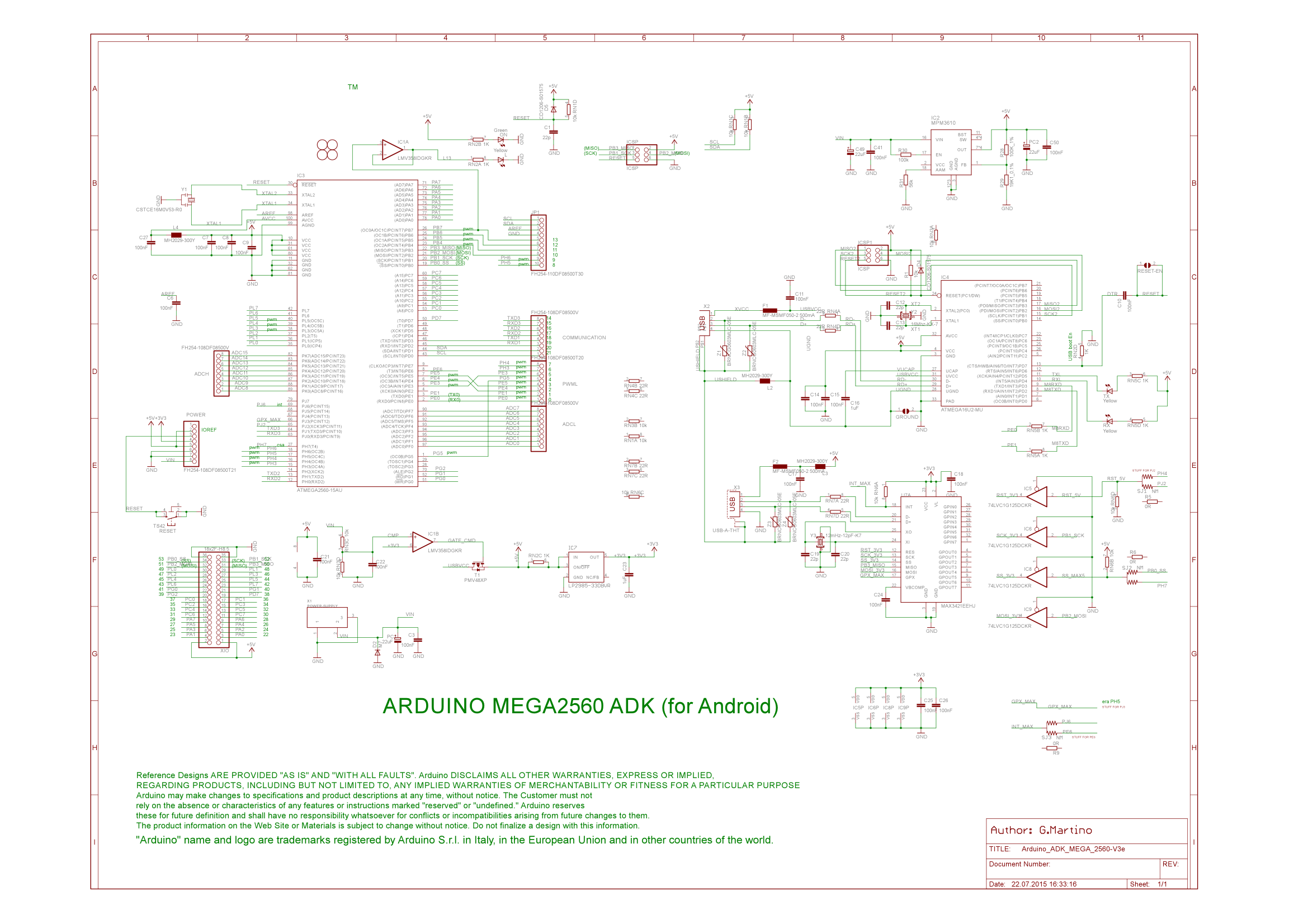
- Open hardware: official schematic PDF and EAGLE reference-design ZIP are still live (schematic, EAGLE files, both linked from and fetched via the board page).
- Historic one-to-one phone↔microcontroller story: at launch (2011) it was the canonical way to put sensors/actuators on an Android phone without rooting, via the DemoKit app (archived ADK 2011 guide).
- Still useful as a dumb USB host today: HID keyboards/mice/gamepads and barcode scanners work through the USB Host Shield library without any Android involvement (forum topic 1261281, USB_Host_Shield_2.0).
− Weaknesses
- OSCOKIRQ failed to assert — the classic failure where Usb.Init cannot talk to the MAX3421E (crystal not starting / chip dead / wrong pin mapping); a decade-old recurring forum topic (topic 109175); the same string is the demo's only error message (demokit_20.ino).
- SS/reset pin mismatch with USB Host Shield sketches: on the ADK the MAX3421E SS is on PH7, while the plain USB Host Shield uses PB4 (D10) — stock shield examples need the board variant set correctly (forum topic 256031); the library handles this via BOARD_MEGA_ADK / USE_UHS_MEGA_ADK (avrpins.h, settings.h).
- Pin 7 is stolen: the official page warns not to use digital 7 (MAX3421E RST), which silently breaks shields/sketches that expect all 0–13 free (board page, Input and Output).
- MAX3421E sits permanently on the shared SPI bus — mixing SD cards or other SPI devices requires deselecting the USB host around transfers (forum topic 451921); the host's SS/INT/GP lines are not broken out on headers, limiting manual bit-banging (board page).
- Power budget trap when charging phones: powered from USB the whole board + phone share 500 mA; the advertised 1.5 A budget requires an external ≥1.5 A supply (board page, Power NB).
- Same Mega-family traps: DTR auto-reset eats the first bytes after opening the port (wait ~1 s); cutting the RESET-EN trace disables it; 3V3 limited to 50 mA; >12 V overheats the LDO; I²C on 20/21 breaks pre-R3 shields (board page, Automatic (Software) Reset / Power).
- Protocol-side gotchas (documented by Google): AOA does not support simultaneous AOA + MTP (must physically/electrically disconnect to switch); an accessory that omits the optional version string can reboot Android ≤10 devices during enumeration (AOA 1.0 docs).
- Dead ecosystem: the ADK wiki mirror cc-distributed.github.io/wiki/ADK is a 404 with no Wayback snapshots (fetched 2026-10-13); Google's ADK docs redirect to the generic accessories page (fetched); the Arduino Playground ADK library page redirects to the read-only playground home (fetched); AOAv2 USB audio support was deprecated in Android 8.0 (AOA 2.0 docs). Expect no official downloads beyond archives/mirrors.
- Modern Android friction: accessory apps must handle USB permission/device-detached flows, and very new phones occasionally ship with quirky USB stacks — long forum threads about ADK boards enumerating but not opening (topic 74280); Bluetooth-class USB devices on the host port were experimental even in 2012 (topic 104791).
- Retour d'expérience expert expert — expert-arduino
- Retour d'experience sur la Mega ADK (Rev3). Les specs sont solides : 54 pins, 4 UARTs, et surtout le contrôleur USB Host MAX3421E integre. C'est la seule carte AVR classique avec un port USB-A maitre natif, ce qui est top pour piloter des peripheriques ou utiliser le protocole AOA. Mais attention a… — expert-arduino
- Merci pour ce rappel. Je confirme le souci d'alimentation qui est très sournois. J'ai passe des heures a croire que ma carte etait morte car mon smartphone refusait de charger. En fait, si tu alimentes la carte via le port USB micro-B standard, tu as droit a seulement 500 mA au total, repartis entr… — maker_bricoleur
- Une petite question technique sur la partie logicielle. Vous parlez des erreurs d'enumeration avec les nouveaux telephones. J'ai une vieille app qui marche sur Android 10 mais qui ne detecte plus rien sur mon nouveau mobile. Est-ce que le problème vient vraiment du hardware ou c'est juste Android q… — newbie_coder
Community feedback and projects
- Adding a Wifi connection to Mega ADK with a ESP-01 forum.arduino.cc
- USB Host Sheild vs Mega ADK & RFID forum.arduino.cc
- Mega ADK vs Mega 2560 forum.arduino.cc
- arduino mega adk + android via usb forum.arduino.cc
- Problems to connect my android phone with arduino MEGA adk via bluetooth forum.arduino.cc
- Official retired board page (specs, power NB, MAX3421E wiring, schematic links)
- Schematic PDF (official, live)
- EAGLE reference design ZIP (official, live)
- ArduinoCore-avr boards.txt (megaADK id, VID/PID, bootloader)
- Archived Google ADK 2011 guide (history, components, DemoKit)
- Archived Google ADK 2012 guide (successor hardware, context)
- Android Open Accessory 1.0 protocol (handshake, VID/PID, string IDs)
- Android Open Accessory 2.0 (protocol versions, PIDs, audio deprecation, ADK source excerpt)
- Current Android accessories docs (ADK docs' redirect target)
- avrpins.h
- settings.h
- USB Host Shield 2.0 library (maintained MAX3421E/ADK stack)
- Wikipedia — AOA/ADK background (Android 3.1 / 2.3.4 accessory mode)
- Wikipedia — AOA/ADK background (Android 3.1 / 2.3.4 accessory mode)
- 109175
- 256031
- 451921
- 1261281
- 74280
- 104791
- OSCOKIRQ failed to assert — the classic failure where Usb.Init cannot talk to the MAX3421E (crystal not starting / chip dead / wrong pin mapping); a decade-old recurring forum topic (topic 109175); the same string is the demo's only error message (demokit_20.ino).
- SS/reset pin mismatch with USB Host Shield sketches: on the ADK the MAX3421E SS is on PH7, while the plain USB Host Shield uses PB4 (D10) — stock shield examples need the board variant set correctly (forum topic 256031); the library handles this via BOARD_MEGA_ADK / USE_UHS_MEGA_ADK (avrpins.h, settings.h).
- Pin 7 is stolen: the official page warns not to use digital 7 (MAX3421E RST), which silently breaks shields/sketches that expect all 0–13 free (board page, Input and Output).
- MAX3421E sits permanently on the shared SPI bus — mixing SD cards or other SPI devices requires deselecting the USB host around transfers (forum topic 451921); the host's SS/INT/GP lines are not broken out on headers, limiting manual bit-banging (board page).
- Power budget trap when charging phones: powered from USB the whole board + phone share 500 mA; the advertised 1.5 A budget requires an external ≥1.5 A supply (board page, Power NB).
- Same Mega-family traps: DTR auto-reset eats the first bytes after opening the port (wait ~1 s); cutting the RESET-EN trace disables it; 3V3 limited to 50 mA; >12 V overheats the LDO; I²C on 20/21 breaks pre-R3 shields (board page, Automatic (Software) Reset / Power).
- Protocol-side gotchas (documented by Google): AOA does not support simultaneous AOA + MTP (must physically/electrically disconnect to switch); an accessory that omits the optional version string can reboot Android ≤10 devices during enumeration (AOA 1.0 docs).
- Dead ecosystem: the ADK wiki mirror cc-distributed.github.io/wiki/ADK is a 404 with no Wayback snapshots (fetched 2026-10-13); Google's ADK docs redirect to the generic accessories page (fetched); the Arduino Playground ADK library page redirects to the read-only playground home (fetched); AOAv2 USB audio support was deprecated in Android 8.0 (AOA 2.0 docs). Expect no official downloads beyond archives/mirrors.
- Modern Android friction: accessory apps must handle USB permission/device-detached flows, and very new phones occasionally ship with quirky USB stacks — long forum threads about ADK boards enumerating but not opening (topic 74280); Bluetooth-class USB devices on the host port were experimental even in 2012 (topic 104791).
- Clignotement d'une LED sur l'Arduino Mega ADK debutant Schéma : IMG-mega-adk-debutant-1-mega-adk-clignotement-led.svg — Mega ADK, LED + résistance 220 Ω entre la broche 13 et GND, câble USB vers l'ordinateur
- Bouton-poussoir et console série debutant Schéma : IMG-mega-adk-debutant-2-mega-adk-bouton-console.svg — Mega ADK, bouton-poussoir entre la broche 2 et GND (pull-up interne), console série sur l'ordinateur
- Lire un capteur analogique (potentiomètre) debutant Schéma : IMG-mega-adk-debutant-3-mega-adk-capteur-analogique.svg — Mega ADK, potentiomètre 10 kΩ sur A0 (5 V / GND / curseur) et LED sur la broche PWM 9
- Premier pont AOA : écho série avec Android intermediaire Schéma : IMG-mega-adk-intermediaire-1-mega-adk-pont-aoa-serie.svg — Mega ADK alimentée en externe (7-12 V, 1,5 A), port USB-A relié au téléphone Android, tableau de bord écho série
- Flux de capteur analogique vers Android intermediaire Schéma : IMG-mega-adk-intermediaire-2-mega-adk-flux-capteur-android.svg — Potentiomètre sur A0, trames envoyées au téléphone Android via le port USB-A host, jauge de mesure à l'écran
- Contrôler une LED depuis Android intermediaire Schéma : IMG-mega-adk-intermediaire-3-mega-adk-controle-led-android.svg — Curseur de luminosité sur le téléphone, commandes PWM reçues par la Mega ADK, LED sur la broche 9
- USB host MAX3421E : diagnostic et pièges d'alimentation avance Schéma : IMG-mega-adk-avance-1-mega-adk-usb-host-max3421e.svg — Chaîne d'alimentation : USB 500 mA partagé vs alimentation externe 1,5 A, polyfuse 500 mA du port USB-A, puce MAX3421E et broche 7 réservée (RST)
- HID host : clavier, souris et scanner sur le port USB-A avance Schéma : IMG-mega-adk-avance-2-mega-adk-hid-host.svg — Clavier USB et lecteur de code-barres branchés sur le port USB-A host de la Mega ADK, sortie sur la console série
- Limites d'AOA sur Android moderne et alternatives avance Schéma : IMG-mega-adk-avance-3-mega-adk-limites-aoa-modernes.svg — Mega ADK classée retired et alternatives modernes : ESP32 en USB natif, module Bluetooth, adaptateur série USB-OTG vers Android
Code library — examples written for this board
clignotante.inoArduinobouton-led.inoArduinoscan-hote-usb.inoArduinoadk-chat-android.inoArduinoadk-telemetrie.inoArduinohote-clavier-usb.inoArduinopont-uart.inoArduinoscan-16-analogiques.inoArduinoscanner-i2c.inoArduinobuzzer-melodie.inoArduino
Examples and repos found online
- arduino/ArduinoCore-avr github.com
- felis/USB_Host_Shield_2.0 github.com