nRF52833-DK (boards.json id: nrf52833-dk)
⚡ The essentials in 60 seconds
- cpu — Arm Cortex-M4 32-bit with FPU @ 64 MHz; 217 EEMBC CoreMark from flash; no GPU.
- memory — 512 KB flash + 128 KB RAM (1:4 RAM:flash ratio).
- radio_multiprotocol_2_4_ghz — Bluetooth 5.x LE at 2 Mbps / 1 Mbps / 500 kbps / 125 kbps (Long Range), AoA/AoD Direction Finding, Bluetooth mesh, IEEE 802.15.4 (Thread, Zigbee), proprietary 2.4 GHz at 2/1 Mbps. TX power −20 to +8 dBm in 4 dB steps; sensitivity −96 dBm (1 Mbps LE), −103 dBm (125 kbps LR). Single-ended antenna output with on-chip balun. Marketed as "Bluetooth 5.1" (Product Spec v1.7), "Bluetooth 5.3" (DK brief v1.2) and "Bluetooth 5.4" (current Nordic page) — same radio, updated qualification branding.
- gpio — 42 general-purpose I/O pins (Product Spec feature list); the DK gives "access to all 42 I/Os and interfaces via connectors" (DK Product Brief).
- digital_analog_peripherals — USB 2.0 full-speed (12 Mbps) device controller; NFC-A (Type 2) tag with wake-on-field; 12-bit 200 ksps ADC with 8 channels and programmable gain; high-speed 32 MHz SPI; up to 4 SPI masters / 3 slaves, 2 I2C-compatible TWI, 2 UARTs, 4× 4-channel PWM, I2S, PDM, QDEC, 5× 32-bit timers, 3 RTCs, comparators, temperature sensor; 128-bit AES/ECB/CCM/AAR co-processor; PPI + EasyDMA everywhere.
- power_chip — 1.7–5.5 V supply, on-chip DC/DC + LDO regulators. 0.6 µA System OFF (3 V, no RAM retention), 1.5 µA System ON with RTC wake-up, 4.9 mA peak TX (0 dBm), 4.6 mA RX, 52 µA/MHz running CoreMark from flash.
- On this board : 9 tutorials · 10 code
The nRF52833 Development Kit, identified by the board code PCA10100 and order code nRF52833-DK, stands as a comprehensive single-board solution from Nordic Semiconductor for engineers and hobbyists working with the nRF52833 System-on-Chip. Released in 2019, this kit remains an active and widely supported platform, serving as the primary reference design for the nRF52833 microcontroller while also supporting development for the related nRF52820 SoC. The board is priced at approximately US$49.00, a figure confirmed by distributor snapshots, making it an accessible entry point into professional-grade wireless development. It is important to note that this specific catalog entry corrects a previous error where the board was mistakenly associated with a non-existent "MakerDiary nRF52833 MDK"; this documentation strictly refers to the official Nordic Semiconductor product.
At the heart of the development kit lies the nRF52833 SoC, which features an Arm Cortex-M4 processor running at 64 MHz. This 32-bit CPU includes a Floating Point Unit, which accelerates mathematical calculations essential for signal processing and complex algorithms, though it does not include a Graphics Processing Unit, as the board is not intended for graphical display tasks. The chip provides 512 KB of flash memory for storing firmware and 128 KB of RAM for runtime data, offering a balanced ratio for many embedded applications. The radio subsystem is multiprotocol, operating in the 2.4 GHz band. It supports Bluetooth Low Energy versions up to 5.x, with data rates ranging from 125 kbps for long-range communication to 2 Mbps for high-speed transfers. It also supports Bluetooth Mesh, IEEE 802.15.4 protocols such as Thread and Zigbee, and proprietary 2.4 GHz protocols. The radio features Direction Finding capabilities (AoA/AoD) and maintains a transmit power range of -20 to +8 dBm. While marketing materials may vary between Bluetooth 5.1, 5.3, or 5.4 branding, these refer to the same underlying radio hardware with updated qualification standards.
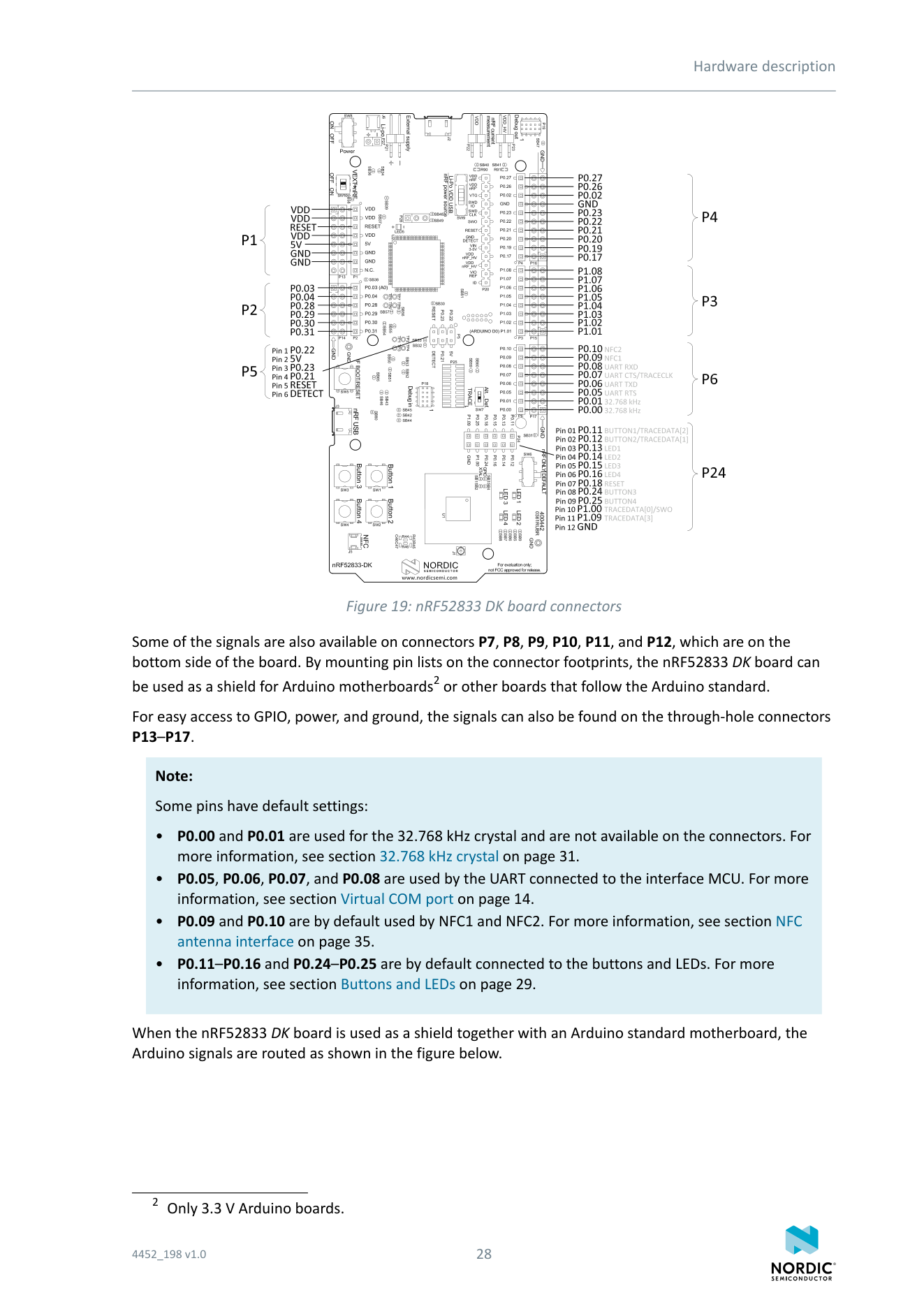
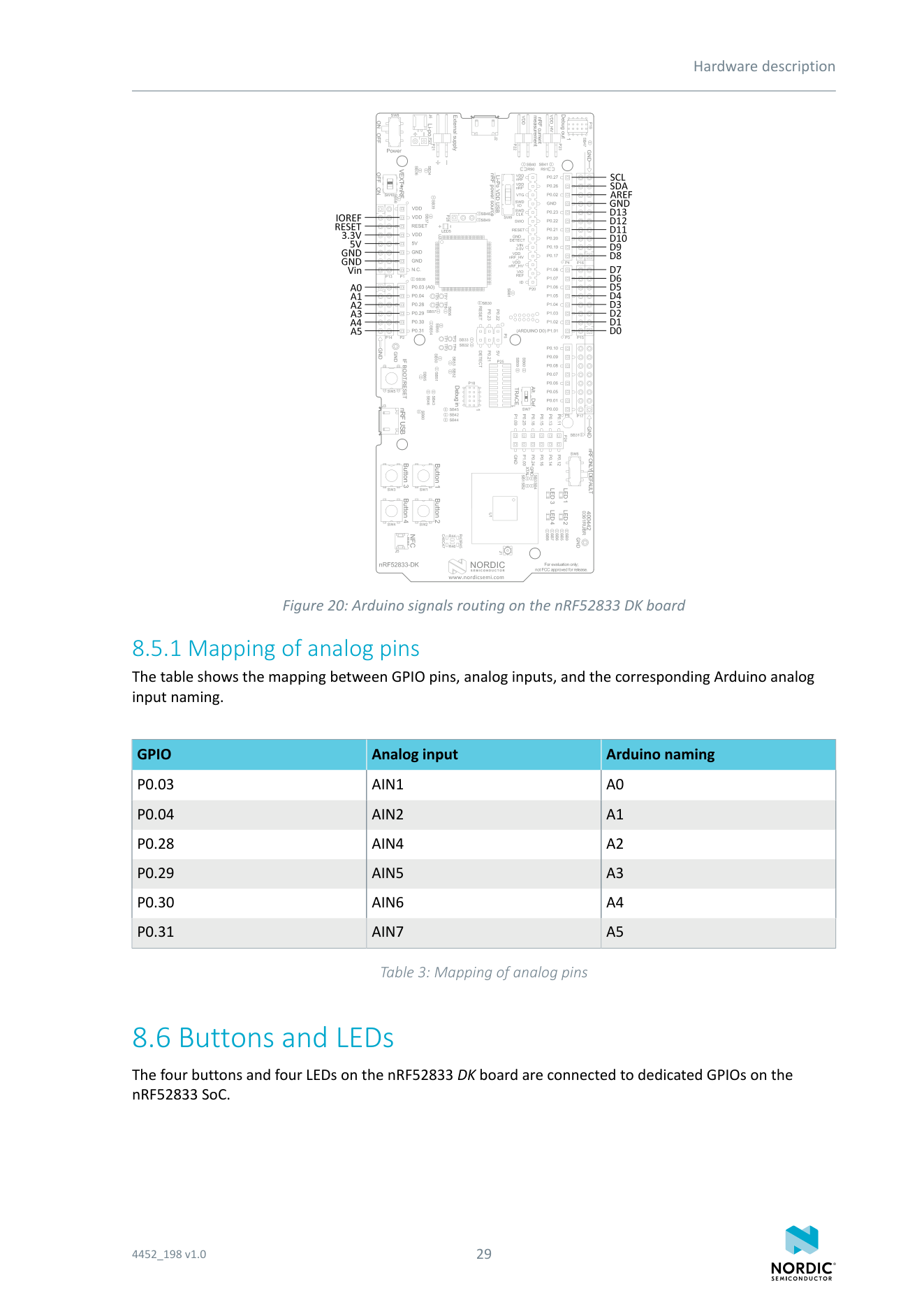
The physical board is designed in the Arduino Uno Rev3 form factor, allowing it to plug into standard shields, although it operates at 3.3 V logic levels. It exposes all 42 general-purpose I/O pins of the SoC through various connectors, including headers P2 through P6 and P24. For analog sensing, the board maps the SoC’s analog inputs to the standard Arduino A0 through A5 pins. The kit includes four user-controllable LEDs and four buttons, which are active-low and require internal pull-up resistors to be enabled in software. A key feature for developers is the integrated SEGGER J-Link On-Board debugger. This interface allows for programming and debugging the nRF52833 chip directly. Uniquely, the J-Link can also debug external targets via the Debug out connector, effectively turning the development kit into a standalone probe for other nRF51 or nRF52 boards. The board supports drag-and-drop programming via a Mass Storage Device (MSD) interface, where users can simply copy a HEX file to a virtual drive to flash the chip, though users should be aware that Windows antivirus software or defragmentation tools can sometimes interfere with this process, requiring a power cycle to recover.
Power management is a critical aspect of low-energy wireless design, and the nRF52833-DK includes specialized features for this purpose. The board can be powered via USB, a Li-Po battery, or an external supply. It includes a CR2032 coin-cell holder and a 5 V boost regulator. For precise power profiling, the board features dedicated current measurement pins and an "nRF ONLY" switch that isolates the interface MCU, allowing for accurate measurement of the SoC’s power consumption using tools like the Nordic Power Profiler Kit. The SoC itself is highly efficient, drawing as little as 0.6 µA in System OFF mode and 1.5 µA in System ON mode with RTC wake-up. The operating temperature range is extended, from -40 °C to +105 °C, making it suitable for harsh industrial environments.
Software support for the nRF52833-DK is extensive and modern. The primary development environment is the nRF Connect SDK (NCS), which integrates the Zephyr Real-Time Operating System. Zephyr provides a robust, scalable foundation for building Bluetooth, Thread, and Zigbee applications. The board is fully supported in upstream Zephyr, allowing developers to use standard build commands like west build and west flash. For those preferring higher-level languages, official CircuitPython builds are available for the PCA10100 board ID, enabling rapid prototyping with Python. Additionally, the board is supported in PlatformIO, a popular extension for code editors like VS Code. While legacy SDKs exist, new designs are strongly encouraged to use the nRF Connect SDK, as older Thread and Zigbee SDKs are now in maintenance-only status.
Developers should be mindful of several hardware nuances. The NFC antenna pins (P0.09 and P0.10) are locked by the NFC peripheral by default and must be explicitly configured as GPIOs in software if needed for other purposes. Similarly, the reset pin (P0.18) is treated as a standard GPIO unless specifically configured otherwise. The board includes an on-board 2.4 GHz PCB trace antenna, but for conducted RF testing, an SWF connector allows the antenna to be disconnected, facilitating precise signal measurements. While the board dimensions follow the Arduino Uno standard, exact millimeter specifications are found only in the hardware drawings. Overall, the nRF52833-DK offers a professional-grade toolkit with integrated debugging, power profiling, and multiprotocol wireless capabilities, backed by a strong ecosystem of documentation and community support.
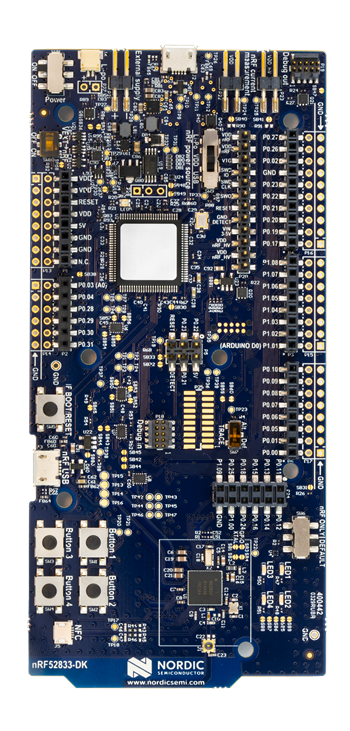
Pinout diagram
| Attr | Specs | verified |
|---|---|---|
cpu | Arm Cortex-M4 32-bit with FPU @ 64 MHz; 217 EEMBC CoreMark from flash; no GPU. | ? unverified |
memory | 512 KB flash + 128 KB RAM (1:4 RAM:flash ratio). | ? unverified |
radio_multiprotocol_2_4_ghz | Bluetooth 5.x LE at 2 Mbps / 1 Mbps / 500 kbps / 125 kbps (Long Range), AoA/AoD Direction Finding, Bluetooth mesh, IEEE 802.15.4 (Thread, Zigbee), proprietary 2.4 GHz at 2/1 Mbps. TX power −20 to +8 dBm in 4 dB steps; sensitivity −96 dBm (1 Mbps LE), −103 dBm (125 kbps LR). Single-ended antenna output with on-chip balun. Marketed as "Bluetooth 5.1" (Product Spec v1.7), "Bluetooth 5.3" (DK brief v1.2) and "Bluetooth 5.4" (current Nordic page) — same radio, updated qualification branding. | ? unverified |
gpio | 42 general-purpose I/O pins (Product Spec feature list); the DK gives "access to all 42 I/Os and interfaces via connectors" (DK Product Brief). | ? unverified |
digital_analog_peripherals | USB 2.0 full-speed (12 Mbps) device controller; NFC-A (Type 2) tag with wake-on-field; 12-bit 200 ksps ADC with 8 channels and programmable gain; high-speed 32 MHz SPI; up to 4 SPI masters / 3 slaves, 2 I2C-compatible TWI, 2 UARTs, 4× 4-channel PWM, I2S, PDM, QDEC, 5× 32-bit timers, 3 RTCs, comparators, temperature sensor; 128-bit AES/ECB/CCM/AAR co-processor; PPI + EasyDMA everywhere. | ? unverified |
power_chip | 1.7–5.5 V supply, on-chip DC/DC + LDO regulators. 0.6 µA System OFF (3 V, no RAM retention), 1.5 µA System ON with RTC wake-up, 4.9 mA peak TX (0 dBm), 4.6 mA RX, 52 µA/MHz running CoreMark from flash. | ? unverified |
temperature | −40 °C to +105 °C operating (extended range). | ? unverified |
board_nrf52833_dk_pca10100 | — all from the User Guide 4452_198 ( unless noted: - Arduino Uno Rev3 form factor (3.3 V only), all GPIO on headers P2–P6, P24 and bottom-side P7–P12; analog mapping AIN1–AIN7 → Arduino A0–A5 (P0.03/04/28/29/30/31). - 4 user LEDs on P0.13–P0.16 (active low, solder bridges SB5–SB8 to disconnect) and 4 buttons on P0.11, P0.12, P0.24, P0.25 (active low, no external pull-ups — internal pull-ups must be enabled). - SEGGER J-Link OB interface MCU: debugger/programmer for the on-board SoC and external targets via Debug out P19 / shield connector P20; virtual COM port (SoC pins P0.05–P0.08, up to 1 Mbps, HWFC); MSD drag-and-drop HEX programming. - Two USB micro connectors: J2 for the interface MCU, J3 for the nRF52833's own USB. - Power options: USB (5 V), Li-Po connector J6/P27 (2.5–5.0 V), VIN pin on P20 (3–5 V), external supply P21 (1.7–3.6 V), CR2032 coin-cell holder (battery included in the box); on-board 5 V boost regulator with reverse-protection diodes; power-source switch SW9 (VDD / Li-Po / USB) and "nRF ONLY" switch SW6 that isolates the interface MCU for low-current measurement. - RF: on-board 2.4 GHz PCB trace antenna + SWF RF test connector (Murata MM8130-2600) with internal switch; matching test probe MXHS83QE3000 adds ~1.0 dB loss at 2440 MHz. NFC antenna (included) plugs into J5 (NFC1/NFC2 shared with P0.09/P0.10). - Current measurement: dedicated pins P22 (VDD) / P23 (VDDH), cut SB40/SB41, 10 Ω series resistor footprints — designed for Nordic's Power Profiler Kit / PPK II. - Clocks: 32 MHz main + 32.768 kHz crystals (P0.00/P0.01 reserved for X2 by default). - Trace: 2×10-pin 1.27 mm footprint (P25), TRACE switch SW7 to move shared GPIOs. | ✔ |
board_dimensions | not stated in the User Guide or Product Brief text extracted. | ? unverified |
- Manufacturer / product: Nordic Semiconductor ASA — nRF52833 Development Kit, order code nRF52833-DK, board code PCA10100. Official single-board DK for the nRF52833 SoC; it also supports development for the nRF52820 SoC ( Wayback snapshot 2025-01-01, fetched 2026-10-14).
- Year: 2019 — DK User Guide v1.0 is dated 2019-10-21, "First release (for DK v0.9.0 and 1.0.0)" (User Guide 4452_198 v1.0, PDF mirror fetched 2026-10-14).
- Status: Active. Nordic product page still live in 2025 snapshots; DigiKey lists it with a 16-week manufacturer lead time (Wayback snapshot 2025-05-24); board is supported and maintained in upstream Zephyr as nrf52833dk (
- Price: US$49.00 at DigiKey (part 1490-NRF52833-DK-ND, qty 1, snapshot 2025-05-24, Also stocked by Mouser ( and Farnell (order code 3261923,
- Variants: one SKU (nRF52833-DK). The same PCB serves two Zephyr/NCS board targets: nrf52833dk/nrf52833 (512 KB flash / 128 KB RAM) and nrf52833dk/nrf52820 (256 KB flash / 32 KiB RAM on-target memory, per the Zephyr board page above). The nRF52833 chip itself also ships in QFN40 and WLCSP packages and powers the micro:bit V2 (nRF52833 Product Specification v1.7 feature list,
+ Strengths
- Full RF-lab features on a budget DK: conducted-measurement SWF connector with antenna-disconnecting switch, current-measurement pins (VDD + VDDH domains), nRF ONLY isolation switch, and Arduino-compatible Power Profiler Kit headers — for $49 (DigiKey snapshot 2025-05-24).
- *J-Link debug out:* programs/debugs external nRF51/nRF52 boards and shield-mounted targets (P19/P20 with target-voltage autodetect) — the DK doubles as a probe.
- Multiprotocol in one chip: BLE 5 (2 Mbps + LR + Direction Finding), Bluetooth mesh, Thread, Zigbee, proprietary 2.4 GHz; −40..+105 °C qualification is unusual for an application MCU (Product Spec v1.7).
- On-chip USB + NFC + 12-bit ADC + AES/CCM/AAR — few competitors integrate all four (Product Spec v1.7).
- MSD drag-and-drop programming on a Nordic board (J-Link OB firmware feature).
- micro:bit V2 lineage: the nRF52833 "exists in millions of popular consumer devices" and powers the micro:bit V2; Nordic holds ~40 % of the BLE market (
- Kit contents: DK board, NFC antenna and a CR2032 battery in the box (Product Brief v1.2).
− Weaknesses
- MSD drive hazards (documented in the User Guide, §7.3): Windows defragmentation, antivirus scans/quarantining, or USB-boot attempts can make the interface MCU unresponsive — recovery is a power cycle; msddisable/msdenable in J-Link Commander toggles it (UG 4452_198,
- Virtual COM port needs DTR: the terminal must assert DTR or the UART lines stay tri-stated; current measurements are unreliable while a serial terminal is connected (UG §7.2, §9).
- Nordic pin-default traps: NFC locks P0.09/P0.10 until CONFIG_NFCT_PINS_AS_GPIOS is set; reset is a normal GPIO (P0.18) until CONFIG_GPIO_AS_PINRESET / nrfjprog --pinresetenable; P0.00/P0.01 are eaten by the 32.768 kHz crystal (ANT/ANT+ requires it); buttons have no external pull-ups (UG §7.1, §8.7, §8.11, §8.6).
- User-reported power failures: "NRF52833 DK not powering up" — 3 of 4 units dead, suspected power-path issue (DevZone
- Wrong-target confusion: "nRF52833-DK blinky problem" — samples built for pca10056/s140 don't map LEDs/buttons on the PCA10100; use the nrf52833dk board definition (DevZone
- Silicon errata: published anomaly lists per revision, e.g. Rev 2 (QIAA-Bx0, QDAA-Bx0, CJAA-Bx0): [20] RTC register values invalid, [36] CLOCK registers not reset when expected, [55] I2S events after STOP, [66] TEMP linearity ( Engineering A bundle NCS/Zephyr apply the workarounds; consult the errata before custom hardware design.
- Documentation bug in Nordic's own brief: the Product Brief v1.2 order-info table says "nRF52833-DK Development kit for the nRF5340 SoC" (copy-paste error from the nRF5340-DK brief) — the kit is for the nRF52833 (Product Brief v1.2 PDF, fetched 2026-10-14).
- Legacy SDK trap: nRF5 SDK for Thread and Zigbee is maintenance-only; new designs must use NCS (ot-nrf528xx README above).
- Catalog trap (this id's origin): no MakerDiary "nRF52833 MDK" exists; Zephyr has no mdk_nrf52833 board (evidence log in nrf52833-mdk.md).
- Retour d'expérience expert expert — expert-microcontroleur
- Retour d'experience sur la nRF52833-DK : c'est une carte très complete pour le prix, surtout grâce à ses fonctionnalites de labo RF (connecteur SWF, pins de mesure de courant). Le J-Link en sortie est un vrai plus pour debugger d'autres cartes. Attention cependant aux pieges documentes dans le guid… — expert-microcontroleur
- Merci pour le rappel sur le DTR, j'ai perdu une heure a comprendre pourquoi je n'avais rien sur ma console. Par contre, tu mentionnes les pieges des pins par defaut. J'ai vu que P0.09 et P0.10 etaient bloques par le NFC ? Comment on desactive ca proprement si on veut utiliser ces pins en GPIO class… — maker-fouille
- Pour le NFC, il faut effectivement definir CONFIG_NFCT_PINS_AS_GPIOS dans ton système de build, sinon les pins restent reservees. Pareil pour le reset : P0.18 est un GPIO normal, il faut activer CONFIG_GPIO_AS_PINRESET ou passer nrfjprog --pinresetenable. Fais gaffe aussi a P0.00 et P0.01, ils sont… — expert-microcontroleur
Community feedback and projects
- nRF5 action! - MySensors Forum forum.mysensors.org
- Using DW3xxx SDK on upstream Zephyr (not NCS) - official path? forum.qorvo.com
- FindMyCat - The Open Source Pet Tracker hackaday.io
- Nordic product page + Get Started + Downloads
- Nordic product page + Get Started + Downloads
- Nordic product page + Get Started + Downloads
- DK User Guide 4452_198 v1.0 (PDF mirrors)
- DK User Guide 4452_198 v1.0 (PDF mirrors)
- DK Product Brief v1.2 (PDF)
- nRF52833 Product Specification (chip datasheet)
- nRF52833 Product Specification (chip datasheet)
- Errata
- Errata
- Zephyr board docs
- PlatformIO
- CircuitPython
- OpenThread nRF52833
- Distributions
- Distributions
- Distributions
- DevZone community
- MSD drive hazards (documented in the User Guide, §7.3): Windows defragmentation, antivirus scans/quarantining, or USB-boot attempts can make the interface MCU unresponsive — recovery is a power cycle; msddisable/msdenable in J-Link Commander toggles it (UG 4452_198,
- Virtual COM port needs DTR: the terminal must assert DTR or the UART lines stay tri-stated; current measurements are unreliable while a serial terminal is connected (UG §7.2, §9).
- Nordic pin-default traps: NFC locks P0.09/P0.10 until CONFIG_NFCT_PINS_AS_GPIOS is set; reset is a normal GPIO (P0.18) until CONFIG_GPIO_AS_PINRESET / nrfjprog --pinresetenable; P0.00/P0.01 are eaten by the 32.768 kHz crystal (ANT/ANT+ requires it); buttons have no external pull-ups (UG §7.1, §8.7, §8.11, §8.6).
- User-reported power failures: "NRF52833 DK not powering up" — 3 of 4 units dead, suspected power-path issue (DevZone
- Wrong-target confusion: "nRF52833-DK blinky problem" — samples built for pca10056/s140 don't map LEDs/buttons on the PCA10100; use the nrf52833dk board definition (DevZone
- Silicon errata: published anomaly lists per revision, e.g. Rev 2 (QIAA-Bx0, QDAA-Bx0, CJAA-Bx0): [20] RTC register values invalid, [36] CLOCK registers not reset when expected, [55] I2S events after STOP, [66] TEMP linearity ( Engineering A bundle NCS/Zephyr apply the workarounds; consult the errata before custom hardware design.
- Documentation bug in Nordic's own brief: the Product Brief v1.2 order-info table says "nRF52833-DK Development kit for the nRF5340 SoC" (copy-paste error from the nRF5340-DK brief) — the kit is for the nRF52833 (Product Brief v1.2 PDF, fetched 2026-10-14).
- Legacy SDK trap: nRF5 SDK for Thread and Zigbee is maintenance-only; new designs must use NCS (ot-nrf528xx README above).
- Catalog trap (this id's origin): no MakerDiary "nRF52833 MDK" exists; Zephyr has no mdk_nrf52833 board (evidence log in nrf52833-mdk.md).
- Premier blinky Zephyr sur le nRF52833-DK debutant Deux commandes west et la LED1 de votre kit Nordic s'anime : le débogueur J-Link est déjà embarqué sur la carte.
- Flasher un .hex sans rien installer : MSD et nRF Connect Programmer debutant Le J-Link OB du kit expose un lecteur USB en glisser-déposer : déposez votre hex, appuyez sur Reset, c'est programmé.
- CircuitPython sur le kit Nordic : le prototypage sans C debutant Il existe un build CircuitPython officiel pour la carte (id pca10100) : code.py, sauvegarde, la LED clignote — idéal pour valider le kit avant d'attaquer le C.
- Premier périphérique BLE avec le nRF Connect SDK intermediaire Le nRF52833 est la puce BLE phare de Nordic : un fichier C, quelques Kconfig, et votre kit diffuse un nom que l'app nRF Connect trouve immédiatement.
- Projet firmware complet avec PlatformIO et la sonde J-Link embarquée intermediaire La carte nrf52833_dk existe dans la plateforme nordicnrf52 : PlatformIO livre le compilateur, GDB et l'upload J-Link — la sonde est déjà sur le kit.
- Utiliser le DK comme sonde J-Link pour une cible externe intermediaire Le kit double d'emploi : sa sortie Debug (P19/P20) programme et déboque vos propres cartes nRF51/nRF52 — avec autodétection de tension.
- Réseau Thread / 802.15.4 avec OpenThread sur le nRF52833 avance Le nRF52833 est un support officiel d'OpenThread via ot-nrf528xx : un kit en nœud FTD, un Raspberry Pi en border router, et un mesh IPv6 sur 2,4 GHz.
- Profiler la consommation : µA réels, DC/DC et Power Profiler Kit avance Le kit est conçu pour la mesure : broches VDD/VDDH dédiées, ponts à couper, switch d'isolation — le banc de mesure de courant intégré au prix du jouet.
- Mesures RF conduites, errata silicium : du kit vers la carte finale avance Connecteur SWF avec antenne déconnectable, liste d'errata par révision, exercice carte custom de la Nordic Academy : le kit comme tremplin vers votre produit.
Code library — examples written for this board
blinky.cCled_couleur.cCbouton_it.cCpwm_rampe.cCconsole_uart.cCble_bouton.cCtick_basse_conso.cCanti_rebond.cCadc_ain1.cCwatchdog_wdt.cC
Examples and repos found online
- nrfconnect/sdk-nrf github.com
- zephyrproject-rtos/zephyr github.com
- DemiLovato69/nrf-52833-dk-rust-examples github.com