RP2350 (generic / RP2350-based boards)
⚡ The essentials in 60 seconds
- mcu_cpu — dual-core, selectable architecture: two Arm Cortex-M33 (Armv8-M, Security/TrustZone-M, DSP, single-precision FPU + double-precision coprocessor) or two Hazard3 RISC-V cores (RV32IMAC). Only one architecture runs at a time per core pair; cores can be swapped live via the ARCHSEL register plus core reset (datasheet §1.1, §3; also Clock: 150 MHz nominal.
- gpu — none (no display engine; HSTX is a digital serial transmitter, see below).
- ram — 520 KB SRAM in 10 independently accessible banks, single-cycle access (datasheet §1.1).
- storage — no internal flash. 8 KB one-time-programmable (OTP) memory. External QSPI flash/PSRAM up to 16 MB with execute-in-place (XIP) + optional second chip select for another 16 MB. RP2354 adds 2 MB in-package flash.
- connectivity — no WiFi/Bluetooth on-chip. 1× USB controller: USB 2.0 Full-Speed device (12 Mb/s), Full/Low-Speed host (integrated USB 1.1 PHY) (datasheet §12 USB). Wireless on "W" boards (e.g. Pico 2 W) comes from an add-on radio companion chip.
- gpio_peripherals — - 30 GPIO (RP2350A) or 48 GPIO (RP2350B); IO voltage IOVDD 1.8–3.3 V (datasheet §1.2 pin description tables). - ADC: 12-bit SAR, 500 kSPS, 4 channels (A) / 8 channels (B) + internal temperature channel (datasheet; No DAC. - PWM: 8 (A) / 12 (B) dual-channel slices = 16/24 channels ( - 2× UART, 2× SPI, 2× I²C, 1× QSPI (XIP), 1× HSTX high-speed serial transmitter (output-only, 8 pins, DDR — Wikipedia cites 300 Mb/s per pin). - PIO: 3 blocks, 12 state machines total (vs 2 blocks / 8 SMs on RP2040), with 2 dedicated IRQs per block (PIO0/1/2_IRQ_0/1) vs one shared pair on RP2040 (datasheet §3.2 interrupt table, p.81–82). - DMA: 16 channels, 4 IRQ outputs (datasheet interrupt table DMA_IRQ_0–3; comparison table in - Interrupts: 52 IRQ inputs per core, all routed to both cores (datasheet §3.2).
- On this board : 9 tutorials · 10 code
The RP2350 represents a significant evolution in the world of microcontrollers, serving as the second generation of silicon from Raspberry Pi Ltd, following the highly successful RP2040. Announced in August 2024, this chip is designed to be the heart of a wide variety of development boards, ranging from the official Raspberry Pi Pico 2 to numerous third-party modules like the SparkFun Pro Micro, Seeed XIAO, and various generic boards. It is important to distinguish the chip itself from any single board; the RP2350 is a versatile component that manufacturers can integrate into different form factors, offering flexibility for hobbyists and engineers alike. With a starting price as low as eighty cents in volume, it aims to provide high performance at an accessible cost, with Raspberry Pi guaranteeing the availability of the reference Pico 2 board until at least January 2040, signaling a long-term commitment to this platform.
At the core of the RP2350 lies a unique architectural feature that sets it apart from most other microcontrollers in its class: the ability to select between two different processor architectures at runtime. The chip contains dual-core processing capabilities, allowing the user to choose between two Arm Cortex-M33 cores or two Hazard3 RISC-V cores. Both options run at a nominal clock speed of 150 MHz. The Arm Cortex-M33 is a modern 32-bit processor that supports advanced security features and digital signal processing, while the Hazard3 RISC-V cores offer an open-source instruction set architecture. A key aspect of this design is that only one architecture runs at a time for a given pair of cores, but users can switch between them without needing to power cycle the device, using a specific register and a core reset. This flexibility allows developers to leverage the extensive software ecosystem of Arm or the open nature of RISC-V, depending on their project needs. However, it is worth noting that while the cores are faster in terms of architecture, the 150 MHz clock speed is lower than the 200 MHz of its predecessor, the RP2040, so developers migrating code should not assume direct cycle-counting compatibility.
Memory and storage capabilities have been significantly enhanced compared to previous generations. The RP2350 features 520 KB of SRAM, which is double the amount found in the RP2040. This memory is divided into ten independently accessible banks, allowing for single-cycle access that can improve performance for data-intensive applications. The chip does not include internal flash storage; instead, it relies on external QSPI flash or PSRAM, supporting up to 16 MB with execute-in-place capability, meaning the processor can run code directly from the external memory without loading it into RAM first. An optional second chip select allows for another 16 MB of external memory. For variants like the RP2354, 2 MB of flash is stacked directly on the die within the package, simplifying board design for those who need integrated storage. Additionally, there is 8 KB of one-time-programmable (OTP) memory, which is used for storing unique identifiers, security keys, and boot configuration data that cannot be altered after manufacturing.
Connectivity and peripheral support are robust, though the chip itself does not include wireless capabilities. There is no on-chip WiFi or Bluetooth; boards that offer wireless connectivity, such as the Pico 2 W, achieve this through an add-on radio companion chip. The RP2350 includes a USB 2.0 Full-Speed device controller and host capability, allowing it to communicate with computers and other USB devices. The GPIO count varies by package, with the RP2350A offering 30 GPIOs and the RP2350B providing 48. These pins operate at voltages between 1.8 and 3.3 volts. The peripheral set includes two UARTs, two SPI interfaces, two I2C interfaces, and a QSPI interface for external memory. A standout feature is the Programmable I/O (PIO) system, which has been expanded to three blocks with twelve state machines in total, compared to two blocks and eight state machines in the RP2040. This allows for highly customized digital interfaces and timing-critical tasks to be handled by hardware rather than software, freeing up the CPU for other tasks. The chip also includes a high-speed serial transmitter (HSTX) for driving displays or other digital interfaces, capable of speeds up to 300 Mb/s per pin.
Security is a major focus of the RP2350, introducing features unusual for such low-cost silicon. It supports Arm TrustZone-M, which allows for the creation of secure and non-secure domains within the system. Peripherals, GPIOs, and DMA channels can be individually assigned to these domains, providing hardware-enforced isolation. The chip includes a hardware SHA-256 accelerator, a true random number generator (TRNG), and support for secure boot using ECDSA signatures. This ensures that only trusted code can run on the device, protecting intellectual property and preventing unauthorized modifications. However, enabling secure boot forces the use of the Arm Cortex-M33 cores, disabling the RISC-V option, as the security mechanisms are tied to the Arm boot path. It is also worth noting that early silicon steppings had some errata, such as input leakage on Bank 0 GPIOs, which has been fixed in later A3 and A4 steppings. Users should be aware of these hardware revisions when designing new products, as early chips may exhibit unexpected behavior with floating inputs.
Software support for the RP2350 is extensive, reflecting its position as a mainstream microcontroller. The official Raspberry Pi Pico C/C++ SDK provides comprehensive support, with build systems that allow targeting specific boards. For third-party boards, developers may need to provide a custom board header file, as the SDK does not include definitions for every generic RP2350 module. MicroPython and CircuitPython both offer official ports for the RP2350, allowing for rapid prototyping using high-level languages. The Arduino ecosystem is also well-supported through the community-maintained Arduino-Pico core, which includes a "Generic RP2350" board entry, making it easy to use standard Arduino libraries. For systems programming, Rust developers can utilize the rp235x-hal crate and the Embassy async framework, which provide safe and efficient access to the hardware. This broad language support ensures that developers can choose the toolchain that best fits their skills and project requirements, whether they prefer low-level control or high-level abstraction.
Despite its strengths, the RP2350 has some limitations and considerations. The lack of on-chip wireless means that projects requiring WiFi or Bluetooth must rely on external modules, which can increase board size and complexity. The need for external flash storage adds another component to the design, although this also offers flexibility in choosing memory size and type. The dual-architecture feature, while innovative, requires careful management, as switching between Arm and RISC-V cores involves resetting the cores and may not be suitable for all real-time applications. Additionally, the security features, while powerful, add complexity to the development process, particularly when implementing secure boot and key management. The DEF CON hacking challenge highlighted vulnerabilities in early secure boot implementations, which have since been mitigated in newer silicon steppings. Developers should stay informed about errata and hardware revisions to ensure their designs are robust and secure. Overall, the RP2350 offers a compelling combination of performance, flexibility, and security, making it a versatile choice for a wide range of embedded applications, from simple blinking LEDs to complex real-time control systems.
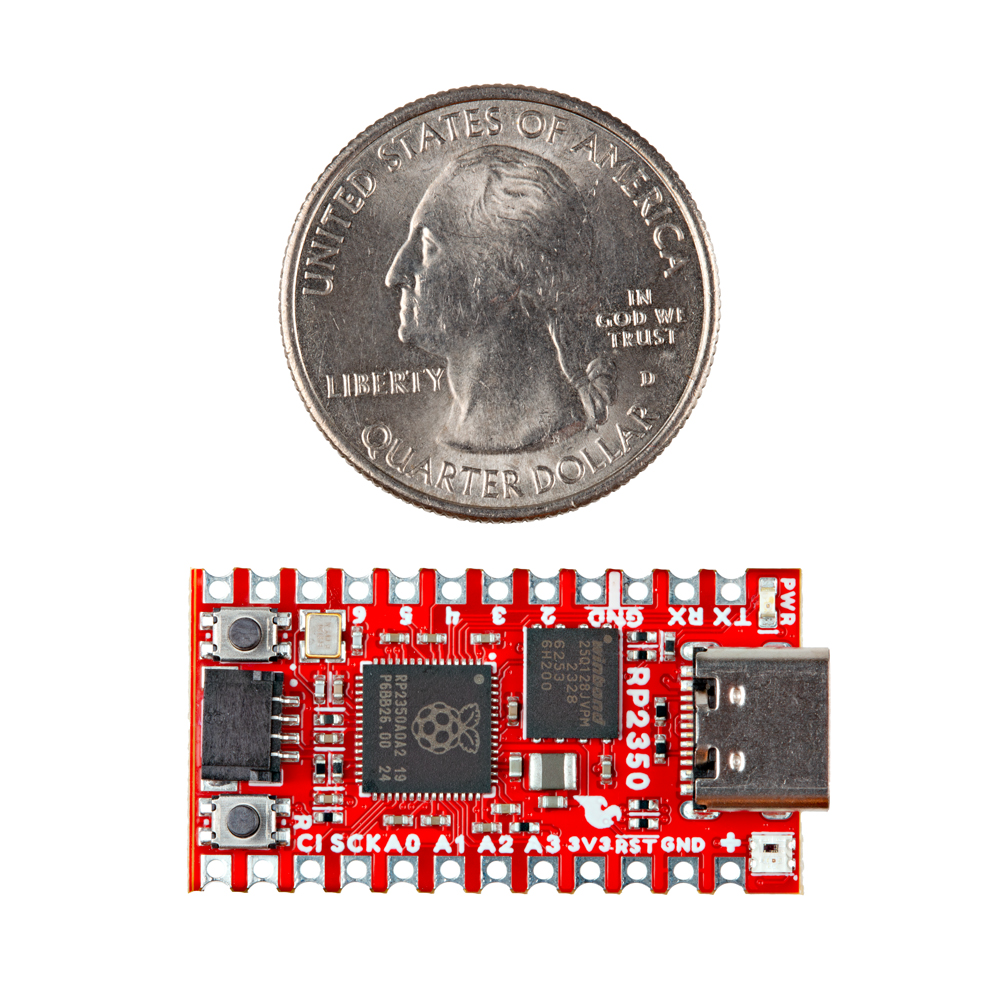
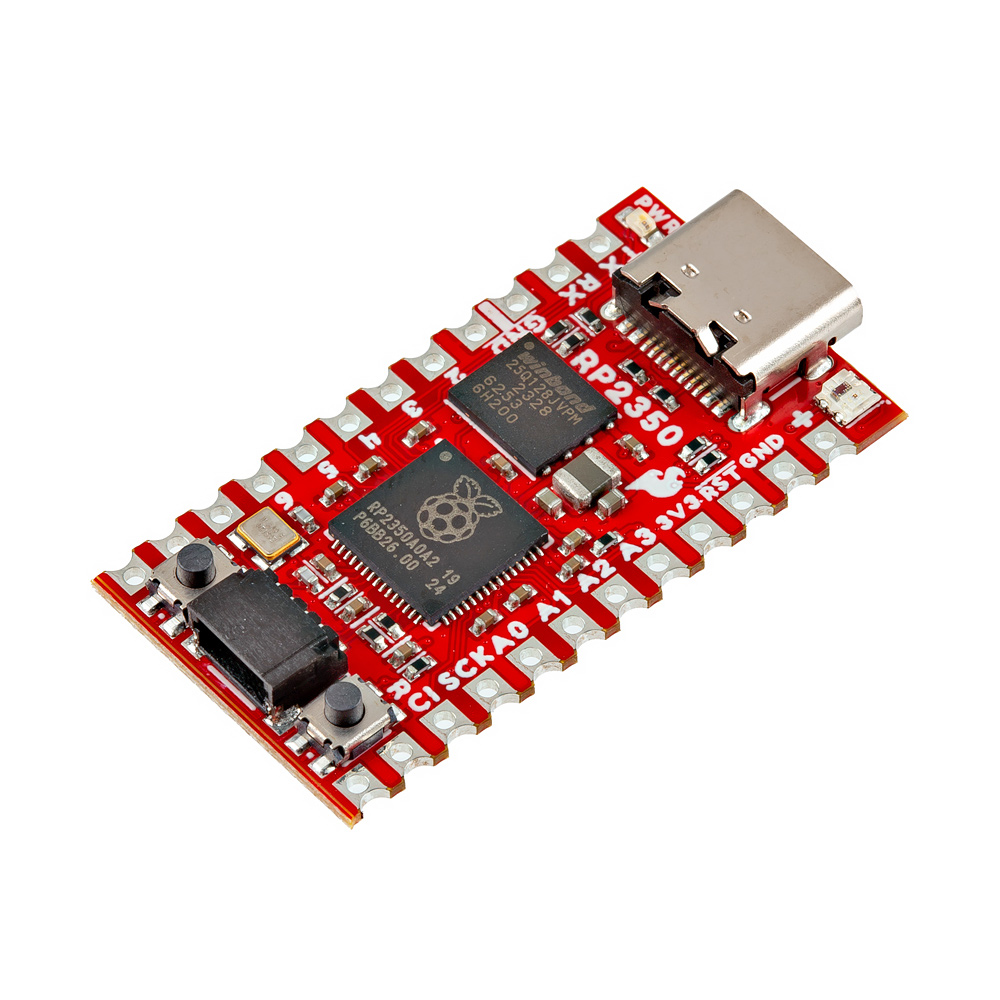
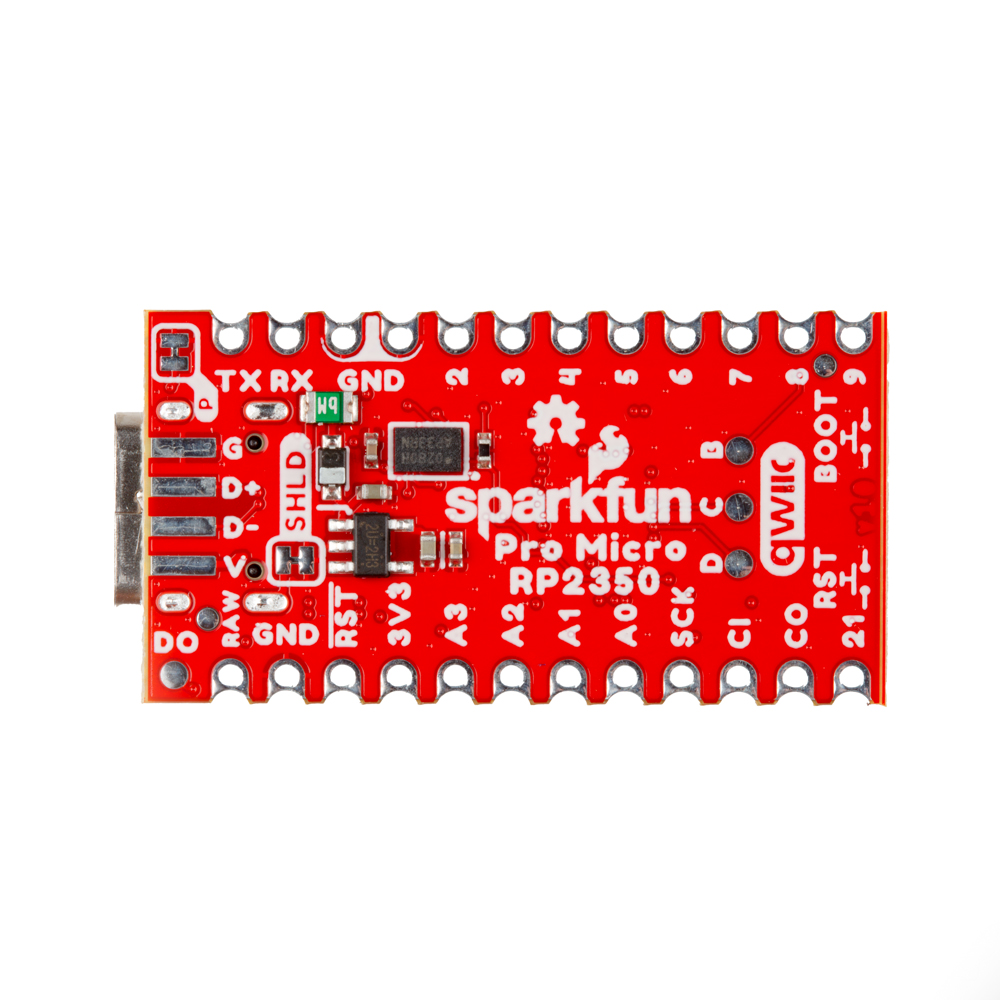
Pinout diagram
| Attr | Specs | verified |
|---|---|---|
mcu_cpu | dual-core, selectable architecture: two Arm Cortex-M33 (Armv8-M, Security/TrustZone-M, DSP, single-precision FPU + double-precision coprocessor) or two Hazard3 RISC-V cores (RV32IMAC). Only one architecture runs at a time per core pair; cores can be swapped live via the ARCHSEL register plus core reset (datasheet §1.1, §3; also Clock: 150 MHz nominal. | ✔ |
gpu | none (no display engine; HSTX is a digital serial transmitter, see below). | ? unverified |
ram | 520 KB SRAM in 10 independently accessible banks, single-cycle access (datasheet §1.1). | ? unverified |
storage | no internal flash. 8 KB one-time-programmable (OTP) memory. External QSPI flash/PSRAM up to 16 MB with execute-in-place (XIP) + optional second chip select for another 16 MB. RP2354 adds 2 MB in-package flash. | ? unverified |
connectivity | no WiFi/Bluetooth on-chip. 1× USB controller: USB 2.0 Full-Speed device (12 Mb/s), Full/Low-Speed host (integrated USB 1.1 PHY) (datasheet §12 USB). Wireless on "W" boards (e.g. Pico 2 W) comes from an add-on radio companion chip. | ? unverified |
gpio_peripherals | - 30 GPIO (RP2350A) or 48 GPIO (RP2350B); IO voltage IOVDD 1.8–3.3 V (datasheet §1.2 pin description tables). - ADC: 12-bit SAR, 500 kSPS, 4 channels (A) / 8 channels (B) + internal temperature channel (datasheet; No DAC. - PWM: 8 (A) / 12 (B) dual-channel slices = 16/24 channels ( - 2× UART, 2× SPI, 2× I²C, 1× QSPI (XIP), 1× HSTX high-speed serial transmitter (output-only, 8 pins, DDR — Wikipedia cites 300 Mb/s per pin). - PIO: 3 blocks, 12 state machines total (vs 2 blocks / 8 SMs on RP2040), with 2 dedicated IRQs per block (PIO0/1/2_IRQ_0/1) vs one shared pair on RP2040 (datasheet §3.2 interrupt table, p.81–82). - DMA: 16 channels, 4 IRQ outputs (datasheet interrupt table DMA_IRQ_0–3; comparison table in - Interrupts: 52 IRQ inputs per core, all routed to both cores (datasheet §3.2). | ✔ |
power | on-chip SMPS (buck, up to 200 mA, VOUT 0.55–3.3 V, nominal 1.1 V core) + low-quiescent LDO mode (up to 1 mA for state retention in sleep); VREG_VIN 2.7–5.5 V; USB_OTP_VDD and ADC_AVDD 3.3 V (datasheet §1.1, §6.3, §14.9.6). | ? unverified |
temperature | ambient operating range −40 to 85 °C (datasheet §14.9.3, Table 1682); regulator over-temperature shutdown, junction threshold configurable 100–150 °C (datasheet §6.3.6). | ? unverified |
process_package | 40 nm ( 5.3×5.3 mm die in QFN-60EP or QFN-80EP, 0.4 mm pitch (Wikipedia). | ✔ |
rp2040_relationship | the RP2350 is software-compatible with the RP2040 (same SDK family, PIO heritage) per At board level, Pico-2-format boards keep the original Pico's 40-pin, 51×21 mm, 0.1″-castellation format (Pico 2 Datasheet, mechanical spec). The chip package itself (QFN-60/80) is not pin-identical to RP2040's QFN-56 — compatibility is at SDK/board level, not silicon footprint. | ✔ |
- Manufacturer: Raspberry Pi Ltd (UK). The RP2350 is Raspberry Pi's second microcontroller silicon, after the RP2040. This card covers the chip itself and the many third-party "generic RP2350" boards built around it (Pico-2 compatible modules, Pro Micro, XIAO, Stamp, etc.), not the Raspberry Pi Pico 2 board specifically.
- Announced: 8 August 2024, launched on the Raspberry Pi Pico 2 at US$5; the RP2350 chip itself costs as little as US$0.80 in volume ( retrieved 2026-10-13).
- Status: Active. Raspberry Pi guarantees availability of the Pico 2 board until at least January 2040 (Raspberry Pi Pico 2 Datasheet, "Availability", retrieved 2026-10-13).
- Variants (chip): RP2350A (30 GPIO, QFN-60 7×7 mm), RP2350B (48 GPIO, QFN-80 10×10 mm), RP2354A/RP2354B — same packages with 2 MB in-package QSPI NOR flash stacked on the die ( RP2350 Datasheet §1.1, Silicon steppings A2 → A3 → A4 (A4 identified by CHIP_ID.REVISION = 0x3; datasheet Appendix C, retrieved 2026-10-13).
- Common board formats using it: Raspberry Pi Pico 2 / Pico 2 W; SparkFun Pro Micro RP2350 & Thing Plus RP2350; Seeed XIAO RP2350; Solder Party RP2350 Stamp (XL); Waveshare RP2350 Core/Zero/Plus/PiZero; Pimoroni PicoPlus2 / Tiny2350 / Plasma2350; Adafruit Metro RP2350 / Feather RP2350; Olimex Pico2XL/XXL; "Generic RP2350" entries in the Arduino-Pico core ( retrieved 2026-10-13).
+ Strengths
- Selectable CPU architecture at runtime: dual Cortex-M33 or dual Hazard3 RISC-V at 150 MHz, switchable without power-cycling (ARCHSEL + core reset) — unique at this price point (datasheet §1.1; Wikipedia).
- Security stack unusual for $1 silicon: Arm TrustZone-M extended system-wide — peripherals, GPIOs and DMA channels are individually assignable to Secure/Non-secure domains; 8 SAU regions + 8+8 MPU regions per core; secure boot (SHA-256 + secp256k1 ECDSA, OTP public-key fingerprint, anti-rollback); encrypted boot keys in OTP; hardware SHA-256 accelerator; TRNG (Arm IP block); redundancy coprocessor (RCP) and glitch detector as fault-injection mitigations (datasheet §10, §3.6.3, §12.12–12.13).
- Triple PIO: 3 PIO blocks / 12 SMs with per-block IRQs, plus HSTX for high-speed digital video-style output — RP2040-compatible philosophy, doubled I/O horsepower (datasheet §1.1, §3.2).
- 520 KB RAM in 10 banks (2× RP2040), 8 KB OTP, 16+16 MB addressable QSPI.
- Low-cost, long-lived: from $0.80 in volume; board availability guaranteed to 2040 (Wikipedia; Pico 2 Datasheet).
- Broad language support: C/C++, MicroPython, CircuitPython, Arduino, Rust (embassy/rp-hal), Free Pascal, assembly (Wikipedia; ecosystem READMEs above).
− Weaknesses
- RP2350-E9 — Bank 0 GPIO input leakage (the big one). Early chips (stepping A2): pins configured as inputs source ~120 µA when the input sits between logic levels, floating inputs to ~2.2 V; originally documented as "latching pull-down" errata, reclassified as "increased leakage current on Bank 0 GPIO when pad input is enabled". Reported by users incl. the Bus Pirate developers. Fixed in A3/A4 steppings announced July 2025. References: ; ;
- RP2350-E3 (QFN-60 only): GPIO_NSMASK0 applies Non-secure PADS permissions to the wrong pads because the register mapping ignores the QFN-60 pad remapping — affects TrustZone use of PADS registers on RP2350A (datasheet Appendix D.1.1).
- Bootrom errata fixed in later steppings: E13 (invalid IMAGE_DEF blocks boot), E14 (connect_internal_flash ignores CS1 pin), E15 (OTP page 62/63 permissions), E18 (bad ECC pattern in OTP partition field bricks boot), E22–E23, E25 — see datasheet Appendix C/D (A3/A4 bootrom changelists).
- Fault-injection findings from the DEF CON 32 hacking challenge: the $10k→$20k OTP-read challenge was won in January 2025 (4 winners) via laser fault injection on secure boot and focused-ion-beam OTP read-out; Raspberry Pi shipped mitigations as errata E20/E21/E24/E26 (bootrom changes in A3/A4). ; datasheet Appendix C.2–C.3.
- Secure boot disables RISC-V: signature enforcement lives on the Cortex-M33 boot path, so enabling SB forces Arm cores (Wikipedia, citing datasheet §10).
- Generic boards need a custom SDK board header: pico-sdk master ships pico2/pico2_w headers but no "generic RP2350" header; third-party boards either ship a header (Arduino core does) or you write one (
- 150 MHz vs RP2040's 200 MHz: the RP2350 clock is lower than RP2040's 200 MHz despite the faster cores — don't assume cycle-counting portability when migrating RP2040 code (Wikipedia comparison table).
- Retour d'expérience expert expert — expert-microcontroleur
- Retour d'experience sur les cartes generiques RP2350. Le selcteur d'architecture entre Cortex-M33 et Hazard3 RISC-V a 150 MHz est reellement utile et fonctionne sans réinitialisation materielle. Par contre attention aux steppings. Les puces A2 souffrent de l'errata RP2350-E9 sur la fuite en entrée … — expert-microcontroleur
- Salut, je confirme pour le E9 sur mon Stamp RP2350. J'ai passe des heures a diagnostiquer pourquoi mes entrées analogiques etaient faussees par les numériques voisines. En mettant des résistances de pull-down externes sur chaque ligne sensible, j'ai stabilise la lecture, mais ça consomme de la plac… — maker-bidouilleur-42
- Interessante remarque sur le E9. Pour ma part, j'utilise surtout le mode RISC-V Hazard3 pour des taches de calcul vectoriel et la bascule dynamique est fluide. Par contre, je n'ai pas rencontre le E3 sur mes cartes Pico-compatible, mais je suppose que ce n'est pas du QFN-60 ? Si tu as un module Pro… — dev-embedded-riscv
Community feedback and projects
- Using both I2C channels on RP2350 forum.arduino.cc
- Waveshare RP2350-Touch-AMOLED-1.43" forum.arduino.cc
- Linux Runs on Raspberry Pi RP2350's Hazard3 RISC-V Cores (2024) hackster.io
- I got almost all of my wishes granted with RP2350 dmitry.gr
- Photon-Emission-Guided Laser Fault Injection Enables RP2350 Secure Debug donjon.ledger.com
Content not available yet.
- RP2350 Datasheet (authoritative, PDF)
- Pico 2 board datasheet (reference design)
- Pico C/C++ SDK
- Pico C/C++ SDK
- Pico C/C++ SDK
- pico-extras (HSTX/scanvideo/audio, WIP)
- Errata / hardware feedback tracker
- Wikipedia RP2350 overview
- MicroPython RP2 port
- Arduino-Pico core (RP2040/RP2350)
- Arduino-Pico core (RP2040/RP2350)
- Rust
- Rust
- Rust
- RISC-V toolchain for RP2350
- Community
- Community
- RP2350-E9 — Bank 0 GPIO input leakage (the big one). Early chips (stepping A2): pins configured as inputs source ~120 µA when the input sits between logic levels, floating inputs to ~2.2 V; originally documented as "latching pull-down" errata, reclassified as "increased leakage current on Bank 0 GPIO when pad input is enabled". Reported by users incl. the Bus Pirate developers. Fixed in A3/A4 steppings announced July 2025. References: ; ;
- RP2350-E3 (QFN-60 only): GPIO_NSMASK0 applies Non-secure PADS permissions to the wrong pads because the register mapping ignores the QFN-60 pad remapping — affects TrustZone use of PADS registers on RP2350A (datasheet Appendix D.1.1).
- Bootrom errata fixed in later steppings: E13 (invalid IMAGE_DEF blocks boot), E14 (connect_internal_flash ignores CS1 pin), E15 (OTP page 62/63 permissions), E18 (bad ECC pattern in OTP partition field bricks boot), E22–E23, E25 — see datasheet Appendix C/D (A3/A4 bootrom changelists).
- Fault-injection findings from the DEF CON 32 hacking challenge: the $10k→$20k OTP-read challenge was won in January 2025 (4 winners) via laser fault injection on secure boot and focused-ion-beam OTP read-out; Raspberry Pi shipped mitigations as errata E20/E21/E24/E26 (bootrom changes in A3/A4). ; datasheet Appendix C.2–C.3.
- Secure boot disables RISC-V: signature enforcement lives on the Cortex-M33 boot path, so enabling SB forces Arm cores (Wikipedia, citing datasheet §10).
- Generic boards need a custom SDK board header: pico-sdk master ships pico2/pico2_w headers but no "generic RP2350" header; third-party boards either ship a header (Arduino core does) or you write one (
- 150 MHz vs RP2040's 200 MHz: the RP2350 clock is lower than RP2040's 200 MHz despite the faster cores — don't assume cycle-counting portability when migrating RP2040 code (Wikipedia comparison table).
- Flasher MicroPython sur une carte RP2350 générique et faire clignoter la première LED debutant Schéma : IMG-rp2350-generic-debutant-1-rp2350-flash-micropython.svg — carte RP2350 générique au format Pico (type Pimoroni Tiny2350 ou XIAO RP2350) maintenue par un doigt sur le bouton BOOT, câble USB branché, fenêtre Thonny avec le REPL MicroPython, LED GP25 illuminée
- Console série sur RP2350 : USB CDC natif et UART0 de secours debutant Schéma : IMG-rp2350-generic-debutant-2-rp2350-console-serie-uart.svg — carte RP2350 générique branchée en USB sur un PC (console CDC), et en parallèle un adaptateur USB-TTL relié à GP0 (TX0) et GP1 (RX0) avec masse commune, terminal à 115200 bauds
- Lire l'ADC 12 bits et le capteur de température interne du RP2350 debutant Schéma : IMG-rp2350-generic-debutant-3-rp2350-adc-capteur-interne.svg — carte RP2350 générique, potentiomètre entre 3V3, GND et curseur sur GP26 (ADC0), puce RP2350 avec bloc ADC 12-bit SAR 500 kSPS et canal température interne, graphique des valeurs 0..4095
- Exploiter les 3 blocs PIO et 12 machines d'état du RP2350 (avec IRQ dédiées) intermediaire Schéma : IMG-rp2350-generic-intermediaire-1-rp2350-pio-3-blocs-irq.svg — puce RP2350 avec les 3 blocs PIO (PIO0/1/2) et leurs 4 machines d'état chacun, signal WS2812 sur PIO0 et compteur sur PIO1, IRQ par bloc reliant PIO et cœurs, LED GP25 animée par la PIO
- Pico SDK 2.x sur une carte RP2350 générique : CMake, board header et PICO_BOARD intermediaire Schéma : IMG-rp2350-generic-intermediaire-2-rp2350-sdk2-board-header.svg — éditeur de code avec CMakeLists.txt et un fichier d'en-tête board custom (maquette de brochage), ligne de commande cmake -DPICO_BOARD=..., carte RP2350 générique connectée en USB avec outil picotool
- Basculer les cœurs de Arm Cortex-M33 à Hazard3 RISC-V avec ARCHSEL intermediaire Schéma : IMG-rp2350-generic-intermediaire-3-rp2350-archsel-riscv.svg — puce RP2350 coupée en deux moitiés, à gauche deux cœurs Cortex-M33 (Armv8-M), à droite deux cœurs Hazard3 (RV32IMAC), registre ARCHSEL et reset de cœur comme interrupteur entre les deux, terminal affichant le banner RISC-V
- Secure boot et TrustZone-M sur RP2350 : signer son firmware sans se faire avoir avance Schéma : IMG-rp2350-generic-avance-1-rp2350-secure-boot-trustzone.svg — puce RP2350 avec bloc boot ROM vérifiant une signature ECDSA secp256k1, mémoire OTP avec empreinte de clé publique et compteur anti-recul, domaines Secure/Non-Secure séparés par la SAU, cœurs RISC-V barrés (désactivés par le secure boot)
- HSTX : générer une sortie vidéo/parallèle haute vitesse avec les 8 broches DDR avance Schéma : IMG-rp2350-generic-avance-2-rp2350-hstx-scanvideo.svg — puce RP2350 avec bloc HSTX, 8 broches de sortie en DDR reliées à un écran RGB passif et un réseau de résistances (DAC R-2R), trame pixel horodatée, PIO et DMA alimentant le HSTX depuis la SRAM 520 Ko
- Auditer le stepping de son RP2350 : fuite Bank 0 (E9), errata bootrom et parades avance Schéma : IMG-rp2350-generic-avance-3-rp2350-errata-stepping-audit.svg — puce RP2350 vue de dessus avec le registre CHIP_ID.REVISION en loupe, broches du Bank 0 surlignées avec un courant de fuite de 120 µA vers une entrée flottante à 2,2 V, calendrier A2 → A3 → A4, multimètre en mesure de courant
Code library — examples written for this board
clignotante.pyPythonbouton-interruption.pyPythonpwm-servo.pyPythonlecture-adc.pyPythonneopixel.pyPythonoled-i2c.pyPythoncapteur-dht.pyPythonjournalisation.pyPythonuart-commandes.pyPythontaches-cooperatives.pyPython
Examples and repos found online
- raspberrypi/pico-examples github.com
- raspberrypi/pico-sdk github.com
- earlephilhower/arduino-pico github.com
- melastmohican/rust-rpico2-embassy-examples github.com
- johnwalicki/RaspPi-Pico-Examples-Fedora github.com