Sipeed Lichee RV Dock (Allwinner D1 / T-Head XuanTie C906)
⚡ The essentials in 60 seconds
- soc — Allwinner D1 (sun20i family), the first mass-market RISC-V application SoC from Allwinner; CPU core is a T-Head XuanTie C906 (mainline binding compatible = "thead,c906", "riscv").
- cpu — 1 core, 64-bit RISC-V RV64IMAFDC + T-Head XuanTie vector extension (xtheadvector, thead,vlenb = <16>), mmu-type = "riscv,sv39", 32 KB I-cache + 32 KB D-cache (64-byte lines), timebase 24 MHz (sun20i-d1s.dtsi). Clock: two OPPs in mainline — 408 MHz and 1,008 MHz @ 0.9 V (the opp-1080000000 node carries opp-hz = <1008000000>); Sipeed/CNX marketing say "up to 1 GHz" (Sipeed wiki RV page). Interrupt controller: T-Head C900-compatible PLIC (thead,c900-plic, 175 sources).
- other_compute — HiFi4 DSP and G2D 2D accelerator in the D1 (same SoC spec block in CNX's MangoPi MQ Pro article, 2022-04-09). No 3D GPU.
- ram — 512 MB DDR3, 16-bit bus, up to 792 MHz, in-package with the SoC (the module overview: "equipped with Allwinner D1 chip … 512MB DDR3"; "16bits 512MB DDR3, Up to 792MHz") (Sipeed wiki RV page).
- storage — microSD slot on the module (TF, 4-bit mmc0; "1TB storage capacity have been tested ok"); SPI NOR footprint (SOP8 pad) on the Dock; SD-NAND pads on the module (multiplexed with the 8-pin LCD interface) (Sipeed wiki Dock page, CNX 2021-12-30).
- video_out — HDMI up to 4Kp30 on the Dock; MIPI DSI 4-lane (up to 1080p60 via the Display Shell add-on), RGB888 parallel (up to 720p30), I80 MCU and 8-pin SPI screen interfaces on the module (CNX 2021-12-30, Sipeed wiki RV page).
- On this board : 9 tutorials · 10 code
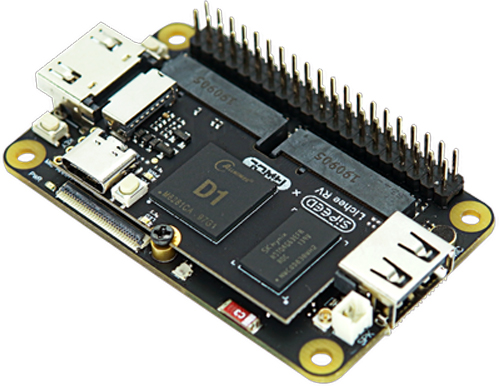
The Sipeed Lichee RV Dock represents a pivotal moment in the democratization of open-source hardware, specifically within the realm of RISC-V architecture. Introduced in late 2021, this kit comprises two distinct physical components: the Lichee RV System-on-Module (SoM), often referred to as the "Nezha CM," and the Dock carrier board. This modular approach is central to the device’s philosophy. The SoM contains the core computing elements, while the Dock provides the user-friendly interfaces needed to interact with the computer, such as ports and connectors. By separating these functions, Sipeed created a platform where the same compute module can be swapped between different carrier boards, allowing developers to choose the exact interface configuration they need for their project, whether that is a standard desktop setup, a home automation panel, or a custom embedded device. At its launch, the starter kit was priced at just $20.90, a figure that led industry observers to describe it as the most affordable usable RISC-V Linux development board on the market, effectively lowering the barrier to entry for experimenting with this new instruction set architecture.
At the heart of the Lichee RV module lies the Allwinner D1 system-on-chip, which was the first mass-market application processor from Allwinner to utilize the RISC-V instruction set. The central processing unit within this chip is the T-Head XuanTie C906, a single-core 64-bit processor. To understand its capabilities, it is helpful to look at the technical specifications in plain terms. The processor operates at speeds up to 1.008 GHz, which is a measure of how many cycles it can perform per second. While this speed is modest compared to high-end desktop CPUs, it is sufficient for running a full Linux operating system and handling typical embedded tasks. The chip supports the RV64IMAFDC instruction set, a standard baseline for 64-bit RISC-V processors, ensuring compatibility with a wide range of software. Additionally, it includes a T-Head vector extension, which allows the processor to perform the same operation on multiple data points simultaneously, a feature useful for signal processing and multimedia tasks. The system is equipped with 512 MB of DDR3 RAM, which is memory used for temporary storage of active applications. While this amount of memory is adequate for command-line operations, lightweight servers, and basic media playback, it is not designed for heavy multitasking or running complex graphical desktop environments.
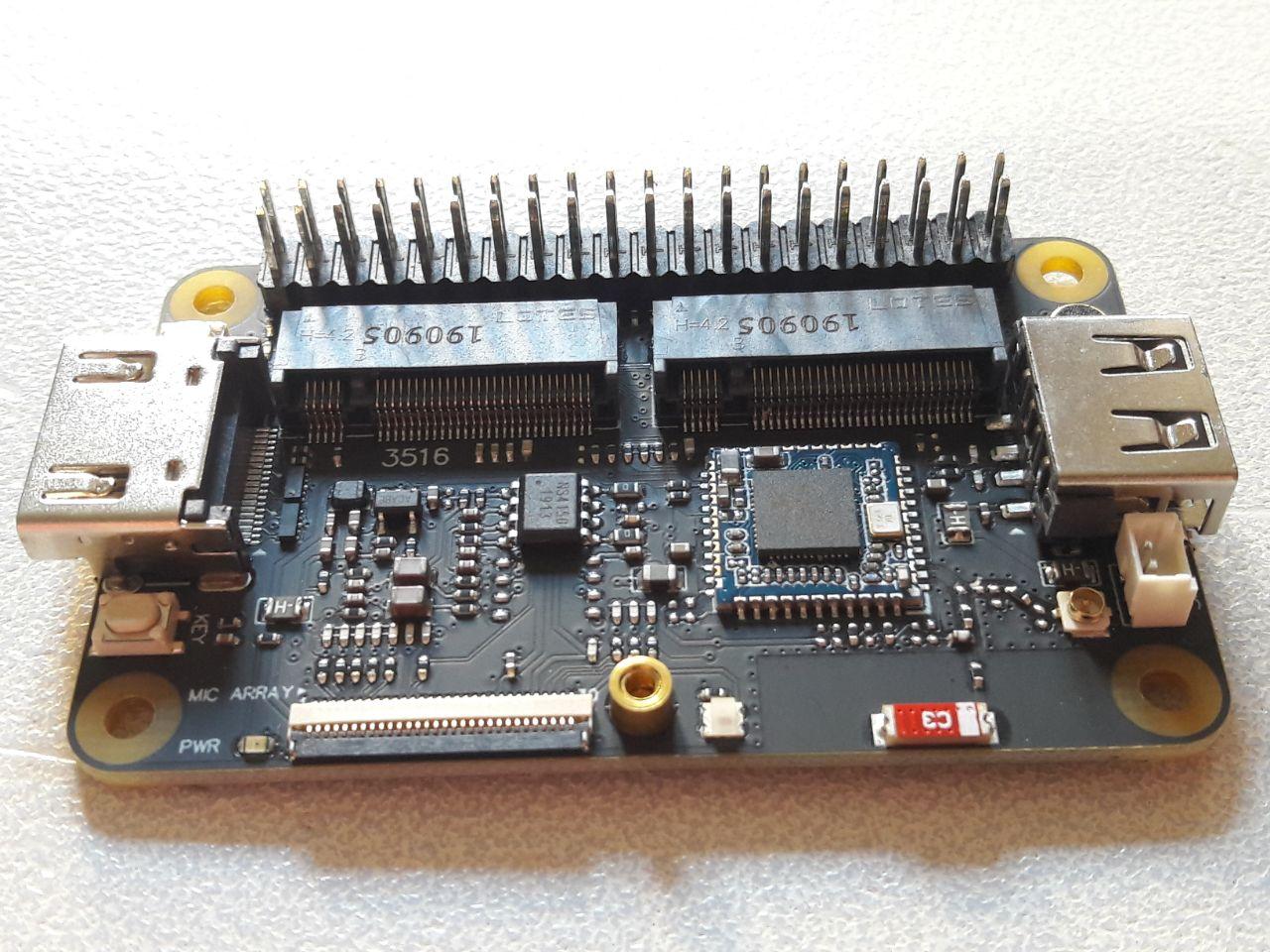
The Dock carrier board is designed to make the module accessible and easy to use for hobbyists and engineers alike. It measures 65.0 by 40.0 millimeters, a compact form factor reminiscent of other popular single-board computers. The board features a full-size HDMI port capable of outputting video at up to 4K resolution at 30 frames per second, allowing the device to connect to modern monitors and televisions. For connectivity, it includes a USB-A host port for connecting peripherals like keyboards, mice, or storage drives, and a USB-C port for power and data. A notable hardware quirk documented by Sipeed is that the USB-C port uses a specific configuration for automatic On-The-Go (OTG) detection, which means that standard USB-C to USB-C cables may not work for data transfer without a hardware modification involving soldering resistors. Users should be aware of this limitation and may prefer using USB-A to USB-C cables for simplicity. The board also includes two 20-pin GPIO headers, providing access to the general-purpose input/output pins of the processor. These pins allow for direct interaction with electronic components, sensors, and actuators, making the board suitable for physical computing projects. The logic level for these pins is 3.3 Volts, a standard voltage for modern microcontrollers, so care must be taken when connecting devices that operate at 5 Volts to avoid damage.
One of the standout features of the Lichee RV Dock is its emphasis on audio capabilities, which is unusual for a board in this price range. It includes a 3-watt speaker amplifier, allowing it to drive a small speaker directly without external amplification. Additionally, there is an on-board electret microphone and support for digital microphones, making it a compelling platform for voice-controlled projects and smart home applications. The board also features a WS2812 RGB LED, often referred to as a NeoPixel, which is driven by a dedicated hardware controller on the chip. This allows for complex lighting effects without burdening the main processor, as the hardware handles the precise timing required to control the LED colors. For wireless connectivity, the board can be equipped with an optional Realtek RTL8723DS module, which provides Wi-Fi 4 (802.11b/g/n) and Bluetooth 4.2. This module connects via the SDIO interface, a high-speed bus typically used for memory cards, ensuring stable performance for network tasks.
Software support for the Lichee RV Dock has matured significantly since its release. The board is supported by mainline Linux, meaning that the necessary drivers and configuration files are included in the official Linux kernel, ensuring long-term support and compatibility with standard Linux distributions. This mainline support was merged into the Linux kernel in early 2023, marking a significant milestone for the RISC-V ecosystem. Users can install various operating systems, including Debian, Ubuntu Server, and Arch Linux RISC-V, as well as specialized distributions like Buildroot for creating minimal, custom images. The availability of an official Ubuntu 24.04 Server image further validates the board’s utility for server-side applications. However, it is important to note that due to the lack of fully supported open-source graphics drivers for the integrated display controller, graphical desktop environments are not fully functional, and the board is best suited for headless server operations or command-line interfaces. The community and Sipeed provide extensive documentation, including device trees and build instructions, to help users get started. While the board has some known limitations, such as the USB-C cable issue and the need for vendor-specific drivers for Wi-Fi and Bluetooth, it remains a powerful and affordable tool for exploring the potential of RISC-V technology in embedded systems, IoT devices, and educational projects.
Pinout diagram
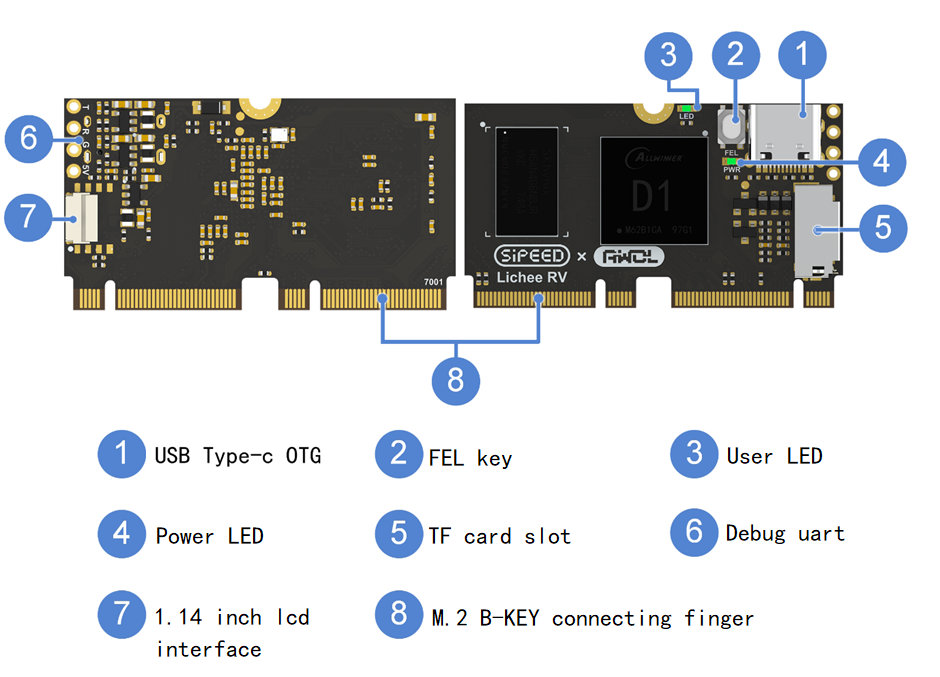
| Attr | Specs | verified |
|---|---|---|
soc | Allwinner D1 (sun20i family), the first mass-market RISC-V application SoC from Allwinner; CPU core is a T-Head XuanTie C906 (mainline binding compatible = "thead,c906", "riscv"). | ? unverified |
cpu | 1 core, 64-bit RISC-V RV64IMAFDC + T-Head XuanTie vector extension (xtheadvector, thead,vlenb = <16>), mmu-type = "riscv,sv39", 32 KB I-cache + 32 KB D-cache (64-byte lines), timebase 24 MHz (sun20i-d1s.dtsi). Clock: two OPPs in mainline — 408 MHz and 1,008 MHz @ 0.9 V (the opp-1080000000 node carries opp-hz = <1008000000>); Sipeed/CNX marketing say "up to 1 GHz" (Sipeed wiki RV page). Interrupt controller: T-Head C900-compatible PLIC (thead,c900-plic, 175 sources). | ✔ |
other_compute | HiFi4 DSP and G2D 2D accelerator in the D1 (same SoC spec block in CNX's MangoPi MQ Pro article, 2022-04-09). No 3D GPU. | ✔ |
ram | 512 MB DDR3, 16-bit bus, up to 792 MHz, in-package with the SoC (the module overview: "equipped with Allwinner D1 chip … 512MB DDR3"; "16bits 512MB DDR3, Up to 792MHz") (Sipeed wiki RV page). | ✔ |
storage | microSD slot on the module (TF, 4-bit mmc0; "1TB storage capacity have been tested ok"); SPI NOR footprint (SOP8 pad) on the Dock; SD-NAND pads on the module (multiplexed with the 8-pin LCD interface) (Sipeed wiki Dock page, CNX 2021-12-30). | ✔ |
video_out | HDMI up to 4Kp30 on the Dock; MIPI DSI 4-lane (up to 1080p60 via the Display Shell add-on), RGB888 parallel (up to 720p30), I80 MCU and 8-pin SPI screen interfaces on the module (CNX 2021-12-30, Sipeed wiki RV page). | ✔ |
audio | on-board 3 W speaker amplifier (4 Ω 3 W speaker) + speaker connector, electret (analog) microphone circuit, 2-channel DMIC (PDM, pins PB11 data / PE17 clk, enabled in the mainline Dock DTS), 30-pin FPC connector for the Mic Array R6 (6-mic) add-on; module-level: HPOUT, LINEIN, MIC3, I2S/SPDIF (Sipeed wiki Dock page, sun20i-d1-lichee-rv-dock.dts). | ✔ |
wireless | optional Realtek RTL8723DS — Wi-Fi 4 (802.11b/g/n, 2.4 GHz) + Bluetooth 4.2, SDIO 4-bit on mmc1 with reset GPIO PG12, BT on uart1 with RTS/CTS (PG16/PG17/PG18 wake/enable lines), ceramic patch antenna + IPEX connector (CNX 2021-12-30, mainline Dock DTS). | ✔ |
wired_network | none on the Dock (the RV-86 Panel sibling has 100M Ethernet; the module can route RMII/RGMII to its connectors) (Sipeed wiki RV page). | ✔ |
usb | 1× USB-C OTG (USB0, on the module — power + gadget + FEL) and 1× USB-A host (USB1, ehci1/ohci1 enabled in the Dock DTS) (mainline Dock DTS). | ✔ |
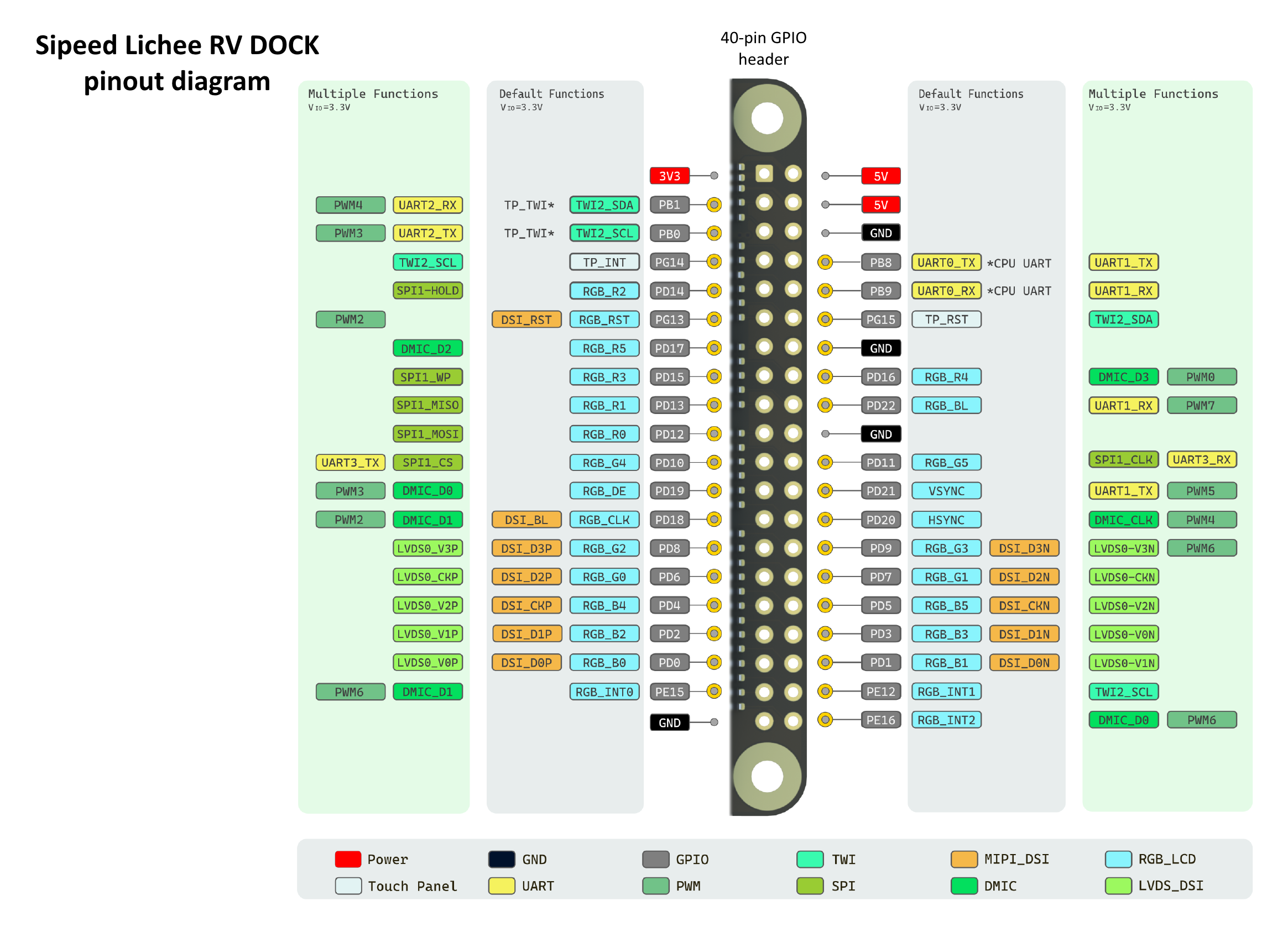
gpio_expansion | 2×20P 2.54 mm header (40 pins) with most module GPIOs, plus the RGB/MIPI screen interfaces routed to the header; the SoM routes all IO through two M.2-B 67-pin connectors; module also exposes I2C (e.g. i2c0 PB10/PB11, i2c2 PB0/PB1), UART, JTAG, LRADC (the Dock's user key is on the ADC — "user key (ADC)", CNX 2021-12-30), PWM and the LEDC (WS2812 controller) on PC0 (Sipeed wiki Dock page, sun20i-d1.dtsi). | ✔ |
misc | WS2812 RGB LED on PC0 driven by the D1 LEDC peripheral (enabled in mainline DTS as a multicolor status LED), power LED, module user LED on PC1, Reset key, user key, FEL key (download mode) (mainline Dock DTS, Sipeed wiki Dock page). | ✔ |
power | 5 V through the module's USB-C port (the Dock has no separate DC jack); CPU core rail fixed at 0.9 V (reg_vdd_cpu, 900000 µV) in the mainline DTS (sun20i-d1-lichee-rv.dts). | ✔ |
temperature | mainline thermal zone trips: 85 °C passive (CPU throttling), 100 °C critical, sensor = on-die THS (sun20i-d1s.dtsi). | ✔ |
format | 65.0 × 40.0 mm, 2-layer Dock + 4-layer module; Pi-Zero-like footprint in spirit (not electrically compatible) (Sipeed wiki RV page, CNX 2021-12-30). | ✔ |
- Manufacturer: Sipeed (Shanghai Sipeed Long Microelectronics Technology Co., Ltd.), Shenzhen/Shanghai, China — brand of RISC-V dev kits (wiki.sipeed.com — Lichee RV Dock, retrieved 2026-10-13).
- Year introduced: the Lichee RV module launched November 2021 ("Sipeed introduced the Lichee RV Allwinner D1 Linux RISC-V board going for just $17 with 512MB RAM last month" — CNX Software, 2021-12-30); the Dock carrier board went on sale December 2021 (same CNX article).
- Launch price: Dock carrier US$5 (bare) / US$8 with the Realtek RTL8723DS Wi-Fi+BT module; starter kit (module + Dock) US$20.90, or US$23.90 with Wi-Fi/BT; Display Shell add-on $4.28; 6-mic array $16.90 (CNX 2021-12-30). CNX called it "by far the most affordable (usable) RISC-V Linux development board on the market" at launch — the Lichee RV kit is widely treated as the board that made RISC-V Linux SBCs cheap enough for the mass market (same article).
- Variants: - Lichee RV Dock (this board, 65.0 × 40.0 mm): HDMI, USB-A host, 2×20P GPIO, WS2812 RGB LED, 3W speaker amp, electret mic, optional RTL8723DS Wi-Fi/BT (Sipeed wiki RV page — comparison table). - Lichee RV Dock Pro (June 2022): adds MIPI/RGB LCD connector, 2 built-in analog mics and an on-board BL702-based JTAG+UART debugger (CNX 2022-06-21). - Lichee RV-86 Panel (86-box, 4″ touchscreen, 100M Ethernet, 86×86 mm) (Sipeed wiki RV page, CNX 2022-05-31). - SoM RAM variants: the module is documented as 512 MB DDR3 on the Sipeed wiki overview and in every CNX spec block, but the same wiki's Dock/Panel comparison table says "1GByte", and CNX lists "512MB or 1GB DDR3" for later RV modules (CNX 2022-05-31).
- Status: Active in Sipeed's catalogue as of the current wiki (pages edited 2022+, still published 2026); mainline Linux support is maintained upstream (see Systems).
+ Strengths
- Cheapest usable Linux RISC-V SBC at launch — $20.90 starter kit, and the whole point of the product: a $17 module + $5 carrier (CNX 2021-12-30).
- Modular M.2-B compute module: the Lichee RV SoM routes all IO through two M.2-B key 67-pin connectors, so the same computer swaps between Dock / RV-86 Panel / custom carriers (Sipeed wiki RV page).
- Voice-first extras: 3 W speaker amp, analog mic, 2-ch digital mic (DMIC) and a 30P FPC for a 6-microphone array (Mic Array R6) — unusual for a $20 board; Sipeed pitched it for smart-audio/WAFT voice UI (Sipeed wiki Dock page, CNX 2022-05-31).
- Hardware WS2812 (NeoPixel) controller: the D1's LEDC peripheral drives the on-board RGB LED in mainline Linux — a multicolor LED class device, no bit-banging (mainline Dock DTS, RGB LED commit).
- T-Head XuanTie vector extension (xtheadvector, pre-rvv-1.0 vendor vector) exposed in the CPU description — historically significant for the first RISC-V vector toolchains (sun20i-d1s.dtsi).
- HDMI 4Kp30 + HiFi4 DSP + G2D on a single-core sub-$25 computer (CNX 2021-12-30, CNX 2022-04-09).
- FEL + SPI + SD-NAND boot media options for production (SOP8 SPI pad on the Dock, SD-NAND pads on the module) (Sipeed wiki Dock page).
− Weaknesses
- USB-C CC pin trap (hardware quirk, documented by Sipeed): the module's Type-C port uses the CC pin for automatic OTG ID, so C-to-C cables do not work out of the box — only A-to-C. Fixing it requires rework: solder 5.1 kΩ 1 % 0402 resistors on R30/R31 and remove diodes D3/D4, which then disables auto-OTG switching (Sipeed wiki RV page — Notice).
- T-Head C906/C9xx errata in mainline Linux: the core reports mvendorid/marchid/ mimpid as 0 ("target-c9xx cores report arch_id and impid as 0"), has no standard cache-management instructions (kernel patches in non-standard th.dcache.cpa/iva/… ops via CONFIG_ERRATA_THEAD_CMO), a PMU event-mapping erratum, the MAE address-mode erratum, and the GHOSTWRITE speculative side-channel tied to xtheadvector (CONFIG_ERRATA_THEAD_GHOSTWRITE marks the whole c9xx class vulnerable) (arch/riscv/errata/thead/errata.c).
- No hardware video codec in mainline: Allwinner's CedarX multimedia libraries "have no clear usage license", so 4K HDMI is display-only in open stacks; CNX likewise notes RISC-V SBC images stay server-only for graphics reasons (Wikipedia: Allwinner Technology, CNX 2024-05-28).
- Wi-Fi/BT needs vendor driver/firmware: the RTL8723DS is wired on SDIO with a GPIO power sequence and its BT on UART with wake lines; Buildroot carries a dedicated BR2_PACKAGE_RTL8723DS/RTL8723DS_BT package rather than a pure mainline path (sipeed_lichee_rv_dock_defconfig, mainline Dock DTS).
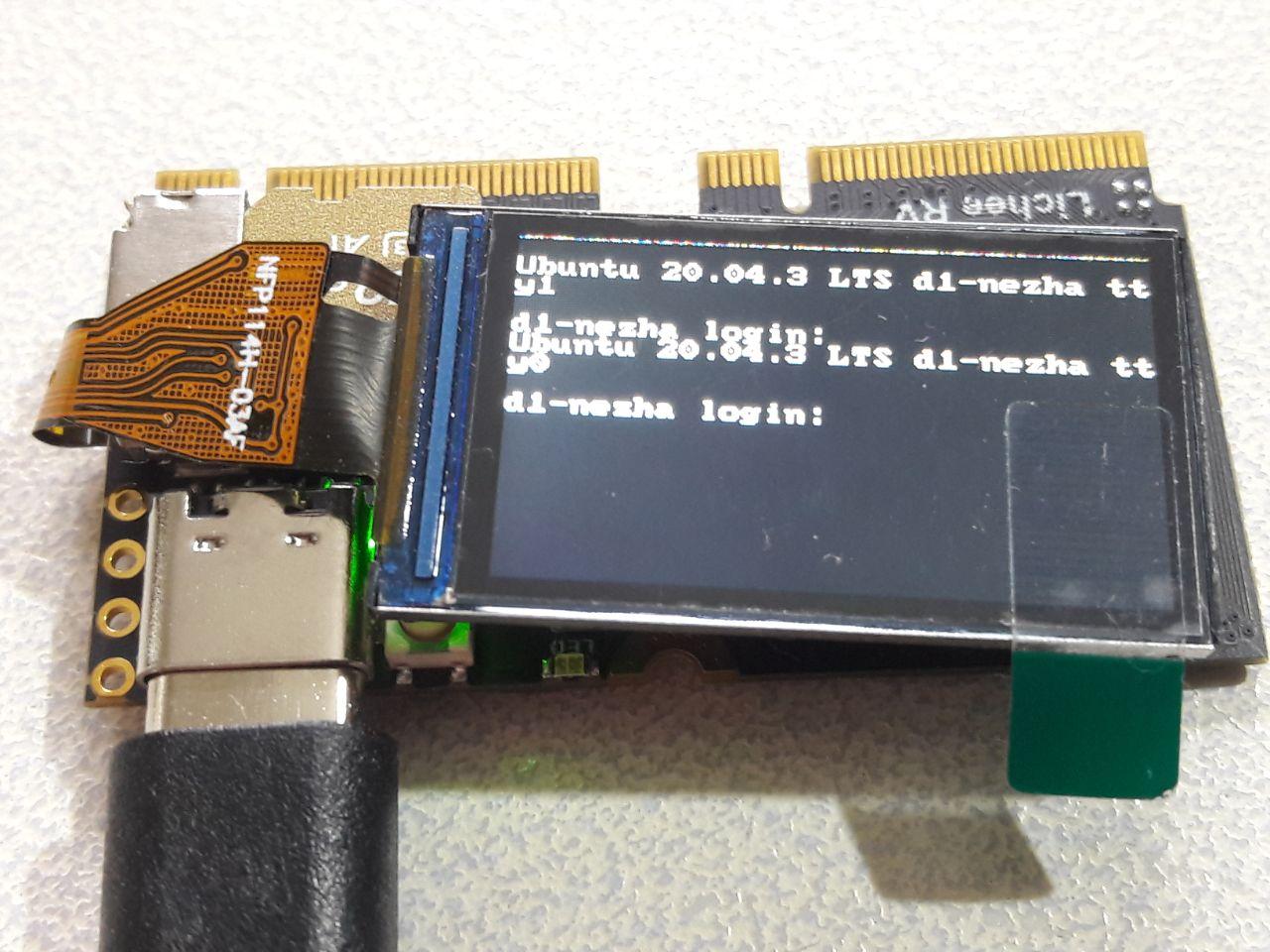
- On-board 1.14″ SPI display was never brought up: "Up to now 1.14 inch screen is not able to display and need to wait for updating" (wiki, page edited 2022-05-13) (Sipeed wiki RV page).
- Documentation drift: the same wiki page lists the Dock RAM as 512 MB (overview) and 1 GB (comparison table) — see Identity; and the Dock wiki was Chinese-only at launch (CNX 2021-12-30). CNX also noted the Dock's source schematics were not initially released (PDFs only) (same article; PDF schematics are now on dl.sipeed.com).
- Single core + 512 MB: fine for a serial console, Wi-Fi and small services; heavy desktop/browser workloads are out of scope (implied by every spec source; server-only Ubuntu image, CNX 2024-05-28).
- Retour d'expérience expert expert — expert-microcontroleur
- Retour sur la Lichee RV Dock. C'est bluffant pour le prix, surtout avec le support mainline Linux qui avance bien. Le SoC D1 est un vrai RISC-V avec extension vectorielle XuanTie, ce qui est historiquement cool, mais attention aux errata connus du noyau (cache, PMU) qui nécessitent des patchs spéci… — expert-microcontroleur
- Merci pour ce retour detaille. Je viens de recevoir mon kit a 20.90 $. Je n'ai pas encore essaye le rework, je vais me contenter des cables USB-A vers USB-C pour le power et le flash. Par contre, je bute sur la documentation : la fiche wiki mentionne parfois 1GB de RAM dans un tableau comparatif al… — maker-debutant-42
- Pour la RAM, la version standard du module Lichee RV est bien 512MB. Les mentions de 1GB concernent probablement d'autres variantes du SoM ou des erreurs de wiki, donc ne compte pas dessus pour la Dock de base. Concernant l'ecran 1.14 pouce, il n'est toujours pas supporte nativement, la note 'not a… — linux-riscv-fan
Community feedback and projects
- Sipeed Lichee RV RISC-V module gets $5+ carrier board with HDMI and USB ports, optional WiFi www.cnx-software.com
- Sipeed LicheeRV - A $16.90 Allwinner D1 Linux RISC-V board www.cnx-software.com
- Sipeed Lichee RV Dock Pro RISC-V SBC adds MIPI/RGB LCD connector, dual MIC, and BL702 JTAG+UART debugger www.cnx-software.com
Content not available yet.
- Lichee RV Dock
- Lichee RV module (Nezha CM)
- Flash tutorial
- BSP SDK
- Datasheet
- Schematic
- Bitmap
- Dimensions
- 3D files
- full download page
- sun20i-d1-lichee-rv-dock.dts
- sun20i-d1-lichee-rv.dts
- sun20i-d1s.dtsi (CPU/OPP/thermal)
- T-Head errata
- DTS merge commit (v6.3)
- Buildroot defconfig
- miloserdev/sunxi_licheerv (ArchLinux)
- CNX 2021-12-30 (Dock launch)
- CNX 2022-06-21 (Dock Pro)
- CNX 2022-05-31 (RV-86/WAFT)
- CNX 2024-05-28 (Ubuntu image)
- Wikipedia: Allwinner Technology
- linux-sunxi D1 page
- mega.nz folder linked from the wiki
- USB-C CC pin trap (hardware quirk, documented by Sipeed): the module's Type-C port uses the CC pin for automatic OTG ID, so C-to-C cables do not work out of the box — only A-to-C. Fixing it requires rework: solder 5.1 kΩ 1 % 0402 resistors on R30/R31 and remove diodes D3/D4, which then disables auto-OTG switching (Sipeed wiki RV page — Notice).
- T-Head C906/C9xx errata in mainline Linux: the core reports mvendorid/marchid/ mimpid as 0 ("target-c9xx cores report arch_id and impid as 0"), has no standard cache-management instructions (kernel patches in non-standard th.dcache.cpa/iva/… ops via CONFIG_ERRATA_THEAD_CMO), a PMU event-mapping erratum, the MAE address-mode erratum, and the GHOSTWRITE speculative side-channel tied to xtheadvector (CONFIG_ERRATA_THEAD_GHOSTWRITE marks the whole c9xx class vulnerable) (arch/riscv/errata/thead/errata.c).
- No hardware video codec in mainline: Allwinner's CedarX multimedia libraries "have no clear usage license", so 4K HDMI is display-only in open stacks; CNX likewise notes RISC-V SBC images stay server-only for graphics reasons (Wikipedia: Allwinner Technology, CNX 2024-05-28).
- Wi-Fi/BT needs vendor driver/firmware: the RTL8723DS is wired on SDIO with a GPIO power sequence and its BT on UART with wake lines; Buildroot carries a dedicated BR2_PACKAGE_RTL8723DS/RTL8723DS_BT package rather than a pure mainline path (sipeed_lichee_rv_dock_defconfig, mainline Dock DTS).
- On-board 1.14″ SPI display was never brought up: "Up to now 1.14 inch screen is not able to display and need to wait for updating" (wiki, page edited 2022-05-13) (Sipeed wiki RV page).
- Documentation drift: the same wiki page lists the Dock RAM as 512 MB (overview) and 1 GB (comparison table) — see Identity; and the Dock wiki was Chinese-only at launch (CNX 2021-12-30). CNX also noted the Dock's source schematics were not initially released (PDFs only) (same article; PDF schematics are now on dl.sipeed.com).
- Single core + 512 MB: fine for a serial console, Wi-Fi and small services; heavy desktop/browser workloads are out of scope (implied by every spec source; server-only Ubuntu image, CNX 2024-05-28).
- Premier boot du Lichee RV Dock avec Ubuntu 24.04 RISC-V debutant Schéma : IMG-sipeed-lichee-rv-dock-debutant-1-licheerv-premier-boot.svg — Lichee RV Dock vue de dessus avec le module Lichee RV (SoC Allwinner D1), le câble USB-A vers USB-C (jamais C-vers-C), l'emplacement microSD sous le module et les broches UART0 PB8/PB9 de la console série
- LEDs du Lichee RV Dock : LED verte et RGB WS2812 pilotée par le LEDC du D1 debutant Schéma : IMG-sipeed-lichee-rv-dock-debutant-1-licheerv-leds-ws2812.svg — Lichee RV Dock avec la LED verte du module sur la broche PC1 et la LED RGB WS2812 du Dock sur PC0 reliée au contrôleur matériel LEDC du SoC D1, plus la LED d'alimentation
- Audio sur le Dock : enregistrer au micro numérique et jouer sur le haut-parleur 3 W debutant Schéma : IMG-sipeed-lichee-rv-dock-debutant-1-licheerv-audio-dmic.svg — Lichee RV Dock en chaîne audio : micro numérique DMIC 2 canaux (PDM, broches PB11 données / PE17 horloge) vers le SoC D1, et amplificateur 3 W vers le connecteur haut-parleur 4 Ω
- Wi-Fi et Bluetooth du module RTL8723DS sur le Lichee RV Dock intermediaire Schéma : IMG-sipeed-lichee-rv-dock-intermediaire-2-licheerv-wifi-bt-rtl8723ds.svg — module Realtek RTL8723DS du Lichee RV Dock : liaison SDIO 4 bits (mmc1) pour le Wi-Fi 2,4 GHz avec GPIO de reset PG12, Bluetooth 4.2 sur uart1 avec lignes RTS/CTS et wake PG16-PG18, antenne céramique et connecteur IPEX
- GPIO, touche utilisateur ADC et PWM sur le connecteur 2×20 du Lichee RV intermediaire Schéma : IMG-sipeed-lichee-rv-dock-intermediaire-2-licheerv-gpio-lradc-pwm.svg — connecteur 2×20 broches 2,54 mm du Lichee RV Dock : broche GPIO avec résistance et LED vers GND, touche utilisateur lue sur l'entrée LRADC (diviseur de tension interne du D1), broche PWM vers un buzzer, logique 3,3 V
- Tina Linux : l'OpenWrt vendor d'Allwinner pour le Lichee RV, installation et sysconfig intermediaire Schéma : IMG-sipeed-lichee-rv-dock-intermediaire-2-licheerv-tina-linux.svg — choix d'image sur Lichee RV Dock : à gauche Tina Linux (OpenWrt 14.07 vendor, menu sysconfig, opkg, multimédia Cedar), à droite l'image mainline (Ubuntu 24.04 ou Buildroot, device tree amont sun20i-d1-lichee-rv-dock), le BROM Allwinner bootant SPL+OpenSBI+U-Boot depuis la microSD insérée
- Construire une image mainline complète avec Buildroot (defconfig officiel du Dock) avance Schéma : IMG-sipeed-lichee-rv-dock-avance-3-licheerv-buildroot-mainline.svg — chaîne de build Buildroot pour le Lichee RV Dock : croisée riscv64, OpenSBI 1.2 (M-mode), U-Boot lichee_rv_dock (S-mode), kernel avec sun20i-d1-lichee-rv-dock.dtb, rootfs ext4 et image sdcard.img à écrire sur la microSD sous le module
- Débriquage FEL/xfel et boot SPI NOR sur le Lichee RV Dock avance Schéma : IMG-sipeed-lichee-rv-dock-avance-3-licheerv-fel-xfel-spi-recovery.svg — chaîne de récupération du Lichee RV Dock : bouton FEL du Dock forçant le BROM Allwinner en mode FEL sur le port USB-C, outil xfel côté PC lisant la DRAM/exécutant un SPL en RAM, et pastille SPI NOR SOP8 soudée sur le Dock pour un boot autonome sans microSD
- Le C906 sous le capot : errata T-Head, OPP 408/1008 MHz, thermique et vector avance Schéma : IMG-sipeed-lichee-rv-dock-avance-3-licheerv-c906-errata-perf.svg — coupe conceptuelle du SoC Allwinner D1 : cœur T-Head XuanTie C906 RV64 avec extension vectorielle xtheadvector, correctifs d'errata du noyau (CMO, PMU, MAE, GHOSTWRITE), deux points OPP 408 MHz et 1008 MHz à 0,9 V, capteur thermique avec seuils 85 °C passif et 100 °C critique
Code library — examples written for this board
clignotante.pyPythonbouton-gpio.pyPythoncapteur-i2c.shBashsurveillance-temperature.shBashcapteur-dht11.pyPythonservo-pwm-sysfs.shBashserveur-web-capteur.pyPythonreseau-ethernet.shBashjournal-cron.shBashveilleur-systemd.pyPython
Examples and repos found online
- tmolteno/d1_build github.com
- devdotnetorg/Lichee-RV github.com
- miloserdev/sunxi_licheerv github.com
- peiyuanix/baremetal-lichee-rv github.com