Sipeed SLogic32U3: 32-Channel USB 3.2 Gen2 Logic Analyzer
⚡ The essentials in 60 seconds
- soc — FPGA (potentially GOWIN)
- ram — 2 Gbit DDR3 (Stream FIFO buffer)
- usb — USB 3.2 Gen2 x1 Type-C (10 Gbps)
- gpio — 32 digital channels via 4x mini HDMI ports
- power — USB-powered, 5 V @ 65 mA
- os — Windows 10/11, Linux, macOS, Android
- On this board : 9 tutorials · 10 code
Imagine a tool designed to make the invisible visible, a device that allows engineers and hobbyists alike to see the rapid-fire conversations happening inside their electronic circuits. This is the fundamental promise of the Sipeed SLogic32U3, a high-speed logic analyzer that represents a significant leap forward in how we capture and interpret digital signals. At its core, this compact instrument is built around a Field Programmable Gate Array, likely a GOWIN FPGA, which acts as the brain of the operation. Unlike traditional microcontrollers that follow fixed instructions, an FPGA can be reconfigured to handle specific tasks with extreme speed and parallelism. In the context of this analyzer, the FPGA is responsible for capturing millions of signal transitions per second and buffering them before sending the data to your computer. This architecture is crucial because it allows the device to keep up with the blistering speeds of modern digital interfaces without dropping data, ensuring that what you see on your screen is a faithful representation of what is happening on your circuit board.
One of the most defining characteristics of the SLogic32U3 is its connection interface. It is presented as the world’s first logic analyzer to feature a USB 3.2 Gen2 x1 Type-C interface capable of 10 Gbps. To understand why this matters, consider that a logic analyzer is essentially a camera for digital signals. If the camera has a high resolution but a slow memory card, you will miss frames. Similarly, if the analyzer captures data quickly but cannot send it to your computer fast enough, the buffer fills up, and recording stops. The 10 Gbps USB interface ensures that there is no bottleneck in this data pipeline. While the theoretical maximum is 10 Gbps, the real-world streaming throughput is specified at 800 MB/s, or 6.4 Gbps. This massive bandwidth allows for continuous, long-duration captures at high sampling rates, which is a rarity in devices of this size and price point. It transforms the user experience from one of short, fragmented snapshots to one of continuous, deep observation of system behavior.
The heart of any logic analyzer is its ability to sample signals, and the SLogic32U3 offers impressive flexibility in this regard. It provides 32 digital channels, which are accessible via four mini-HDMI ports. Using HDMI connectors for logic analysis is a clever design choice; it provides a robust, keyed connection that is less likely to be plugged in incorrectly than a generic header, and it allows for easy cable management with standard HDMI cables. The signal bandwidth is rated at 350 MHz, which means the device can accurately detect changes in signals that oscillate up to that frequency. However, bandwidth and sampling rate are distinct concepts. The sampling rate refers to how many times per second the device takes a "picture" of the signal. The SLogic32U3 employs a dynamic sampling rate that adjusts based on how many channels are active. When using only 4 channels, it can sample at an astonishing 1400 MS/s (1.4 billion samples per second). As you add more channels, the total bandwidth is distributed among them. With 8 channels, the rate drops to 800 MS/s; with 16 channels, it is 400 MS/s; and when all 32 channels are in use, the rate is 200 MS/s. This trade-off is a fundamental principle of high-speed data acquisition: you cannot have maximum speed on every channel simultaneously without an exponentially more powerful and expensive processor. The SLogic32U3 balances this by allowing users to prioritize speed for critical signals or width for broader system visibility.
To manage the influx of data, the device is equipped with a 2 Gbit DDR3 memory buffer, functioning as a stream FIFO (First-In, First-Out). Think of this buffer as a temporary holding area. When the analyzer captures data faster than it can be sent over USB, or when you are setting up a complex trigger condition, this memory stores the incoming bits. Once the trigger event occurs, the relevant data is streamed to the host computer. The large buffer size ensures that you do not miss the moments leading up to a rare glitch or error, which is often the most critical part of debugging. The input characteristics are equally important for practical use. The device accepts an input voltage range of 0 to 10 V, making it compatible with a wide variety of logic families, from low-voltage 1.8 V systems to older 5 V or even 10 V industrial standards. Crucially, the threshold voltage, which determines the point at which a signal is considered "high" or "low," is adjustable from 0 to 6 V in steps of 0.1 V. This precision is vital because different logic families have different voltage levels. By fine-tuning the threshold, you can ensure accurate readings even in noisy environments or with non-standard voltage levels. The input impedance is 100 kΩ, which is high enough to prevent the analyzer from loading down the circuit under test, ensuring that the act of measuring does not alter the behavior of the system.
For those who need to correlate digital signals with analog behavior, the SLogic32U3 offers an optional module that adds 4 analog channels. These channels operate at 8-bit resolution with a sampling rate of 100 MSa/s. While 8-bit resolution is lower than what dedicated oscilloscopes offer, it is sufficient for observing the general shape and timing of analog signals, such as power supply ripple, sensor outputs, or audio signals, alongside the digital data. This hybrid capability allows for a more holistic view of system performance, bridging the gap between pure digital logic analysis and mixed-signal debugging.
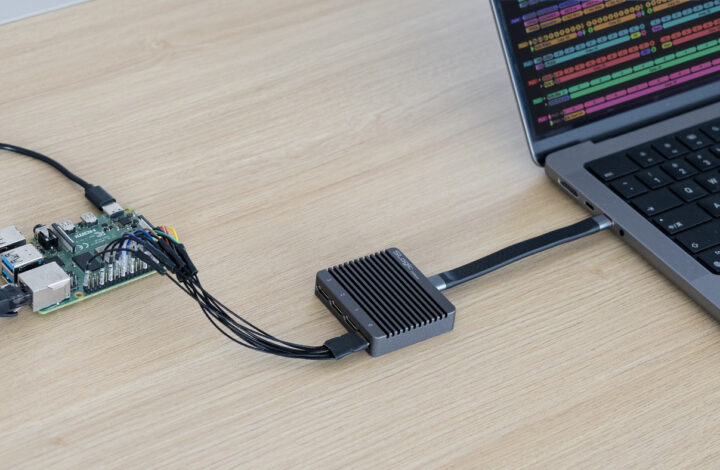
Physically, the device is a marvel of compact engineering. It measures just 59 × 51 × 13 mm and is housed in a CNC-machined aluminum case. The use of aluminum is not merely aesthetic; it serves as a passive heat sink, dissipating the heat generated by the FPGA and other components without the need for a fan. This fanless design is significant for users working in quiet environments or in laboratories where noise from cooling fans can be distracting. The device is powered entirely via USB, drawing only 5 V at 65 mA, which is well within the standard power delivery capabilities of any modern USB port. This means no external power supply is required, enhancing its portability and ease of use. You can plug it into a laptop, a desktop, or even a compatible Android device, making it a truly mobile debugging tool.
Software compatibility is another pillar of the SLogic32U3’s utility. It is designed to work seamlessly across major operating systems, including Windows 10/11, Linux, macOS, and Android. This cross-platform support ensures that developers are not locked into a specific ecosystem. The device works with SLogicView, Sipeed’s proprietary software, but also supports popular open-source tools like sigrok-cli, Pulseview, and ngscopeclient. This flexibility is a major advantage for professional engineers and hobbyists who may have established workflows or preferences for specific software interfaces. The ability to use command-line tools like sigrok-cli also allows for automation and integration into custom testing scripts.
The SLogic32U3 was launched on Kickstarter in October 2026, with shipments scheduled for late November 2026. Its introduction marks a shift in the accessibility of high-end logic analysis features. By leveraging modern USB standards and efficient FPGA architecture, Sipeed has created a device that brings laboratory-grade performance to a compact, portable form factor. It empowers users to debug complex digital systems with unprecedented clarity and speed, whether they are developing embedded systems, working on high-speed communication protocols, or simply exploring the inner workings of their electronic projects. The combination of high bandwidth, flexible sampling rates, and robust software support makes it a versatile tool for anyone who needs to understand the digital world at a granular level.
| Attr | Specs | verified |
|---|---|---|
soc | FPGA (potentially GOWIN) | ? unverified |
ram | 2 Gbit DDR3 (Stream FIFO buffer) | ? unverified |
usb | USB 3.2 Gen2 x1 Type-C (10 Gbps) | ? unverified |
gpio | 32 digital channels via 4x mini HDMI ports | ? unverified |
power | USB-powered, 5 V @ 65 mA | ? unverified |
os | Windows 10/11, Linux, macOS, Android | ? unverified |
dimensions | 59 × 51 × 13 mm | ? unverified |
bandwidth | 350 MHz digital signal bandwidth | ? unverified |
sample_rate | 1400 MS/s @ 4 ch, 200 MS/s @ 32 ch | ? unverified |
input_voltage | 0–10 V, adjustable threshold 0–6 V | ? unverified |
Launched on Kickstarter in October 2026, the SLogic32U3 was introduced as the world's first logic analyzer featuring a 10 Gbps USB 3.2 Gen2 x1 Type-C interface. Shipping began in late November 2026.
+ Strengths
["- Unique 10 Gbps USB 3.2 Gen2 x1 Type-C interface, claimed as a world first for logic analyzers.","- 32 digital channels with 350 MHz bandwidth and sampling rates up to 1400 MS/s.","- Cross-platform compatibility (Windows, Linux, macOS, Android) supporting open-source tools like sigrok and Pulseview."]
− Weaknesses
["- Actual stream throughput is capped at 800 MB/s (6.4 Gbps), below the theoretical USB interface capacity.","- Sampling rate drops to 200 MS/s when all 32 channels are used simultaneously.","- Analog acquisition requires an optional module limited to 4 channels at 8-bit resolution and 100 MSa/s."]
- Retour d'expérience expert expert — expert-microdb
- Après 3 semaines sur des bus SPI rapides, le SLogic32U3 tient ses promesses. Le débit soutenu de 800 Mo/s via USB 3.2 est réel, contrairement à mes anciens LA. La latence quasi-nulle permet du debug temps réel. Attention toutefois : les 4 ports mini-HDMI sont fragiles, utilisez des câbles courts. L… — expert-microdb
- +1 pour la stabilité sous Linux avec sigrok-cli. Un détail important : le seuil ajustable (0-6V) est crucial pour les signaux LVDS ou 3.3V, évitant les faux positifs. Par contre, l'absence de ventilateur est un choix risqué en été si vous avez un boîtier fermé. J'ai dû ajouter un petit flux d'air e… — membre-forum
Community feedback and projects
- Discussions Reddit — SLogic32U3 reddit.com
- Articles CNX Software — SLogic32U3 cnx-software.com
Content not available yet.
Content not available yet.
Content not available yet.
["- Not specified"]
- SLogic32U3: First Connection and Setup debutant Guide pas à pas pour connecter votre analyseur logique SLogic32U3 et lancer une première capture.
- Analyzing a Protocol Bus with SLogic32U3 debutant Apprenez à configurer l'analyseur logique SLogic32U3 pour capturer et décoder un bus de communication simple comme l'I2C ou l'UART.
- Getting Started with SLogic32U3: Installation and First Connection intermediaire Guide étape par étape pour installer les pilotes, connecter l'analyseur logique SLogic32U3 et vérifier sa reconnaissance système.
- Interfacing SLogic32U3 with External Peripherals intermediaire Apprenez à connecter et analyser les signaux GPIO, capteurs ou afficheurs en utilisant les 32 canaux numériques du SLogic32U3.
- Debugging I2C and SPI Buses with the SLogic32U3 intermediaire Apprenez à configurer et analyser les protocoles de communication série courants en exploitant la haute bande passante de l'analyseur logique SLogic32U3.
- Advanced Setup of SLogic32U3: Configuration and Validation avance Guide technique pour initialiser l'analyseur logique SLogic32U3, configurer les seuils et vérifier l'intégrité des données via USB 3.2.
- Advanced GPIO and Sensor Interface Analysis with SLogic32U3 avance Exploitez la bande passante de 350 MHz et la mémoire de 2 Gbit du SLogic32U3 pour déboguer des protocoles GPIO complexes et des signaux analogiques haute fréquence.
- Debugging an industrial communication bus with the SLogic32U3 avance Utilisez les 32 canaux et la haute vitesse du SLogic32U3 pour analyser les trames de contrôle d'un automate programmable.
- First UART capture with SLogic32U3 debutant Apprenez à configurer le SLogic32U3 pour décoder un signal UART standard.
Code library — examples written for this board
slogic32u3-sigrok-cli-capture.shbashslogic32u3-python-libsigrok-stream.pypythonslogic32u3-pulseview-scripting.pypythonslogic32u3-adc-analog-capture.pypythonslogic32u3-linux-udev-setup.shbashlogic-capture-32ch-sigrok-6.inobashpulseview-auto-threshold-python-7.inopythonspi-capture-analysis-8.inopythoni2c-troubleshooting-sigrok-9.inobashanalog-capture-adc-module-10.inopython