Adafruit Metro ESP32-P4 Hydra
⚡ The essentials in 60 seconds
- soc — ESP32-P4 Dual-core 32-bit RISC-V @ 360 MHz + 40 MHz low-power core
- ram — 768 KB SRAM, 32 KB low-power SRAM, 16 MB PSRAM (external)
- storage — 16 MB QSPI NOR Flash
- wifi_bluetooth — ESP32-C6 coprocessor: WiFi, Bluetooth LE 5.3, Thread, Zigbee
- ethernet — Ethernet MAC peripheral (no PHY mentioned)
- video — 2-lane MIPI DSI display interface, 2-lane MIPI CSI camera interface
- On this board : 9 tutorials · 10 code
The Adafruit Metro ESP32-P4 Hydra represents a significant leap in microcontroller capability, bridging the gap between traditional hobbyist boards and high-performance embedded systems. At its core lies the ESP32-P4 v1 system-on-chip, a dual-core 32-bit RISC-V processor that operates at speeds up to 360 MHz. To understand the significance of this architecture, it is helpful to consider that RISC-V is an open-standard instruction set architecture, offering a modern alternative to proprietary cores like ARM. The dual-core design allows the board to handle complex multitasking scenarios, such as running a graphical user interface while simultaneously processing sensor data or managing network communications. Complementing these high-performance cores is a dedicated low-power core running at 40 MHz. This separation of duties is a critical design choice for battery-operated devices, as it allows the high-speed cores to remain asleep during idle periods, drastically reducing energy consumption while still maintaining basic system responsiveness. It is important for users to note that this specific board utilizes the v1 revision of the ESP32-P4 chip, distinguishing it from the newer P4X v3 variants, which may have different performance characteristics or errata.
Memory architecture on the Hydra is equally robust, designed to support demanding applications that require rapid data access and substantial storage. The board features 768 KB of high-performance SRAM, which serves as the primary working memory for active code and data, ensuring that the processor rarely has to wait for information. For applications requiring larger memory footprints, such as those involving large buffers for image processing or complex data structures, the board includes 16 MB of external PSRAM (Pseudo-Static RAM). This external memory is significantly larger than the internal SRAM, allowing developers to store large datasets or high-resolution graphics without exhausting the fast, on-chip memory. Additionally, there is 32 KB of low-power SRAM, which retains data even when the main power domains are shut down, facilitating deep sleep modes and quick wake-ups. For persistent storage, the board is equipped with 16 MB of QSPI NOR Flash. This type of flash memory is optimized for speed and reliability, providing ample space for the operating system, applications, and user data. The combination of these memory types creates a hierarchical storage system that balances speed, capacity, and power efficiency.
One of the most distinctive features of the Metro ESP32-P4 Hydra is its approach to wireless connectivity. Unlike many single-chip solutions that integrate radio functions directly into the main processor, this board employs a separate coprocessor, the ESP32-C6, to handle all wireless communications. This coprocessor is connected to the main ESP32-P4 via an SDIO interface, a high-speed parallel communication bus. This architectural decision offloads the heavy lifting of network stack processing from the main CPU, allowing the powerful RISC-V cores to focus on application logic. The ESP32-C6 provides comprehensive connectivity options, including WiFi, Bluetooth LE 5.3, Thread, and Zigbee. This multi-protocol support makes the board exceptionally versatile for Internet of Things (IoT) applications, where devices may need to communicate over different standards depending on the infrastructure or specific use case. For instance, Thread and Zigbee are low-power mesh networking protocols ideal for smart home devices, while WiFi and Bluetooth offer broader compatibility with smartphones and local networks.
The board’s interface capabilities are heavily oriented towards multimedia and visual applications, a departure from the simple digital I/O focus of many microcontrollers. It features two 22-pin MIPI connectors, which are industry-standard interfaces for high-speed data transfer in mobile and embedded devices. One connector is designated for MIPI DSI (Display Serial Interface), allowing the connection of high-resolution displays. Notably, these connectors are compatible with 2-lane displays used in Raspberry Pi projects, leveraging a widely available ecosystem of screens. The second MIPI connector is for MIPI CSI (Camera Serial Interface), enabling the connection of cameras. This setup is compatible with Raspberry Pi Zero v1 cameras, providing a ready-made path for computer vision projects. By integrating these advanced video interfaces, the Hydra allows developers to build sophisticated user interfaces and vision systems that would typically require much more powerful and expensive hardware. The physical connectors are compact, using a 0.5 mm pitch, which requires careful handling but saves valuable board space.
Connectivity and expansion are facilitated through a variety of ports and headers. The board includes two USB ports: a USB-C port for power, debugging, and firmware updates via TinyUF2, and a USB-A host port. The USB-A port supports High-Speed USB at 480 Mbps, allowing the board to act as a host for peripherals such as keyboards, mice, or storage devices. This host capability is controlled via software, giving developers fine-grained control over power delivery to connected devices. For general-purpose input and output, the board features standard Arduino Uno-style headers, operating at 3.3 V logic levels. These headers provide access to digital and analog pins, making it compatible with a vast library of existing shields and projects. Additionally, a STEMMA QT connector is included, which simplifies the connection of I2C sensors and peripherals using standardized JST-SH cables. The board also supports a microSD card via a 4-bit SDIO interface, providing an easy way to expand storage for logging data or storing media files.
Power management is flexible, accommodating various power sources to suit different deployment scenarios. The board can be powered via a DC barrel jack accepting 7-12 V, through the USB-C port, or by a LiPo battery. When using a battery, an integrated charging circuit manages the power flow, allowing the board to operate while charging and automatically switching between power sources. This flexibility is crucial for portable applications. The physical footprint of the board is compact, measuring 72.3 x 53.3 x 14.7 mm, which fits within the standard Metro form factor, allowing it to be mounted in enclosures designed for other Metro boards. The board also includes user-friendly indicators, such as an RGB NeoPixel LED and a user LED on pin D13, along with reset and boot buttons for easy debugging and mode selection. With a price point of $34.95, the Adafruit Metro ESP32-P4 Hydra offers a compelling balance of high-performance computing, advanced multimedia interfaces, and versatile connectivity, making it a powerful tool for developers looking to push the boundaries of embedded system design.
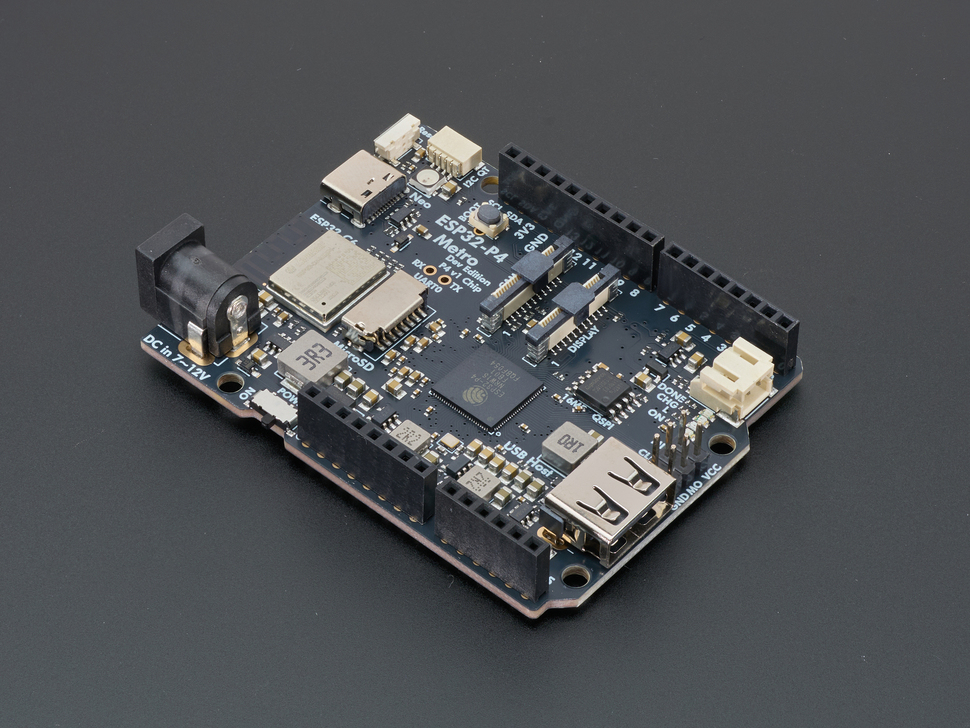
| Attr | Specs | verified |
|---|---|---|
soc | ESP32-P4 Dual-core 32-bit RISC-V @ 360 MHz + 40 MHz low-power core | ? unverified |
ram | 768 KB SRAM, 32 KB low-power SRAM, 16 MB PSRAM (external) | ? unverified |
storage | 16 MB QSPI NOR Flash | ? unverified |
wifi_bluetooth | ESP32-C6 coprocessor: WiFi, Bluetooth LE 5.3, Thread, Zigbee | ? unverified |
ethernet | Ethernet MAC peripheral (no PHY mentioned) | ? unverified |
video | 2-lane MIPI DSI display interface, 2-lane MIPI CSI camera interface | ? unverified |
usb | USB-C (OTG/Serial/JTAG), USB-A High-Speed Host (480 Mbps) | ? unverified |
gpio | Metro/Arduino Uno headers (D0-D13, 6 analog), STEMMA QT, SPI header | ? unverified |
power | 7-12V DC barrel jack, USB-C, LiPo battery connector with charging | ? unverified |
os | TinyUF2 support, ROM bootloader | ? unverified |
dimensions | 72.3mm x 53.3mm x 14.7mm | ? unverified |
connectors | microSD (4-bit SDIO), 22-pin MIPI DSI/CSI connectors | ? unverified |
peripherals | UART, SPI, I2C, I3C, I2S, PWM, ADC, Touch, SD/MMC, CAN/TWAI | ? unverified |
indicators | RGB NeoPixel, User LED (D13), Reset/Boot buttons | ? unverified |
The Adafruit Metro ESP32-P4 Hydra was released to provide a high-performance platform based on the ESP32-P4 v1 SoC. It combines a powerful RISC-V core with an ESP32-C6 coprocessor for full wireless connectivity, targeting advanced multimedia and IoT applications.
+ Strengths
["Dual-core 32-bit RISC-V processor clocked up to 360 MHz with 16 MB external PSRAM.","Complete wireless connectivity via ESP32-C6 coprocessor (WiFi, Bluetooth LE 5.3, Thread, Zigbee).","Advanced video interfaces with two MIPI DSI/CSI connectors compatible with Raspberry Pi Zero v1 displays and cameras."]
− Weaknesses
["Uses the ESP32-P4 v1 chip and not the newer P4X v3 version.","Ethernet MAC interface is present but no external PHY is mentioned in the specifications.","The $34.95 price point is higher than classic ESP32 microcontrollers."]
- Retour d'expérience expert expert — expert-microdb
- Après 3 semaines sur la Metro Hydra, le P4 est un monstre. 360 MHz RISC-V + 16 Mo PSRAM/Flash, c'est rare. Le vrai atout ? Les connecteurs MIPI. J'ai branché une caméra Zero v1 et un écran DSI de Raspberry Pi en 2 voies. Ça tourne niquel. Le coprocesseur C6 gère le WiFi/BLE via SDIO, donc pas de so… — expert-microdb
- Super retour ! J'hésitais avec le P4. Le combo MIPI + USB HS est effectivement unique. Tu gères la cohabitation avec le C6 comment ? Le TinyUF2 via USB-C est-il stable pour les mises à jour OTA ? Et le CAN bus, tu l'as testé ? Je crains un peu la complexité du SDK Espressif pour ce SoC, mais si le … — membre-forum
Community feedback and projects
- Discussions Reddit — Adafruit Metro ESP32-P4 Hydra reddit.com
- Articles CNX Software — Adafruit Metro ESP32-P4 Hydra cnx-software.com
Content not available yet.
Content not available yet.
Content not available yet.
["Video compatibility strictly depends on using specific displays and cameras (2-lane DSI/CSI).","The USB-A host port requires software control of power supply to function correctly.","No information provided regarding thermal limitations of the 360 MHz core under maximum load."]
- First connection and startup of the Metro ESP32-P4 Hydra debutant Apprenez à alimenter, connecter et vérifier le fonctionnement de base de votre carte Adafruit Metro ESP32-P4 Hydra.
- Controlling GPIOs and a Simple Display on Metro ESP32-P4 Hydra debutant Apprenez à manipuler les broches d'entrée/sortie et à afficher des données sur un écran compatible via les interfaces MIPI.
- Store Data on Adafruit Metro ESP32-P4 Hydra debutant Apprenez à enregistrer des données simples sur la mémoire flash de la carte Hydra pour créer un journal local.
- First Startup of the Metro ESP32-P4 Hydra intermediaire Guide étape par étape pour alimenter, flasher et vérifier le fonctionnement de base de la carte Adafruit Metro ESP32-P4 Hydra.
- Controlling an I2C sensor with ESP32-P4 Hydra intermediaire Apprenez à configurer le bus I2C et à lire les données d'un capteur via les broches GPIO de la carte Hydra.
- Advanced Startup: Power, USB, and Debugging on ESP32-P4 Hydra avance Guide technique pour initialiser correctement l'alimentation, les interfaces USB et le débogage du SoC ESP32-P4.
- High-Speed USB Storage Automation on ESP32-P4 Hydra avance Configurez le port USB-A hôte pour monter et écrire sur des clés USB à 480 Mbps, exploitant la puissance du RISC-V.
- Using the USB-A Host Port to Read a USB Drive intermediaire Ce tutoriel explique comment activer et utiliser le port USB-A High-Speed 480 Mbps de la carte Adafruit Metro ESP32-P4 Hydra pour lire des fichiers depuis une clé USB standard.
- Using the USB-A host port for USB flash drive reading avance Exploitez la puissance du bus USB High-Speed 480 Mbps de la Metro ESP32-P4 Hydra pour accéder à des clés de stockage externes.
Code library — examples written for this board
esp32-p4-hydra-gpio-blink.inoC++ (Arduino)esp32-p4-hydra-mpu6050-i2c.inoC++ (Arduino)esp32-p4-hydra-wifi-http.inoC++ (Arduino)esp32-p4-hydra-sdcard-write.inoC++ (Arduino)esp32-p4-hydra-usb-host-mouse.inoC++ (Arduino)esp32-p4-hydra-gpio-led-blink.inoC++ (Arduino)esp32-p4-hydra-stemma-i2c-sensor.inoC++ (Arduino)esp32-p4-hydra-sd-card-logging.inoC++ (Arduino)esp32-p4-hydra-wifi-c6-proxy.inoC++ (Arduino)esp32-p4-hydra-usb-host-hid.inoC++ (Arduino)