BeagleBone AI-64 (TI TDA4VM / J721E)
⚡ The essentials in 60 seconds
- soc — Texas Instruments TDA4VM (Jacinto 7 / J721E family; SRM titles it "TI J721E DRA829/TDA4VM/AM752x processor"). Sources: CNX launch article, SRM ch.4, TI TDA4VM product page.
- cpu — 2× Arm Cortex-A72 (64-bit) @ up to 2.0 GHz (SRM comparison table; CNX).
- real_time_cores — 6× Cortex-R5F (3 dual clusters — 1 in MCU domain, 2 in main domain; "3x dual Arm Cortex-R5 co-processors" per mainline commit fae14a1cb8dd).
- dsp_accelerators — 1× C7x floating-point DSP + MMA (Matrix Multiply Accelerator, ~8 TOPS INT8), 2× C66x VLIW DSP, 12× PRU (2× PRU-ICSS), plus fixed-function vision blocks (VPAC capture/imaging pipeline, VPE/M2M, H.264 encode, H.264/H.265 decode) (CNX spec table, TI TIDL docs).
- gpu — PowerVR Series8XE GE8430 (SRM features table).
- ram — 4 GB LPDDR4 (Kingston Q3222PM1WDGTK-U, "3.2 GHz" i.e. LPDDR4-3200 class) — SRM ch.4.
- On this board : 9 tutorials · 10 code
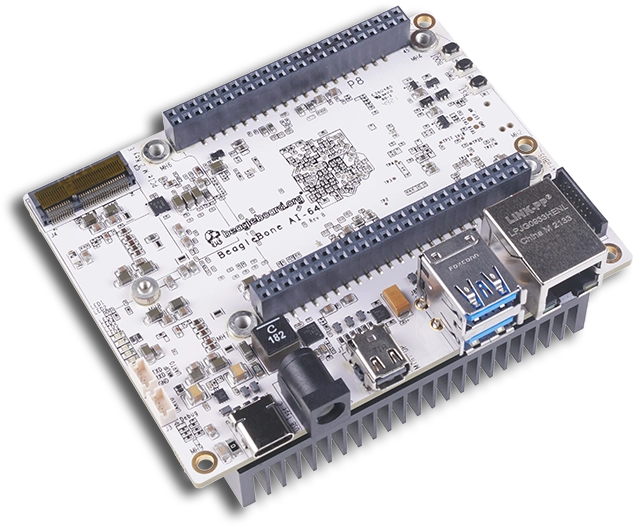
The BeagleBone AI-64 stands as a distinctive entry in the world of single-board computers, bridging the gap between hobbyist experimentation and industrial-grade edge computing. Launched in June 2022 by the BeagleBoard.org Foundation, this board serves as the successor to the original BeagleBone AI, positioning itself as a flagship for robotics and artificial intelligence applications at the edge. At its heart lies the Texas Instruments TDA4VM, a processor from the Jacinto 7 family, which introduces a level of computational complexity rarely seen in boards of this size. Unlike simpler microcontrollers or standard microprocessors, the TDA4VM is a heterogeneous system-on-chip, meaning it combines different types of processing cores to handle various tasks simultaneously. This design allows the board to run a full Linux operating system while also managing real-time control loops and heavy mathematical calculations required for machine learning, all within a compact form factor measuring just four by three inches.
The processing power of the AI-64 is distributed across several specialized units. For general-purpose computing, it features two Arm Cortex-A72 cores running at up to 2.0 GHz. These 64-bit cores handle the main operating system, user applications, and network services. However, what truly sets this board apart is its array of auxiliary processors. It includes six Cortex-R5F cores, which are designed for real-time tasks where timing precision is critical, such as motor control or sensor data acquisition. Additionally, the board houses a C7x floating-point DSP paired with a Matrix Multiply Accelerator, providing approximately 8 trillion operations per second for integer calculations. This specific hardware is optimized for running neural networks locally on the device, allowing for tasks like image recognition or object detection without needing to send data to the cloud. Complementing these are two C66x VLIW DSPs and twelve Programmable Real-Time Units, offering further flexibility for custom signal processing and low-level hardware interfacing.
Memory and storage are configured to support these demanding workloads. The board comes equipped with 4 GB of LPDDR4 RAM, a type of low-power memory that offers high bandwidth for moving data quickly between the processor and the memory chips. For storage, it includes 16 GB of eMMC flash, which is soldered directly onto the board for reliability and speed. While 16 GB may seem modest for storing large datasets or multiple operating systems, the board supports microSD cards and includes an M.2 E-key socket. This socket allows users to add Wi-Fi and Bluetooth modules or even high-speed NVMe storage drives, although it is important to note that the PCIe interface on this specific board has known limitations and may not operate at full theoretical speeds. The absence of onboard Wi-Fi means users must rely on these add-ons or USB dongles for wireless connectivity, a design choice that keeps the base cost lower and allows for more flexible networking options.
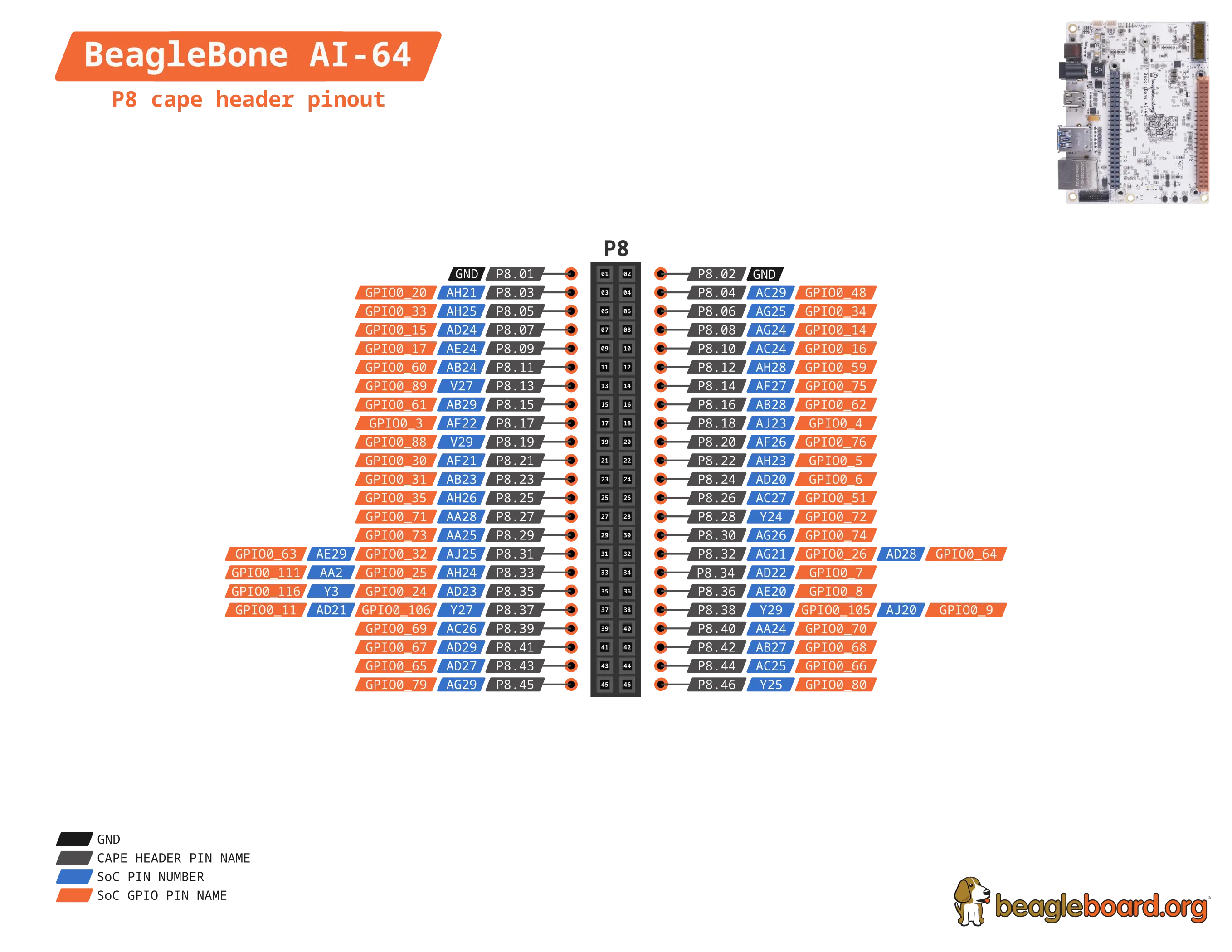
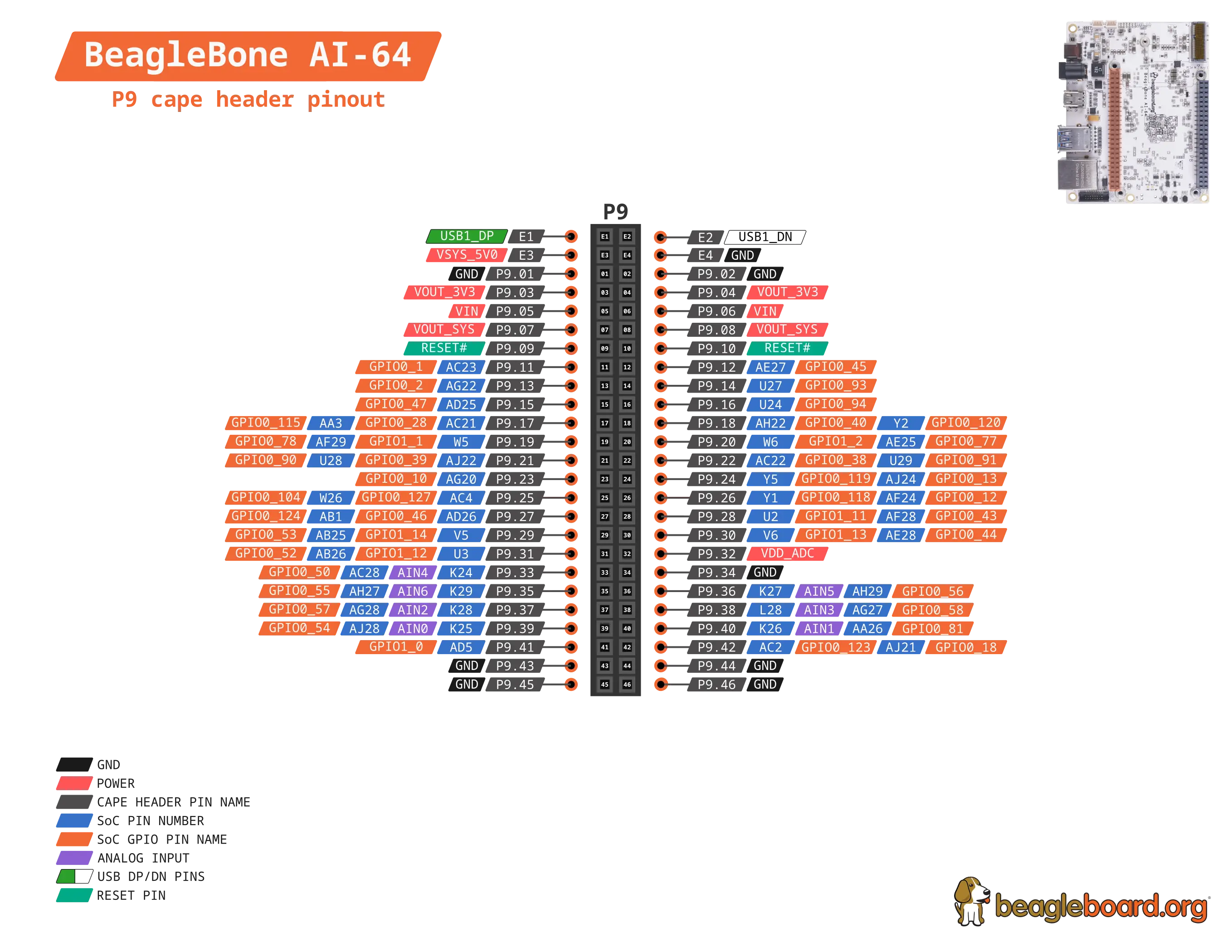
Connectivity and expansion are central to the BeagleBone philosophy. The AI-64 retains the classic P8 and P9 cape headers, which are 46-pin expansion connectors compatible with the vast ecosystem of BeagleBone capes. These headers expose a wide range of digital and analog signals, including UART, I2C, SPI, and PWM pins. It is crucial to note that all header signals operate at 3.3 volts; connecting 5-volt logic can damage the processor. The board also features two 4-lane MIPI CSI camera inputs, allowing for high-resolution video capture from modern camera modules. This is supported by dedicated hardware blocks for video processing, enabling the board to capture, process, and encode video streams without burdening the main CPU. For display output, it includes a mini DisplayPort connector, which requires an active adapter for HDMI compatibility, and a MIPI DSI connector for direct screen attachment.
Power management is another critical aspect of this board’s design. It requires a robust 5-volt power supply capable of delivering at least 3 amps, which can be provided via a USB-C connector or a barrel jack. Standard USB ports from a computer often cannot supply enough current, so an external power adapter is recommended for stable operation. The board’s power consumption varies significantly depending on the workload, ranging from around 1.75 watts at idle to higher levels during intensive AI computations. The system uses a sophisticated power management integrated circuit to regulate voltages for the various cores and peripherals, ensuring efficient operation and thermal management.
Software support for the BeagleBone AI-64 is extensive but complex due to the heterogeneous nature of the hardware. Official images are based on Debian Linux and include the necessary drivers for basic functionality. For developers looking to utilize the AI accelerators, Texas Instruments provides a comprehensive software development kit that includes libraries for deep learning inference and computer vision. While mainline Linux support has been improving, with the board’s device tree being merged into the kernel starting with version 6.2, full access to the specialized DSP and vision hardware often requires using the TI downstream kernel or specific user-space drivers. This duality means that while basic GPIO and networking tasks are straightforward, leveraging the full potential of the AI accelerators involves a steeper learning curve and familiarity with TI’s specific software stack.
Despite its capabilities, the board has faced some documented challenges. Early production units experienced occasional boot failures related to memory initialization, which have been addressed in later revisions and software updates. Users may also encounter quirks with USB enumeration or the M.2 slot’s speed limitations. Furthermore, the board is currently considered mature but is being gradually superseded by newer models like the BeagleY-AI in the manufacturer’s lineup. Nevertheless, for projects requiring a blend of real-time control, robust Linux capabilities, and dedicated AI acceleration in an open-hardware package, the BeagleBone AI-64 remains a powerful and versatile tool. Its open-source hardware design, certified by OSHW, ensures that schematics and documentation are freely available, fostering a community-driven approach to troubleshooting and innovation.
Pinout diagram
| Attr | Specs | verified |
|---|---|---|
soc | Texas Instruments TDA4VM (Jacinto 7 / J721E family; SRM titles it "TI J721E DRA829/TDA4VM/AM752x processor"). Sources: CNX launch article, SRM ch.4, TI TDA4VM product page. | ✔ |
cpu | 2× Arm Cortex-A72 (64-bit) @ up to 2.0 GHz (SRM comparison table; CNX). | ? unverified |
real_time_cores | 6× Cortex-R5F (3 dual clusters — 1 in MCU domain, 2 in main domain; "3x dual Arm Cortex-R5 co-processors" per mainline commit fae14a1cb8dd). | ✔ |
dsp_accelerators | 1× C7x floating-point DSP + MMA (Matrix Multiply Accelerator, ~8 TOPS INT8), 2× C66x VLIW DSP, 12× PRU (2× PRU-ICSS), plus fixed-function vision blocks (VPAC capture/imaging pipeline, VPE/M2M, H.264 encode, H.264/H.265 decode) (CNX spec table, TI TIDL docs). | ✔ |
gpu | PowerVR Series8XE GE8430 (SRM features table). | ? unverified |
ram | 4 GB LPDDR4 (Kingston Q3222PM1WDGTK-U, "3.2 GHz" i.e. LPDDR4-3200 class) — SRM ch.4. | ? unverified |
storage | 16 GB eMMC (Kingston EMMC16G-TB29-PZ90) + microSD slot (1.8/3.3 V signalling) — SRM ch.4. | ? unverified |
networking | 1× Gigabit Ethernet RJ45 (MCU CPSW port, DP83867 PHY per mainline DTS). No onboard WiFi/BT — an M.2 E-key socket (PCIe + USB + SDIO) is provided for a WiFi/BT module (CNX, SRM ch.3). | ✔ |
usb | USB 3.0 Type-C dual-role (device, no power output) + 2× USB 3.0 Type-A host via a TUSB8041 4-port hub (up to ~2.8 A total for hosts, SRM ch.4). | ? unverified |
video | miniDP out (audio over miniDP), MIPI DSI connector, 2× 4-lane MIPI CSI camera inputs (CNX spec table). | ✔ |
gpio_expansion | two 46-pin BeagleBone cape headers P8/P9 at BeagleBone-Black-compatible spacing; all header signals 3.3 V ("do not connect 5 V logic… board will be damaged", SRM ch.7). CNX counts 72 digital pins (7 of them analog-capable, 3.3 V ADC). Header exposes up to 4× UART, 2× I²C (more via mux), 2× SPI, 8× PWM, 4× timer, CAN, pulse capture, quadrature encoder, PRU I/O (CNX table). Pin-mux table per header pin (e.g. P8_03 → GPIO0_20 at muxmode 7) is in SRM ch.7. | ✔ |
other_i_o | 3-pin 3.3 V TTL debug headers for WKUP_UART0 and UART0, JTAG tag-connect, MikroBUS Shuttle connector (CNX), buttons: Reset, Boot, Power; 1 power LED + 5 user LEDs (SRM ch.4). | ✔ |
power | 5 V ≥ 3 A via USB-C or 2.1 mm barrel jack; TPS65941213/TPS65941111 PMIC (SRM ch.3/ch.6). | ? unverified |
typical_consumption | (SRM ch.6, measured at 5 V): idle at U-Boot 210 mA; kernel boot peak 460 mA; kernel idle 350 mA (~1.75 W); loading a webpage 430 mA. | ? unverified |
size_weight | 4″ × 3.1″; 192 g with heatsink (SRM ch.4). | ? unverified |
temperature | on-die processor temperature sensors only (CNX table). | ? unverified |
- Manufacturer / designer: BeagleBoard.org Foundation (design by Seeed Studio under BeagleBoard.org guidance; manufactured and sold by BeagleBoard partners — Digi-Key, Element14, OKdo, Seeed). OSHW certified US002120 (certification.oshwa.org/us002120.html).
- Year / release: launched 14 June 2022 (Wikipedia BeagleBoard timeline, retrieved 2026-10-13; CNX Software launch article, 2022-06-15).
- Launch price: about US$187 at distributors (CNX, 2022-06-15).
- Status: active but mature; the product page now points buyers to the newer BeagleY-AI as the "latest AI-enabled board" (beagleboard.org/boards/beaglebone-ai-64, retrieved 2026-10-13).
- Variants: one shipping revision family (board ID BBONEAI-64-B0 in the at24 EEPROM, per the mainline DTS commit message fae14a1cb8dd); hardware repo schematic is "Rev B1" (beagleboard/beaglebone-ai-64 README).
- Positioning: successor to BeagleBone AI (2019); edge-AI / robotics flagship of the BeagleBone line (beagleboard.org product page).
+ Strengths
- Heterogeneous compute on an SBC form factor: A72 + 6× R5F + C7x+MMA + 2× C66x + 12× PRU + GPU + video codecs — "8 TOPS AI accelerator" class silicon (TDA4VM) in a 4″×3.1″ BeagleBone board (CNX).
- Cape compatibility: same P8/P9 header placement as BeagleBone Black, 3.3 V signalling, with PRU/IEP/QEP signals still routed (SRM ch.7) — rare on a 2 GHz 64-bit AI board.
- Dual 4-lane MIPI CSI + VPAC imaging pipeline + H.264/265 codecs: design for smart cameras/robotics without external bridge chips (CNX spec table).
- Real-time offload: R5F and PRU cores run bare-metal/RTOS firmware (remoteproc) for deterministic motor control / sensor loops while Linux handles the application layer (mainline DTS reserved-memory carveouts for R5F/C66x/C7x).
- Open hardware: full schematics, PCB and docs in git.beagleboard.org/beagleboard/beaglebone-ai-64 (GitHub mirror here); OSHW-certified.
- Security: K3 security architecture with HS-FS/HS devices, OP-TEE (secure_ddr carveout in DTS) — full High-Security features documented in TI's J721E security guide.
- M.2 E-key with PCIe/USB/SDIO for WiFi/BT or accelerator/NVMe-style add-ons (CNX; see Problems for the PCIe speed caveat).
− Weaknesses
- Early-board cold-boot lockups (DDR bring-up): "Random System lockup during kernel bootup" — 35/496 and 32/1000 cold boots failing on 2022 serials until LPDDR4 configuration changes (SK IO latencies, write-DBI) (issue #43).
- Rare TISCI device-manager crash around GPU power-up (~1 in 1000 cold boots, ti-sci … Mbox timedout + pvrsrvkm … adding gpu_0 device link failed) (issue #44).
- USB quirks: bottom Type-A port randomly enumerates at USB 2.0 (#36); Rev B USB-C does not support hot-plug (#35); USB hub regression in some images (#40).
- M.2 PCIe speed limit: with the TDA4 internal clock the slot failed to run 5 Gbps; DTS workaround caps modules to 2.4 Gbps (#28).
- Robotics signals not ready: quadrature encoder (QEP) "still not working" (#38); software watchdog not implemented (#37); eHRPWM/SPI configuration unclear to users (#19, #16).
- Reset button does nothing when booting from eMMC on some images (#29).
- Power discipline: needs a genuine 5 V ≥ 3 A supply — PC USB tethering often can't feed it (SRM ch.3); back-powering or driving I/O with power off "will damage the processor and void the warranty" (SRM ch.7 warnings).
- miniDP output requires a DP cable or an active miniDP→HDMI adapter (SRM ch.3).
- No WiFi/BT on board (M.2 module or USB dongle required) and only 2 host USB-A ports (SRM ch.3).
- 16 GB eMMC vs. heavy SDK: the TI Edge AI stack images/tools are multi-GB, so the onboard flash fills quickly; use microSD/USB/NVMe (via M.2) for datasets.
- Mainline gaps: mainline DTS historically shipped a reversed C6x DSP carveout (fix 1a314099b755) and needed mcu_cpsw/RGMII delay fixes for Ethernet; DSP/CSI/codec use still effectively requires the TI downstream stack.
- git.beagleboard.org is behind Anubis anti-bot, which broke automated Yocto fetches (GitHub mirrors requested/created, #45).
- Retour d'expérience expert expert — expert-pi-like
- Grosse deception sur les peripheriques pour une carte a 187 dollars. J'ai passe trois jours a comprendre pourquoi mon dongle USB ne marchait pas : apparemment le port Type-A du bas enumere en USB 2.0 aleatoirement (issue 36), et le USB-C de la Rev B refuse le hot-plug. C'est dommage car le SoC TDA4… — expert-pi-like
- Je confirme le souci du cold-boot. J'avais des lockups aléatoires au démarrage jusqu'à ce que je mette à jour la config DDR (latences SK IO), cf issue 43. Par contre, une fois que Linux tourne, la separation des coeurs est interessante : j'utilise les PRU pour la boucle de controle moteur en temps … — maker-robot-01
- Petite question sur le stockage : le eMMC de 16 Go est vraiment trop petit pour les images Edge AI de TI ? Je debute et je ne veux pas griller la carte. Si quelqu'un a une experience avec l'OS officiel, est-ce que ca tient sur la carte SD ou faut-il imperativement un SSD via le port M.2 ? Ca m'embe… — nouveau_maker
Community feedback and projects
- AI-64 - remoteproc confusion forum.beagleboard.org
- BeagleBone AI-64 - lost in information forum.beagleboard.org
- Connecting display on BeagleBone AI-64 miniDP is not working forum.beagleboard.org
- How can I enable 4xCAN and 2xGPIO on the BeagleBone Ai64 forum.beagleboard.org
Content not available yet.
- Product page
- doc/SRM
- System Reference Manual (official docs)
- BeagleBone_AI-64_Rev_B1_SCH_220602.pdf
- BeagleBone_AI-64_SCH.pdf
- Hardware design repo
- Hardware design repo
- SoC
- Mainline DTS
- TI Edge AI / TIDL
- TI Edge AI / TIDL
- TI Edge AI / TIDL
- Images & updates
- Images & updates
- Images & updates
- Community
- CNX Software, 2022-06-15
- Wikipedia — BeagleBoard
- Early-board cold-boot lockups (DDR bring-up): "Random System lockup during kernel bootup" — 35/496 and 32/1000 cold boots failing on 2022 serials until LPDDR4 configuration changes (SK IO latencies, write-DBI) (issue #43).
- Rare TISCI device-manager crash around GPU power-up (~1 in 1000 cold boots, ti-sci … Mbox timedout + pvrsrvkm … adding gpu_0 device link failed) (issue #44).
- USB quirks: bottom Type-A port randomly enumerates at USB 2.0 (#36); Rev B USB-C does not support hot-plug (#35); USB hub regression in some images (#40).
- M.2 PCIe speed limit: with the TDA4 internal clock the slot failed to run 5 Gbps; DTS workaround caps modules to 2.4 Gbps (#28).
- Robotics signals not ready: quadrature encoder (QEP) "still not working" (#38); software watchdog not implemented (#37); eHRPWM/SPI configuration unclear to users (#19, #16).
- Reset button does nothing when booting from eMMC on some images (#29).
- Power discipline: needs a genuine 5 V ≥ 3 A supply — PC USB tethering often can't feed it (SRM ch.3); back-powering or driving I/O with power off "will damage the processor and void the warranty" (SRM ch.7 warnings).
- miniDP output requires a DP cable or an active miniDP→HDMI adapter (SRM ch.3).
- No WiFi/BT on board (M.2 module or USB dongle required) and only 2 host USB-A ports (SRM ch.3).
- 16 GB eMMC vs. heavy SDK: the TI Edge AI stack images/tools are multi-GB, so the onboard flash fills quickly; use microSD/USB/NVMe (via M.2) for datasets.
- Mainline gaps: mainline DTS historically shipped a reversed C6x DSP carveout (fix 1a314099b755) and needed mcu_cpsw/RGMII delay fixes for Ethernet; DSP/CSI/codec use still effectively requires the TI downstream stack.
- git.beagleboard.org is behind Anubis anti-bot, which broke automated Yocto fetches (GitHub mirrors requested/created, #45).
- Flasher l'image officielle et démarrer la BeagleBone AI-64 debutant Schéma : IMG-beaglebone-ai64-debutant-1-flasher-image-et-premier-boot.svg — BeagleBone AI-64 vue de dessus, flèches sur le bouton BOOT, le port USB-C et l'éjecteur microSD, câble 5 V branché.
- Faire clignoter une LED sur la broche P8_03 avec libgpiod debutant Schéma : IMG-beaglebone-ai64-debutant-2-clignoter-led-broche-p8-03.svg — broches P8 de la BeagleBone AI-64, zoom sur P8_03 reliée via une résistance 330 Ω à une LED puis GND, mention « 3,3 V max ».
- Surveiller la température et l'alimentation du TDA4VM debutant Schéma : IMG-beaglebone-ai64-debutant-3-surveiller-temperature-et-alimentation.svg — BeagleBone AI-64 avec son dissipateur, sonde de température et wattmètre USB annotés, courbe de température montante sous stress.
- Réseau : Ethernet Gigabit unique et module Wi-Fi en M.2 E-key intermediaire Schéma : IMG-beaglebone-ai64-intermediaire-1-reseau-gige-et-module-wifi-m2.svg — BeagleBone AI-64 avec un câble RJ45 sur son unique port Ethernet et un module Wi-Fi M.2 E-key glissé dans son connecteur, annotation « PCIe bridé à 2,4 Gbps ».
- Caméra MIPI CSI et encodage H.264 matériel via GStreamer intermediaire Schéma : IMG-beaglebone-ai64-intermediaire-2-camera-csi-encodage-h264-materiel.svg — BeagleBone AI-64 avec un module caméra relié par nappe FFC au connecteur CSI0, pipeline annoté CSI → VPAC → VPE → encodeur H.264 → fichier MP4.
- Remoteproc : inventorier et démarrer les co-processeurs R5F et C66x intermediaire Schéma : IMG-beaglebone-ai64-intermediaire-3-remoteproc-demarrer-r5f-c66x.svg — carte d'architecture du TDA4VM (2 Cortex-A72, 3 paires Cortex-R5F, 2 DSP C66x, C7x+MMA, 12 PRU) avec des flèches « start » depuis Linux vers un core C66x via /sys/class/remoteproc.
- Inférence de réseau de neurones sur le C7x+MMA avec edgeai-tidl-tools avance Schéma : IMG-beaglebone-ai64-avance-1-inference-edgeai-tidl-c7x-mma.svg — BeagleBone AI-64 avec image caméra encadrant un objet (classe et score affichés), flux annoté modèle quantisé INT8 → TIDL → accélérateur C7x+MMA 8 TOPS.
- Écrire un overlay device tree pour les nappes cape sous K3 avance Schéma : IMG-beaglebone-ai64-avance-2-overlay-device-tree-k3-cape.svg — nappes P8/P9 de l'AI-64 avec tableau de muxmodes du SRM en médaillon, flux .dtso → dtc → /sys/kernel/config/device-tree/overlays.
- Stockage : déborder des 16 Go d'eMMC (microSD, NVMe M.2, migration) avance Schéma : IMG-beaglebone-ai64-avance-3-etendre-stockage-au-dela-des-16go-emmc.svg — BeagleBone AI-64 entourée de ses trois stockages : puce eMMC 16 Go, microSD 128 Go, SSD NVMe sur adaptateur M.2, flèches de migration rsync de l'eMMC vers la microSD.
Code library — examples written for this board
clignotante.pyPythonbouton-gpio.pyPythoncapteur-i2c.shBashsurveillance-temperature.shBashcapteur-dht11.pyPythonservo-pwm-sysfs.shBashserveur-web-capteur.pyPythonwifi-station.shBashjournal-cron.shBashveilleur-systemd.pyPython
Examples and repos found online
- RobertCNelson/linux-dev github.com
- beagleboard/beaglebone-ai-64 github.com
- loic-fejoz/beaglebone-ai64-tutorial github.com
- Hypnotriod/bbai64 github.com
- kevinacahalan/BeagleBoneAI64_Heterogeneous_App_Example github.com